Showing posts with label 19th Century. Show all posts

The Kansas Gold Rush

Dan Allosso

Map of Kansas and Nebraska Territories, 1854
Kansas! For most East and West-coasters, it’s one of those flyover states.  Even for Midwesterners like me, it’s most frequently remembered as a long flat stretch of driving, on the way to someplace else.  With apologies to Kansans, for many other Americans Kansas is either a band from the 70s (“Point of Know Return,” remember? “Dust in the Wind”?), the gray place Dorothy lived before being swept into Technicolor Oz, or the scene of an early, bloody civil war that helped push the nation over the brink between the 1854 Kansas-Nebraska Act and statehood in 1861.

So I was surprised today, when I discovered in a January, 1859 Ranney Letter that “more than two hundred persons in this county” in southern Michigan were planning to go to Kansas in search of gold the following summer.  It hadn’t occurred to me–maybe because I’m familiar with the flat, drive-through Kansas you can see on current maps–that the Nebraska and Kansas Territories extended to the Rocky Mountains and contained quite a bit of what is now Colorado and Wyoming, as well as a big section of the northern foothills (including the Black Hills) that in 1861 would become the Dakota Territory.

In other words, Gold Country.  Between 1854 and 1861, Kansas and Nebraska were part of The West in a way they no longer are.  Fort Laramie, the site of the 1868 Treaty between the U.S. and the Lakota, Dakota, and Arapaho nations, was originally in the Nebraska Territory.  Pikes Peak, now 100 miles south of Denver and 30 miles west of Colorado Springs, was in Kansas.

“How did I miss this?” I thought, with some alarm.  But when I flipped through the pages of books from the “Western” part of my library, such as Patricia Nelson Limerick's The Legacy of Conquest, I find a Kansas and Nebraska embroiled in Stephen Douglas’s expansionism.  Similarly, on my “Impending Crisis” shelf, David Potter’s book of that name devotes many pages to the 1854 Act and to the Lecompton Constitution.  But Lecompton is in the northeastern corner of present-day Kansas, and Stephen Douglas was from Illinois.  The free-state revolutionaries of Topeka and the Bleeding Kansas border war with Missouri were likewise situated on the eastern borders of the present state.

Published by Oliver Ditson, Boston, 1856
On the pages of the Kansas Historical Society’s website, I learned that the people of Kansas were apparently divided in 1859 over whether their state should be a “Big Kansas” including the western gold region, or a “Little Kansas” without it.  Kansas entered the Union in January, 1861, during the (extremely) lame-duck session between Abraham Lincoln’s election and his inauguration, with a population of 107,206.  William Seward had introduced a bill in the Senate in February, 1860, to admit “Little Kansas” under its free-state Wyandotte Constitution, which fixed the border at 102 degrees west longitude, excluding the Rockies.  The bill was defeated by Democrats who opposed Kansas as a free state; but they also objected to the “Little Kansas” borders, saying the Wyandotte convention had exceeded its authority in changing the territorial boundaries.  Were they afraid that the country around Pikes Peak would soon have sufficient population (the target was 93,000) to become yet another free state?

It just goes to show, I guess, how much complex and interesting detail lies just under the surface of the broad brushstrokes we use to integrate local and regional histories into American History.  The Kansas State Historical Society’s site includes a reprint of a 1967 article from their journal written by Calvin A. Gower of St. Cloud (MN) State University, titled “‘Big Kansas’ or ‘Little Kansas,’” which describes the Pikes Peak gold rush and the controversy over Kansas’ borders.  We’re lucky to have more and more of these resources online at our fingertips.  Does their availability obligate us to rethink the relationship between the broad strokes and the details–at least for the regions where we live, write, and teach?

The Last Confederate General to Lay Down His Arms

Heather Cox Richardson

It is a pet peeve of mine that most people think the Civil War ended at Appomattox Court House on April 9, 1865, when General Robert E. Lee surrendered to General U. S. Grant.

It didn’t.

Brigadier General Stand Waite
General Lee surrendered only his own Army of Northern Virginia that day. There were still more than a hundred thousand Confederate soldiers in the field. True, everyone knew that Lee’s surrender marked the beginning of the end. But the last major Confederate army did not quit until May 26, when General Kirby Smith surrendered his Army of the Trans-Mississippi to Major General Edward Canby in Louisiana.

But here’s another little-known fact related to the end of the war that seems to me should be as widely known as the events at Appomattox: The last Confederate general in the field to surrender was Brigadier General Stand Watie, who did not lay down his weapons until June 23, 1865.

Why is this significant? Because Stand Watie was a member of the Cherokee Nation. He commanded the First Indian Brigade of the Confederate Army of the Trans-Mississippi.

It’s a stretch to say that Indians were at the heart of the American Civil War, but it’s not at all a stretch to say that the West was. Eastern Americans from the North and the South fought to control the economic system the nation would impose on the West. Easterners had lived with slavery in their midst since the very beginnings of European settlement on the Atlantic coast; it was only when the slave system threatened to spread across the lands of the old Louisiana Purchase that the inhabitants of the two eastern regions came to blows.

Indian Frontier to 1890 (from Bedford St. Martin's). Click to enlarge.
The West over which the North and South fought was not, of course, uninhabited. The people who had lived there for generations had a profound interest in the national events of 1861-1865, and participated accordingly. Once the easterners had stopped smashing at each other, the Indians continued to be active participants in American events whether they wanted to be or not. Many Plains Indian bands went to war with the U.S. government in the post-Civil War years, but even those that didn’t found themselves tangled in eastern concerns. The question of who would be welcome as a citizen in the rebuilding nation was hotly contested, and in that contest Indians became important players (the Fourteenth Amendment, anyone?).

When Stand Watie took for himself the status of being the last Confederate general to surrender, he claimed the historical significance of the West and of Indians in the American Civil War.

That, it seems to me, is worth noting in the same breath that we use to talk about what happened at Appomattox.

Blueberries

Dan Allosso

When I read old books, I’m always on the lookout for references to other old books, or to topics that were relevant when the book was written, but that may not be well known now.  These sometimes lead in new and surprising directions.  There were several things in Bolton Hall’s Three Acres and Liberty, the book that launched the back-to-the-land movement in 1907, that seemed to deserve more investigation.  The thing that really jumped out at me, though, was a passing remark he made about blueberries.

In spite of being a hardy native plant that the Indians had harvested from time immemorial, Hall says “with our present knowledge of the blueberry, it is doubtful if it can be made a commercially cultivated crop.”  This surprised me, since one of my family’s favorite activities when we lived out East was picking blueberries at a big berry farm in the shadow of Mount Monadnock.  But Bolton Hall was no dummy.  Three Acres and Liberty describes a variety of intensive gardening techniques that are popular today (and that many people think were invented by their current proponents), including the use of manure instead of commercial fertilizers; “super close culture,” where plants are set very close together to use the land and water efficiently and keep down weeds; “companion cropping” and “double cropping,” to extend the growing season; rotation to reduce the impact of pests; soil inoculation using nitrogen-fixing legumes (just recently discovered when he wrote); mulching to save water; raising chickens, ducks and rabbits to use waste and produce food and manure; canning and drying to preserve even small quantities of food; and even disposal of city sewage by using human waste on urban gardens.  So I had to believe he was right about blueberries not being commercially viable in 1907.  And of course, the obvious next question was, when did this change?

Apparently, Hall wrote those words just about as late as he could have.  Commercial blueberry production began in Maine in the last quarter of the nineteenth century, but the source of the berries were native plants that propagated themselves and spread as they had always done.  The only change was that growers removed the surrounding trees to give the blueberries more room and light.  However, in 1911 a New Jersey woman named Elizabeth Coleman White (1871-1954) read a USDA Bulletin about experiments in blueberry propagation.  She invited the bulletin’s author, botanist Frederick Colville, to the New Jersey pine barrens, where blueberries grew wild as they did in Maine.  White and Colville got the locals, who picked the wild berries regularly, to tag the bushes where they found the largest fruits.  They asked the local pickers questions about taste, time of ripening, plant vigor, and disease resistance, and brought the best plants back to the family’s farm in Whitesbog.  By 1916, White and Colville had created the “Tru-Blu-Berry,” America’s first commercial blueberry.  In 1927, White helped organize the New Jersey Blueberry Cooperative Association, which still exists today.

I’ve only scratched the surface of this story – there’s a lot that could be done with a topic like this! – but the thing I like most about it is that White and Colville were smart enough to use the expertise and local wisdom of the poor folk, the “pineys,” who went out into the barrens to pick wild fruit.  The Progressive Era is remembered as a time when top-down, expert-driven solutions became all the rage.  Often these scientific innovations were imposed on rural people without consultation, much less consent.  And often these changes were much less valuable and lasting than the experts promised.  So it’s great to find a story where the innovation came from a cooperative process, and led to a tangible and lasting improvement.  I’ll think of this next summer, when I pick the fruit from the eighteen blueberry plants of half a dozen varieties I planted this fall.
____________

Sources:  

Distinguished Women of Past and Present: http://www.distinguishedwomen.com/biographies/white-ec.html

USDA Technical Bulletin #275, 1932: http://organicroots.nal.usda.gov/download/CAT86200269/PDF (This is really cool! Did you know the USDA has an online National Agricultural Library with an “Organic Roots Digital Collection”?  I didn’t until today.  Here it is: http://organicroots.nal.usda.gov.)

Contemporary Images of the Indians in Buffalo Bill’s Wild West Show

Heather Cox Richardson

I have recently tumbled over two youtube videos that show provocative images of the Indian performers in Buffalo Bill’s Wild West Show. These videos compile images from the collections of the Library of Congress.

Buffalo Bill’s Wild West Show is well
known. It was William F. Cody’s venture to cash in on the rodeos that were popular across the West. He launched the Wild West Show in 1883, promising to bring the “real” West to customers back east. He showed cowboys and stagecoach robberies and battles between soldiers and Indians, promising to eastern audiences that they were seeing the reality of life in the late nineteenth-century American West.

Historians have torn Buffalo Bill’s claim to shreds, pointing out how carefully Cody crafted the performances to illustrate his own beliefs about the meaning of America and the West. But, “true” or not, the show was a roaring success. In 1887, Cody boasted: “I kick worse than any quartermaster’s mule ever kicked if I don’t clear a thousand dollars a day.” That year, he took the show to England to perform for Queen Victoria.

The Wild West Show was popular enough that Thomas Edison expended some of his early film to record pieces of it. The first video shows images from his experiment spliced together. It reveals the performers parading through a
packed street as they entered a town. Indians and cavalrymen move in a column amid a churning throng of boys and men. It’s a male crowd; only one girl is immediately obvious, and she seems notably uncomfortable in the setting. Many modern Americans forget that, in the nineteenth and early twentieth century, Indians were not uncommon sights in urban America. This chaotic street scene (complete with boys darting right in front of a horse, which shies away) is an eye-opener.

The rest of the clips on the video show Annie Oakley, a cowboy riding a bronco, and two scenes of Indian dances. The dances are good illustrations that Cody’s “real” West was carefully crafted to show what eastern audiences wanted to see. The filmed dances say far more about racist audiences than Indian cultural practices.

Those dancing scenes contrast powerfully with the still images on this second video. These are photographs taken in the late nineteenth century by artist Gertrude Kasebier. Her goal was to take images of the Lakota in the Wild West Show that would reveal them as individuals. She preferred to capture her subjects at rest, without the accouterments of their stage personas. Her images are quite a contrast to those in the Edison film.

The Ranney Letters Are Going Online

Dan Allosso

As I was doing research toward my dissertation in Ashfield, Massachusetts, last year, I came across a series of family letters written by a set of eight brothers (they had one sister, but she apparently wrote no letters).  The Ranney brothers were all born between 1812 and 1833 in Ashfield, but all of them except the third son Henry went west—some farther than others.  They wrote each other regularly for more than fifty years, and over a hundred of their letters are preserved at the Ashfield Historical Society.  The collection probably includes most of the letters Henry Sears Ranney  received from his brothers (he was apparently a very meticulous record-keeper, and served as Ashfield’s Town Clerk for fifty years!), but not all.  For example, there is no mention of the death at age 25 of younger brother Lyman, who was working for a merchant in Tahlequah and had written several letters home with interesting observations of the South and the Indian Nation.  And unfortunately the collection does not include copies of letters Henry wrote.  That’s unfortunate, but not unexpected.  Although blotter-books were widely used in this period to make copies of handwritten letters, this practice was usually reserved for business correspondence.
   
A collection of a hundred family letters spanning half a century is treasure for a historian interested in the lives of regular people.  Because the writers were all brothers, there is very little time wasted on empty formality—they get right to the point and write about what’s most important to the family.  Reading the letters, we get a rare glimpse at the interests and concerns of a fairly normal American family, as they experienced life in the nineteenth century.    

The Ashfield Historical Society has been great about letting me transcribe and post these letters, which I have begun to do at www.ranneyletters.com.  In the long run, I hope they can become a resource for teachers looking for primary material on the Yankee Migration to the northwest, and for anyone interested in the voices of regular Americans in the nineteenth century.  When I’ve completed the set (something over a hundred letters and several background essays on local history, research, etc.), I’m going to self-publish them into a paperback volume.  As I prepare the material, I’m hoping to get feedback from people on what is useful and interesting; I’ll use this when I prepare the final version for print.  So if you get a chance, please take a look or tell people you think may be interested.  And stay tuned, letters will be posted more or less daily. 

The story begins in May, 1839, with a three-page letter from twenty-four year old Lewis George Ranney to his younger brother Henry.   Lewis begins with the most important news: “our folks are well as usual.” Their parents had moved most of the family to Phelps New York in 1833.  Henry, sixteen at the time, had stayed behind in Ashfield.  In early 1838, George Ranney bought 105 acres in Phelps for $5,000; a year later he bought another hundred acres for $2,800.  Eldest son Alonzo Franklin Ranney had a two acre house lot in town, worth $500, and Lewis was living at home in 1839 when he wrote to Henry—but he had already decided by this time that he was going on to Michigan.  

The contents of the letter reveal the topics that interested Lewis, that he knew his brother would want to hear about.  First, news of both the immediate and extended family.  In response to Henry’s letter, Lewis lists the birth dates of all the siblings.  Their mother, Achsah Sears Ranney, had eleven children in the 21-year period between age 23 and 44, and then lived to age 80.  Nine of the children were alive in 1839.  Lewis goes on to mention a couple of Ashfield acquaintances, and then tells Henry that their father wants him to send money.  Funds will be tight in Phelps until the harvest, several months away, and their father “has had none from Michigan.”  This is a very interesting point, because it shows that the family is not only in contact over half the continent, but is financially connected as well.  Money and information (and, as we’ll see later, merchandise) flows in both directions between family members all over North America.  We’re mistaken if we assume that when people moved west, they cut their ties with family and went on their own.  This web of continuity and connection is one of the most interesting aspects of the collection.

Knowlton’s Books

Dan Allosso

I recently made a trip over to the Franklin County Courthouse in Greenfield, Massachusetts, to see if they had any documents in their Probate Office on the families I’ve been researching.  I should have done this a long time ago, but I never managed to get around to it.  Now that I’m leaving the area, I had to get over there or lose the chance.  It was worth the trip.  I found wills and estate inventories for several of my people.  Most importantly, I found a huge folder for Dr. Charles Knowlton (1800-1850), including the will and inventory, an inventory of items sold in the estate sale (and who they were sold to!), and guardianship papers and accounts for the minor children Knowlton left behind.  You can learn a lot about your subject from these documents.  Who were his friends?  Who did he trust to look after his children?  Who owed him money?

One of the most interesting things for me, so far at least, has been the inventory.  It lists everything from horses and buggies (how did he get around when seeing patients?) to featherbeds and mustard spoons (what did the house and furnishings look like?).  The list of medical devices was surprising, and suggests (I’m going to check with a couple of historians of medicine to be sure) Knowlton was at the cutting edge of his profession.

And then there are the books.

By cross-referencing between the inventory and the estate sale documents, I think I’ve managed to identify nearly all of the books in Charles Knowlton’s library.  The majority of them are medical texts, as might be expected.  There are 72 titles I was able to identify, but many of them contained multiple volumes (largest being Braithwaite's Retrospect with 18 vols.), so the actual count was easily over a hundred books.  This seems like quite a large collection for a country doctor.  And interestingly, they aren’t all dated around the period when Knowlton was studying medicine (the mid-1820s).  Several of them were brand new at the time of his death (1850), which again validates the idea that Knowlton was trying to stay up to date on the very latest procedures and techniques.  In addition to the texts, he subscribed to several regional and national medical journals – one of which, The Boston Medical and Surgical Journal, he was a regular contributor to.

I don’t know enough yet about these medical texts to say whether this collection represents a particular medical point of view, but I notice there are a lot of anatomy texts and a lot of texts on treating women.  This makes sense, given Knowlton’s interest in birth control, women’s health, and women’s rights in general.  Interestingly, one of the books in what I’m calling the Freethought section of his library is Mary Wollstonecraft's Vindication of the Rights of Woman.

Which brings us to the non-medical portion of the collection.  The general library contained 28 titles, many of which (such as Peregrine Pickle) were probably books used in the education of the Knowltons’ three children or for family entertainment.  The Freethought library, in contrast, contained 43 titles.  I’m making value judgments here, assigning texts to one category or another.  Clearly, Knowlton’s medicine was influenced by his philosophy.  And clearly, even a book like Noah Webster’s An American Dictionary of the English Language could be political.  But also obviously, the Thomas Paine texts belong in Freethought, as do the histories of religion (Knowlton liked to understand the other position, and anticipate his opponent’s argument in debate).  And I’ve also put Democracy in America and Weld’s American Slavery As it Is in this section, because I think Freethought was very political for Knowlton, and his ideas about America were tightly bound to this perspective.

Charles Knowlton died in 1850, so of course we don’t see one of the foundational texts of contemporary secularism, Darwin’s Origin of Species. Robert Chambers’s Vestiges of The Natural History of Creation, however, is right where it ought to be on Knowlton’s shelf.  This is remarkable, and it demonstrates not only Charles Knowlton’s incredible coolness, but that if anything, James Secord underestimated the importance of Chambers’s anticipation of Darwin’s theory of evolution in his book, Victorian Sensation.

To see the list of Knowlton’s books, complete with links to the Google or Archive.org viewable copies, check out to my post at here.

Paean to the Museum of the Fur Trade Quarterly

Heather Cox Richardson

One of my favorite publications—historical or otherwise—is the quarterly magazine of Chadron, Nebraska’s Museum of the Fur Trade. A yearly membership at the museum is $15, and it’s worth every penny, even if, like me, you live two thousand miles away from Chadron, Nebraska. It’s worth it because you get this nifty little magazine.

Nicotiana rustica
The journal is sixteen pages of totally cool information about the artifacts of the fur trade and daily life on the Plains before the twentieth century. It’s always stuff you had never even thought to wonder about. The Fall 2011 issue, for example, has an article by James Hanson on the use of “Circassian Tobacco” in nineteenth-century Russian America. This was apparently an important trade good, exceedingly popular with the Alaskan natives. Turns out it was the same form of tobacco originally cultivated in eastern America. That species, Nicotiana rustica, had been replaced in Virginia by 1620 by a milder South American species, but when eastern Americans abandoned it, Nicotiana rustica traveled to Asia and Europe where its biting flavor remained popular. The article follows Nicotiana rustica through Ukraine and back to Russian America. Five pages of text and photographs and you have learned something you never even thought to wonder about.

But the big news for me—and for anyone who teaches the history of the American West—in the Fall 2011 issue was a wonderful article by W. Raymond Wood exploring the enormous importance of cats on the frontier.

Apparently, the brown rat, also known as the Norway rat, came to the American West with Euroamericans and quickly infested local Indian communities and the frontier forts in their vicinities. In the 1830s, a man at one fort recorded the numbers of rats he trapped: in February 1836 alone he got 89. Mind you, these are just the ones he caught.

In the West, rats and the native field mice decimated stored food. One military leader complained that every day the rats ate five bushels of his fort’s corn supply. Even worse, perhaps, their tunnels undermined any man-made structure, from Mandan earth lodges to military forts.

A detail from George Caleb Bingham's painting
Such a destructive rodent infestation put a premium on cats. Quite literally, for a settler a cat could make the difference between a successful career on the frontier and bankruptcy, because only a cat could protect expensive food supplies. Cats became among the most valued of frontier possessions, as Laura Ingalls Wilder suggested when she recounted the aftermath of a rodent chewing off her father’s hair while he slept. She entitled a chapter of Little Town on the Prairie “The Necessary Cat,” and told how her father paid a small fortune for a newborn kitten to beat back the advancing mice. Thanks to Wood’s article, that passage from Wilder fits into a larger squirming, squeaking story. Now, too, George Caleb Bingham’s famous painting “Fur Traders Descending the Missouri” (1845) makes a great deal more sense . . . and it’s clear that the animal hunched on the bow is a cat, not, as some would have it, a fox.

This magazine is a little gem. I look forward to every issue.

The Past Is a Foreign Country

Dan Allosso

So I’m sitting in a Starbucks in Keene New Hampshire, writing a biography of freethinker Charles Knowlton.  I’m doing a chronological first draft; there’s plenty of detail, background, explanation, and interpretation that I’ll need to add to this, but I figured getting down the skeleton of the story is the first step.

Pun not intended, but there it is.  I’m writing about the first time Knowlton goes up to the “medical lectures” in Hanover (they formed the basis of what later became Dartmouth Medical School).  The fourteen-week lectures cost $50, which neither Knowlton nor his traveling companion Herman Partridge could scrape together.  So the two men decided to steal a body, since it was an open secret that Hanover paid $50 for “subjects” they could use in anatomy lectures.

This was probably Knowlton’s idea.  He had already stolen a body and gotten away with it by this time.  He was 22; his companion Partridge was 31.  Ironically, Partridge later became the Coroner of their home-town Templeton, Massachusetts.  They found one body, but it was badly decomposed when they got to it and only yielded a skeleton.  Then they heard of another burial, ten miles in the wrong direction.  Desperate (the lectures had already commenced and they were missing them!), they went out in the night and stole this body too.

Carrying the corpse into Keene, where I now sit writing about it, Partridge was sure they had been discovered.  Their wagon was old and their horse slow.  They had to get out and push when they went up hills.  Certainly there would be no chance of an escape, if they were caught.  Partridge’s panic, however, was premature.  They avoided the town and tavern, staying the night with a farmer who had lived in Templeton.  The eighty-mile trip took them three days, and when they arrived in Hanover, the corpse was unusable and the anatomy professor was not buying.  But he gave them $20 to dispose of the body.

As I write these events, I find myself trying to imagine what Keene looked like in 1822.  What it was like to drive an old wagon over country paths, taking three days to make a trip we can now accomplish in two hours.  And I hope that, since it’s interesting to me, it will be to my readers when I satisfy my own curiosity and fill in these details.

For every sentence of narrative, it seems as if there’s another sentence of explanation and context.  So it’s not just that these things happened in this particular sequence, but that they happened in this alien world where you can’t pass over the meaning of carrying a body through town at a snail’s pace.  The suspense would go on for a much longer time, if people on horseback or even running on foot could catch up to you.  The anxiety that someone was going to smell the foul thing decaying under the covers in the wagon must have built to an extreme level, when hours passed under the hot sun as the old horse trudged on.

But here I sit, in an air-conditioned café.  The past really is a foreign country . . .

David Hempton on the Church and the Long Eighteenth Century

Randall Stephens

London, 1808. General Collection, Beinecke Rare Book and
Manuscript Library, Yale University.
The April issue of Historically Speaking includes Donald Yerxa's interview with David Hempton. In July 2012 Hempton will assume his role as dean of Harvard Divinity School. Hempton is a leading historian of religion with numerous scholarly interests, including religion and political culture, comparative secularization in Europe and North America, the history and theology of evangelical Protestantism, and the rise of world Christianity in the early modern period. He has written a number of important and award-winning books, including Methodism and Politics in British Society, 1750-1850 (Stanford University Press, 1984); Religion and Political Culture in Britain and Ireland: From the Glorious Revolution to the Decline of Empire (Cambridge University Press, 1996); Methodism: Empire of the Spirit (Yale University Press, 2005); and Evangelical Disenchantment: Nine Portraits of Faith and Doubt (Yale University Press, 2008). His most recent book is The Church in the Long Eighteenth Century, published in 2011 by I.B. Tauris as part of its History of the Christian Church series.

Donald A. Yerxa: What are you attempting to do in The Church in the Long Eighteenth Century?

David Hempton: This is a general history of worldwide Christianity in the so-called long 18th century (roughly 1680 to 1820). I adopt a consciously global perspective on the identity and manifestations of the church and try to move beyond emphases and topics that are rooted mainly in Europe. In a sense I have written two books for the price of one. Book one seeks to "map" world Christianity in all its manifest diversity—Catholic, Protestant, Orthodox, and multiple indigenous varieties. I also try to address the thorny problem of missionary motivation in the early modern period before choosing sites of "encounter" between European Christians and the wider world in North and Latin America, the Caribbean Islands, India, China, and Africa. Book two deals with more conventional themes such as the Enlightenment, the evangelical revival, the rise of religious toleration and antislavery sentiment, the French and American Revolutions, secularization, and much else besides. Even here, I try to offer some fresh interpretations of some much-studied episodes in the history of Christianity.

Yerxa: What are some of the topics that come to the fore in your survey of global Christianity that would not be particularly present in a study of European and/or North American Christianity?

Hempton: One way to answer that question would be to look at how the field of ecclesiastical or church history has changed since, for example, the volumes of the Pelican History of the Christian Church first appeared in the 1960s. The Pelican series has stood the test of time for half a century, but obviously much has changed since then. For example, Gerald Cragg's excellent volume, The Church in the Age of Reason, 1648-1789 (1960), deals mostly with the ecclesiastical history of Western Europe, and especially the intellectual challenges posed by the Enlightenment. Since then, shifts in intellectual culture associated with postcolonialism, postmodernism, and feminism and changes in historical methods ushered in by the growth of social, cultural, and global history have transformed the way we think about early modern religion. In particular, religious encounters between European Christians and native peoples throughout the world can be interpreted no longer merely through the eyes of Europeans. Hence, I deal with complex manifestations of Christianity among indigenous people, slave cultures, and other civilizations. . . . read more at Project Muse>>>

Exploring Family History

Randall Stephens

This weekend NPR featured an interesting story about one scholar's quest to learn more about his family.
Eyre Crowe, Slaves Waiting for Sale, Richmond, Virginia, ca. 1861

"Lawrence Jackson went through most of his life not knowing much about his family history," reports Guy Raz.  Continues Raz:

So he began a search, armed with only early boyhood memories, for his late grandfather's old home by the railroad tracks in Blairs, Va. Jackson describes his journey in a new book, My Father's Name: A Black Virginia Family after the Civil War.

Shortly after Jackson began a search for his roots, he found out his great-grandfather was a slave.

"If you said to me that my father's grandfather grew up in slavery and actually spent maybe the first 10 or 15 years of his life as human chattel, I wouldn't have been able to take that idea so seriously" . . . 


This short segment well illustrates how the past still impacts the present.  A course that deals with 19th century US history might make use of stories like this.  In addition programs like Henry Louis Gates' African-American Lives uncover the past in a very personal way.  What better sense could students get of the significance of history?

I'll admit, I've never incorporated a genealogy project into the curriculum.  Yet, stories like these above make me wonder if it would work.

Pledging Allegiance to the American Flag

Steven Cromack

Did you ever wonder why children in America pledged allegiance to the American flag?  The story actually begins in Boston.  1892 was the four-hundredth anniversary of Columbus’s discovery of the New World.  That year, two Bostonians embarked on a mission to use their paper and the event as an opportunity to put flags in schoolhouses across the country. 

Puck Magazine, 1902.
A Boston businessman by the name of James Upham owned the magazine Youth’ s Companion, which featured serials and other stories for youngsters and families.  At the time, it commanded a circulation of 500,000.  In 1891, Upham began using the magazine to sell American flags to schools. It worked.  By the end of that year, the magazine had sold 25,000 flags.  During the same year, he also petitioned the governing board of the Columbian Exposition for a day to celebrate the founding in schools.   The board agreed that it would be a good idea, provided the federal government would approve it.  Upham then went to Washington to petition Congress and the President.

Because of Upham’s efforts, in July of 1892, President Benjamin Harrison declared that October 21, 1892 would be a national day of celebration:

The system of universal education is in our age the most prominent and salutary feature of the spirit of enlightenment, and it is peculiarly appropriate that the schools be made by the people the center of the day's demonstration. Let the national flag float over every schoolhouse in the country and the exercises be such as shall impress upon our youth the patriotic duties of American citizenship.

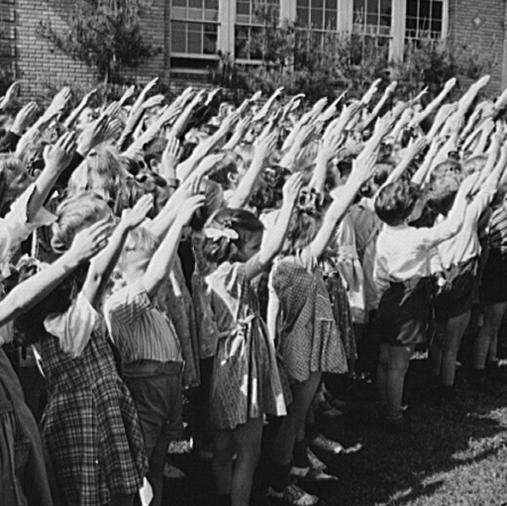
In preparation for the event, Upham hired Francis Bellamy, a Christian socialist to write a pledge for the students to recite as part of the October ceremony.  Yes, that’s right, a socialist wrote the Pledge of Allegiance.  In its original form, students were supposed to raise their right arm in the air as a form of salute and recite:
   
I pledge allegiance to my Flag and the Republic for which it stands, one nation, indivisible, with liberty and justice for all.

Southington, Connecticut school children
pledging their allegiance to the flag, 1942,
Library of Congress.


After a few short years, many states passed legislation that required students in the public schools to recite the Pledge.  In the wake of World War I, however, and against the backdrop of a rapid influx of immigrants to the United States, many became concerned that America’s heritage and cultural identity were at stake.  In 1923, adults from across the nation converged on Washington D.C. and held the first annual National Flag Convention.   People had become not only concerned about the lack of attention the Pledge was getting, but also, that many immigrants would use the words “my flag” to maintain allegiance to their home flags.  The people at the Convention resolved to amend the Pledge to read:

I pledge allegiance to the Flag of the United States, and to the Republic for which it stands, one nation, indivisible, with liberty and justice for all.

A year later, the next Convention added the words “of America.”

In 1939, as war raged in Europe and images began to appear of the Hitler salute, the Sons of the American Revolution began pressuring Congress to adopt an official set of flag rules and etiquette for ceremonies.  Outraged by the schools’ compulsory flag salute and pledge recitation some began to challenge its legality.  As a result, the Supreme Court struck down compulsory pledge recitation during the school day in Minersville School District v. Gobitis (1940). 

In the wake of Pearl Harbor and American nationalism, Congress responded to public pressure by passing the Flag Code in 1942, changing the salute to a hand over the heart.  As far as flags in the schools were concerned, the Flag Code only mandated the display of the American flag during the school day.  While the Pledge was no longer mandatory, many schools continued to start the day with an optional recitation, keeping in line with an already well-established tradition.  In addition, after Pearl Harbor everyone was proud to pledge allegiance to their flag.

Self-publishing Histories?

Dan Allosso

I’ve been pondering the idea of self-publishing history, and I think the time has nearly come.

Say self-published to anyone over about 30, and the first thought they’ll probably have is “vanity press.” It has always been possible to have a manuscript printed and bound, and there are plenty of examples of useful histories that have been produced this way. Nearly all the “Centennial” histories on display or for sale at small-town historical societies were written by local people, mostly without formal literary or historical training, and published in small lots by local printers or specialist publishers. There were once many more local printers willing to take on “octavo” printing and bookbinding. Dr. Charles Knowlton, for example, self-published his 500-page tome Elements of Modern Materialism using a small printer in Adams, Massachusetts, in 1828 (he bound the volumes in leather and stamped the spines with gilt ink himself), and his infamous birth control book, The Fruits of Philosophy was also produced at Knowlton’s own expense and sold by Knowlton out of his saddle-bags to his patients, until Abner Kneeland began advertising an expanded second edition in The Boston Investigator in 1833.

There are a number of companies specializing in reprinting out-of-copyright books, and many old town histories are for sale at historical societies in these reprint formats. But there are many more stories at these repositories than made it into those old histories, and there are often local historians who work for years at these societies, digging up material on particular families, or on political and social movements that interest them. The market for their stories may be very specific (as in the case of town or regional history), diffuse (as in the case of genealogy), or may be too small to be economically feasible for a standard publisher. This is where self-publishing can change the game.

I’ve been watching the self-publishing industry for several years, and it has changed dramatically. When I wrote my first novel, companies like iUniverse were just beginning to offer self-publishing packages online. These companies used the newly-developed print on demand technology that companies like Amazon and Ingram were adopting to produce mainstream titles just-in-time, to print their clients’ work. They offered editorial services, marketing packages, and bare-bones “publishing,” if you wanted to do those other things yourself. For a little over a thousand dollars, you could get your book into print.

The objection to vanity publishing has always been that it’s trash. If you couldn’t get a publisher interested in your book, the wisdom held, it did not deserve to see the light of day. There’s some truth to this argument, but I think it was much more valid when the book trade was big, profitable for small publishers, and the business was widely distributed among thousands of firms. Nowadays, a small number of media giants control nearly all of the titles that “move,” as well as most of the backlists that fill the rest of the shelves in bookstores. These companies, studies and anecdotal accounts suggest, are becoming ever more conservative. The costs of launching a commercial title are so high for them that they would much prefer to get a new book from an established author than to take a risk.

But wait a minute. The major publishers, just like iUniverse, Amazon, and Ingram, print on demand. So, where are the costs? Hint: they’re not in the royalties. The real expenses are pre-production costs and distribution, and overwhelmingly, marketing. This is partly because the publishers’ economic model is still based on bookstores, and the need to put thousands (or hundreds of thousands) of physical copies on shelves around the world. But what about those regional, special-interest, niche-market titles?

There are a number of new small publishers catering to niches. Combustion Books for anarchist steam-punk titles and Chelsea Green for sustainable living and farming titles like Harvey Ussery’s brilliant The Small-Scale Poultry Flock, for example. But I chose in 2007 to buy the bare-bones package and self-publish. I lined up my own editing (author Terry Davis, whose workshop I was attending, for story; my Dad, a master teacher of language and literature, for line-editing), sent in my file and my check, and they printed my book. That was just the beginning. I quickly learned that having a title, even on Amazon, does not make the registers ring. Marketing, getting the word out, getting people to look for it, took some real effort. Luckily, the internet offers people in niches an incredible opportunity to find kindred spirits, wherever they may be. I found teen-review websites where I could have my young adult novel read and reviewed by actual teens (they liked it), and I found a contest I could enter my book in (which it won). It’s still selling well, five years later.

But back to history. I had a delightful conversation this week with a woman in Maine who has written a memoir that should be published. It has humor, conflict, suspense, local flavor, and incredible human interest. But how to get it into print? Well, the good news is that, since I tried it in 2007, the self-publishing industry has gone through another generation of change. You can now publish on Amazon, Lulu, and a variety of other platforms, with much more format-flexibility than was available a few years ago and completely free of charge. And they pay much better than they used to back in the early days. Much better on a per-unit basis, in fact, than traditional publishers. If you know what you want to say, if you’re comfortable with the technical end of putting a book together (I like to remind myself that Knowlton and many of the people who published books in the past didn’t have a professional editor, either), and especially if you know who will want the book and how to reach them, self-publishing might be something to consider.

(For Historical Society members going to the conference this Spring, I notice there isn’t a formal session about publishing options. Maybe we can get an informal thing going, or talk about it over lunch if anyone’s interested . . .)

Board Games, Capitalism, and Piracy

Heather Cox Richardson

It’s fairly widely known that the game Monopoly was developed in America in the late nineteenth century to illustrate the evils of land monopoly. Rising prices, especially in the cities, in the 1870s and 1880s brought fortunes to a lucky few and misery to many. Ideas for negotiating this rough transition to a modern economy sprouted from all sorts of fertile minds, but few held the popularity accorded to Henry George’s Single Tax plan. George had lived both in California and New York during land booms and argued that land values rose through public development, rather than through individual enterprise. To restore equality, he argued, the government should take this unearned wealth back from the pockets into which it fell by taxing the value of the land.

This seemed a remarkably easy way to address the problem of growing inequality. Henry George clubs sprang up across the U.S. and even spread to Europe. George came close to winning the mayoralty of New York City in 1886 (he won more votes than newcomer Theodore Roosevelt). And Elizabeth Magie invented The Landlord’s Game, Monopoly’s forerunner, to explain the principles of land monopoly to potential Single Tax acolytes.

As anyone who has endured a rainy afternoon as a child knows, playing Monopoly was also a brutal lesson in the harshest form of capitalism. Invariably, one player emerged early as the canniest trader, or was lucky enough to capture Boardwalk and Park Place. S/he would slowly bleed the rest of the players dry over the long, painful course of hours. The only real option for a losing player was to rob the bank (something that, sadly, I didn’t figure out until I watched my children play the game). As someone said to me today, a young loser did not figure out the game was rigged, but rather assumed s/he was just bad at the game.

The structure of “land monopoly” and the internalization of failure, of course, were what Henry George’s followers were trying to highlight.

In contrast to the long, slow death of Monopoly stands the original Pirateer, a game that took the toy world by storm in 1994. It was produced independently, very briefly, by the Mendocino Game Company. In 1996, it won the Mensa Select Award for board games. In Pirateer, four gangs of pirates compete to collect a treasure from the island at the center of the board. They must then get it back to their own harbor before their ships are sunk by the other pirates, tacking according to wind patterns and the roll of dice. It is a rollicking game, essentially a free-for-all, but one that is bounded by natural laws (the wind), limited elements of luck—the roll of dice—and by a player’s strategic skill.

Crucially, anyone can win Pirateer right up to the very last play of the game. A clever four-year-old seeing the patterns of the board differently than his opponents can beat a seasoned player. No one can have a lucky break that determines the entire cast of the game. Everyone stays enthusiastic. No one gets an early advantage that means success four painful hours later. And the resentments at the end of Pirateer are correspondingly minor compared with those after Monopoly.

The contrast between these games hit me today when someone suggested that the true secret to the success of capital accumulation was protecting goods from piracy. The discussion was of the 1400s and the importance of walled cities, but it seems to me to hold true for colonial settlements in America, and even for modern-day attempts to regulate the internet.

Monopoly and Pirateer. Worth thinking about.

Half-Breeds, Stalwarts, and Contingency

Heather Cox Richardson

A year or so ago, a graduate student studying for her comprehensive exams asked me if I could explain the difference between Stalwart and Half-Breed Republicans in the nineteenth century. I could, I said, so long as she understood that no one cared.

I went on to explain that the difference between Stalwarts and Half-Breeds crystallized in the Republican national convention in 1880. In that contest, Stalwarts, led by Roscoe Conkling and Don Cameron, wanted to secure the nomination for former president U. S. Grant. Half-Breeds backed James G. Blaine.

What was at stake in the nomination was really nothing other than a personal feud. Conkling and Blaine had hated each other since the war years. Conkling had become Grant’s right-hand man during his presidency, and he hoped to become the crucial figure in a renewed Grant government, handing out patronage to his supporters in New York. Blaine had a different set of friends, and they pushed his nomination in the hope that he would cut out the Conkling men.

The nomination process did not proceed as either camp hoped. A significant body of delegates refused to support either Grant or Blaine. They threw their votes to a dark horse, James Garfield of Ohio. The Blaine delegates, willing to vote for anyone but Grant, followed. Garfield won the 1880 nomination, and the 1880 election.

I told my friend that the distinction between Stalwarts and Half-Breeds didn’t matter because there was little daylight between the actual policy positions of Conkling and Blaine. The ascendancy of either would not have changed the course of the Republican Party, or the legislation it supported. For the purposes of the country they were interchangeable, and so, for that matter, was Garfield. The difference between Stalwarts and Half-Breeds was rather like the difference today between John Boehner and Eric Cantor: a difference in style, to be sure, but not such a great difference that one can imagine history graduate students in 2130 being asked to explain its significance.

Today, as I wrote about this fight, I rethought that flippant dismissal.

In order to quiet the angry Stalwarts, the Republican convention put Stalwart Chester Arthur into the vice presidency. But then, to calm the Half-Breeds, President Garfield named James G. Blaine himself to the position of Secretary of State in the new administration. This was the most powerful position in the Cabinet, and Stalwarts—led, as ever, by the insatiable Roscoe Conkling—cried foul.

When Garfield offered the fabulously lucrative position of collector of the port of New York to an appointee without consulting Conkling, the fat was in the fire. Conkling, a famously touchy character, was undoubtedly personally affronted. But he claimed to oppose the appointment on the grounds that the Senate’s power to advise and consent gave Senators the power of appointment. Garfield was usurping power, he insisted; senators had ultimate say over who received government appointments in their home states. What was really at stake, though, was whether or not Conkling would control New York.

To force the issue into the open, Conkling resigned his position in the Senate. New York’s other senator, Thomas Platt, joined him (thereby earning the memorable nickname “Me Too” Platt). They were confident the New York legislature would reelect them, thus slamming Garfield and returning the Stalwarts to the top position in the government. They were wrong. New Yorkers had had enough of Conkling’s dictates and were not willing to endorse the idea that senators should hold sway over the president’s appointments. The legislature turned to entirely new senators.

Traditional historians who even tried to find any significance in this teapot tempest blamed the fight between Conkling and Blaine for the assassination of President Garfield two months later. In July, Charles Guiteau shot President Garfield in an apparent attempt to put Stalwarts in power after all. From this the nation got civil service reform, but, as I told my scholarly friend, no real change in governmental policies.

Here is where histories generally drop the Stalwarts and Half-Breeds.

But I came to realize today that there was, in fact, a terrifically significant event to come out of this clash: Roscoe Conkling was out of a job.

With his political career suddenly gone, Conkling had to find a way to rebuild his fortunes. He had always been a brilliant orator, and he turned naturally to the law. The first client through his door was Jay Gould, the railroad magnate. Conkling used his great popularity and fame as a legislator to become one of the nation’s premier litigators for big business. It was in that capacity that he argued the case of San Mateo County v. Southern Pacific Railroad in December 1882. In this case, Conkling argued that a county tax on the railroad violated the due process clause of the Fourteenth Amendment. He insisted, based on his position as a congressman who had participated in the framing of that amendment, that when it adopted the Fourteenth Amendment, Congress had intended for it to protect corporations as well as individual persons. The court did not explicitly comment on Conkling’s really quite outrageous claim in 1882, but in 1886, it announced that Conkling’s doctrine was so definitive that it would not hear arguments to the contrary. The principle that corporations were protected by the Fourteenth Amendment limited government regulation of business well into the twentieth century.

And therein lies the great historiographical revelation of my current project. I have always seen political history as the story of competing ideas, but again and again I find small personal quirks changing the course of history. If only Thurlow Weed had not wanted to protect William Henry Seward we would not have gotten President Andrew Johnson; if only Charles Sumner hadn’t been so snobbish the Grant presidency would have succeeded.

And if only Stalwarts and Half-Breeds had been on speaking terms, corporations might never have been protected by the Fourteenth Amendment.

American Political Partisanship in Historical Perspective

Heather Cox Richardson

Peter Orszag had an article last week at Bloomberg arguing that political partisanship in America has increased dramatically in recent years because Americans have self-segregated their housing according to political leanings. Once in like-minded groups, he suggests, they tend to reinforce each other and drift toward extremes as individuals try to outdo each other in enthusiasm for their political affiliations.

This is an interesting theory. It suggests our political inclinations are beyond our control and that society has spiraled into extremism for reasons we cannot stop.

It would certainly be quite interesting to Americans of the 1840s and 1850s, whose partisanship was so extreme congressmen took guns to the House of Representatives to protect themselves, settlers in Kansas and Missouri murdered each other in their beds, and millions of men killed off several hundred thousand of each other before deciding to call it quits. Who knew that when they moved West, setting up shelters wherever they found good land, that antebellum Americans were unconsciously segregating into political neighborhoods?

There is a much more obvious and more plausible explanation than political segregation for the increases in political partisanship that have occurred with pretty cyclical regularity in American history. It is an explanation that suggests that partisanship and compromise are both deeply imbedded in the American political tradition.

Rising politicians need to be able to attract attention. To that end, they need to distinguish themselves from the successful politicians who hold power. When those senior politicians have emphasized compromise, aspiring politicians have attacked them and advocated more extreme positions. Extremism begets extremism until the system becomes utterly dysfunctional. At that point, aspiring younger politicians can attract attention by advocating not extremism, but compromise.

This cycle of compromise to partisanship to extremism to compromise has turned over again and again in American history.

To see how this works, let’s look at the first generation of professional politicians in America: the Jacksonians of the 1830s. The men who wanted to put Andrew Jackson in the White House needed a way to garner support for a man who was widely regarded as volatile and a rather dim bulb. How could they elevate him when men like Henry Clay, the Great Compromiser, controlled the political scene? By viciously attacking Clay and men of his ilk with unfounded accusations, decrying compromise as weakness, and building a constituency that despised the very art of compromise Clay performed so well.

How then could the next generation of politicians opposed to Jackson’s Democratic Party build its own constituency? By attacking the Democrats, of course.

As political leaders squared off, the newspapers that supported them echoed their rhetoric. There, and not in unconsciously politically segregated communities, individual editors turned up the heat of extremism. Each tried to outdo the competition to draw readership and the advertising dollars readers attracted. Partisanship rose as voters learned to value conflict rather than compromise.

As members of each party more and more often characterized their opponents as corrupt, dangerous, and evil, compromise became increasingly unthinkable.

We know how that turned out.

But the need for politicians to distinguish themselves from their predecessors can serve compromise as well as conflict. When partisanship has become more important than actual governing the government ceases to function in any sort of a competent way. Astute younger politicians then can build careers by promising to compromise with opponents to create solutions that make the government work again. Theodore Roosevelt, for example, recognized voters were frustrated by the extremism of the late nineteenth century that had paralyzed government just when the nation was desperate for solutions to the crises of industrialism. Roosevelt created an image of himself as bipartisan, willing to side with Democrats even against members of his own party to do what was good for the country (a position that infuriated old-fashioned Republicans and Democrats both). Roosevelt was not alone, though. His construction of a politics of compromise was part of the reaction of his generation to the partisanship of the previous generation. That premium on compromise produced the bipartisan Progressive Era.

Which, in turn, was followed by the growing extremism of the 1920s . . . and so on.

These political swings have been part of American society since at least the 1830s. They are not about living quarters. While housing patterns may reflect the current political values of the national culture, Americans are not first self-segregating politically and then self-integrating politically every few generations. What they are doing, though, is listening to their political leaders, reading the news, watching TV, and now, using the internet. What they hear drives their attitudes toward politics.

Far from being a reflection of living patterns created without our conscious control, partisanship and compromise are both deliberate decisions made by political leaders.

Music History Roundup

.
Julie Taboh, "National Jukebox Offers Digital Treasures: Library of Congress unveils website featuring thousands of rare and historic audio recordings," Voice of America, May 13, 2011

. . . . The site, called National Jukebox, is a collaborative project between the Library of Congress and Sony Music Entertainment. It offers online access to a vast selection of music and spoken-word recordings produced in the U.S. between 1901 and 1925.>>>

James Oestreich, "An Exploration of the World That Made Bach and That Bach Remade," NYT, May 17, 2011

Bach, as the culmination of the German Baroque, effectively eclipsed his ancestors, whether actual family members or simply musical forebears.

The family connections are fascinating but still murky. There were so many musical Bachs during the era that the surname became synonymous with “musician” in central Germany, and they continue to trickle to light. A new Harmonia Mundi recording showcases a particularly revealing specimen, the “Trauermusik” of Johann Ludwig Bach, a contemporary cousin of Johann Sebastian based in Meiningen.>>>

Chris Wilson, "The Rosslyn Code: Are the Chapel's Mysterious Stone Symbols a Musical Score?" Slate, May 17, 2011

Rosslyn Chapel was deserted when Tommy Mitchell's son, Stuart, stepped into the small antechamber one frozen afternoon last December. Savage blizzards had blanketed Scotland for the previous two weeks, and much of the chapel's staff had left early to beat the icy conditions. The cold was marshalling its forces against the scattered heat lamps inside as Stuart walked to the back of the room, where 13 stone arches crisscross along the ceiling.

Stuart Mitchell, who is 45, is thin and spry with wavy brown hair and emits a rapid-fire laugh when he finds something amusing, which is often. Stuart first took an interest in the Rosslyn Chapel when his father, a former Royal Air Force cryptographer, invited him along for a visit about 10 years ago. As a professional composer, Stuart was instantly enchanted by Rosslyn's angelic stone musicians. He has come back often in the years since, but he still can't get inside the chapel without buying a ticket, which he does begrudgingly.>>>

John Hacker, "Dance caps off Saturday’s reenactment events," Carthage Press, May 17 2011

CARTHAGE, Mo. An actual 1800s-era dance wouldn’t have had the music speakers or electric lighting found in the Civil War reenactment dance last night. But that didn’t make it seem any different to Chris Palmer.>>>

Lici Beveridge, "Digging up roots: American music history endures," Hattiesburg American, May 13, 2011

I have been to see the New Harmonies exhibit at the historic Train Depot twice already.

The first time I went to see the exhibit.

The second time was to hear musician George Winston talk about harmonica music and perform some songs on harmonica.

About 75 people attended Winston's performance Thursday. I think I learned more about harmonica music than I ever thought possible.>>>

Tocqueville and Beaumont's Roadtrip

Randall Stephens

The June 2011 issue of Historically Speaking will include an interview with Leo Damrosch on his book Tocqueville's Discovery of America (FSG, 2010). It's an insightful, lively work of literary history. It will be out in paperback this summer. I paste here part of my extended review of Tocqueville's Discovery, which appears in the April 18th issue of Christian Century.

To European visitors in the first half of the 19th century, Americans were like their newfangled steamboats: noisy, combustible, always on the move—and dirty. "I hardly know any annoyance so deeply repugnant to English feelings as the incessant, remorseless spitting of Americans," Frances Trollope reported. Riding aboard one of the garish, belching behemoths on the Mississippi, Trollope observed that when Americans were not spitting, they were eating their food too quickly. And after that they picked their teeth with a pocketknife.

Charles Dickens also seemed to hold his nose as he passed through America. "In all modes of travelling, the American customs, with reference to the means of personal cleanliness and wholesome ablution, are extremely negligent and filthy," scowled the English novelist. The Americans he encountered aboard a crowded steamboat were tedious: "There is no diversity of character. They travel about on the same errands, say and do the same things in exactly the same manner, and follow in the same dull cheerless round." . . .

Damrosch is a gifted writer with a flair for vivid, eloquent descriptions. Over a long career in literary studies, he has written on David Hume, Samuel John­son, Alexander Pope and William Blake. His Jean-Jacques Rousseau: Rest­less Genius was a National Book Award finalist. Tocqueville's Discovery of Amer­ica takes him into deeper historical waters. Skillfully weaving in original sources and the words of Americans and of European observers, Damrosch follows Tocqueville and Beaumont from New York to Detroit, from New Orleans to Washington, D.C., asking the reader to share in Tocqueville's discovery of a turbulent, changing society. "What Tocque­­ville eventually created was not an ac­count of 'Americans' as a unique type," writes Damrosch, "but a structural explanation of some profound reasons why democracy, by its very nature, tends to produce certain characteristics in its citizens.">>>