Showing posts with label Travel. Show all posts

Norway Doorway, pt 4: Way up North and Academic Travel

Randall Stephens

Academics do their fair share of traveling. Research trips. Conferences. Job interviews . . . Hiltons. Best Westerns. Off-season dorm rooms that smell of Ramen Noodles and stale beer. Roach motels that smell even worse.

For me, a trip to Svalbard this week for my work as a Fulbright Roving Scholar is without comparison.

Today I join my two colleagues, Sarah Anderson and Isaac Larison, at the Longyearbyen Skole. The three of us will be speaking with students about the American educational system, postwar US history, Native American culture, religion in the South, and more.

Longyearbyen's population hovers around 2,000, much more if you throw in polar bears and Siberian Huskys. The village looks a little bit like an IKEA-designed base camp on the planet Hoth. Very cool. We're thrilled to be up here 800 miles north of the arctic circle. And strangely, thanks to warm ocean currents, it's more mild than one would think. All three of us have spent plenty of time crisscrossing the country in planes, trains, and automobiles. It certainly helps that, like plenty of others in our profession, we like to travel.

In a primer for grad students who are about to make their way into their field of choice, Paul Gray and David E. Drew write in the Chronicle about one of the perks of higher ed: travel. (A shrinking perk, for sure, as states cut budgets, and deans slash and burn.) In "What They Didn't Teach You in Graduate School 2.0," Gray and Drew write:

Travel is a major fringe benefit in academe. The amount of travel varies by field and by institution. In most fields, one or more major meetings a year take place at the national and regional levels. Despite financial stringencies, most institutions pay your way if you are on the program or involved in recruiting (usually restricted to senior faculty members). Furthermore, each meeting is scheduled in a different location. Because it is easier to win approval for a short trip than it is for a long one, take the opportunity to attend nearby meetings whenever they occur.

Food for thought for those, to quote the Pernice Brothers, "contemplating suicide or a graduate degree."

Perhaps the travel bit was a bigger boon in ages past. More than 30 years ago David Lodge parodied the academic jetset in his hilarious, exuberant novel Small World. (Sadly, no characters are zooming north to Svalbard.) As a send-up that's now become a period piece, Lodge's book reads like a Mad Men version of the tenured-and-sinecured classes. A choice passage:

The whole academic world seems to be on the move. Half the passengers on transatlantic flights these days are university teachers. Their luggage is heavier than average, weighed down with books and papers--and bulkier, because their wardrobes must embrace both formal wear and leisurewear, clothes for attending lectures in, and clothes for going to the beach in, or to the Museum, or the Schloss, or the Duomo, or the Folk Village. For that's the attraction of the conference circuit: it's a way of converting work into play, combining professionalism with tourism. . . (162)

Now where was that Svalbard Museum, and where did I put my extra hat?

"Fourth of July, Bah Humbug!" Says Frederick Marryat

Randall Stephens

Many a European traveler crisscrossed the United States in the 1830s and 1840s, writing down their observations, scoffing and laughing when and where appropriate, or cheering on the bumptious new country. Tocqueville is the most famous. Charles Dickens and Frances Trollope also come to mind. But there are scores of others, too. (I've been trying to track down any travel record written by a Norwegian in the 19th century. Any help?) Reading their accounts is fascinating and illuminates what English, French, and German men and women of letters made of this loud, proud, rowdy new nation.

Naval officer and British novelist Frederick Marryat (born , July 10, 1792, London—died Aug. 9, 1848, Langham, Norfolk, Eng.) was not pleased with the rough-and-tumble barbarities of the Americans and their seeming disinterests in real education and real cultivation. He thought it especially irksome that the egalitarian handshake was the universal greeting in the land. Was everybody here of the same station? How awful.

So, to shed light on what some non-Americans thought about our national holiday and what it said about the country, I quote a passage here from Marryat's A Diary in America: With Remarks on Its Institutions (New York, 1839). Note the judgments about education and the mobocratic tendencies of the young country.

"Lesson 62. "Story about the 4th of July. "6. "I must tell you what the people of New York did. In a certain spot in that city there stood a large statue, or representation of King George III. It was made of lead. In one hand he held a sceptre, a kind of sword, and on his head he wore a crown.

7. "When the news of the Declaration of Independence reached the city, a great multitude were seen running to the statue.

8. "The cry was heard, 'Down with it—down with it P and soon a rope was placed about its neek, and the leaden King George came tumbling down.

9. "This might fairly be interpreted as a striking prediction of the downfall of the monarchial form of government in these United States.

10. "If we look into history, we shall frequently find great events proceeding from as trifling causes as the fall of the leaden statue, which not unaptly represents the character of a despotic prince.

11. "I shall only add, that when the statue was fairly down, it was cut to pieces, and converted into musket-balls to kill the soldiers whom his majesty had sent over to fight the Americans."

This is quite sufficient for a specimen. I have no doubt that it will be argued by the Americans: "We are justified in bringing up our youth to love our institutions" I admit it; but you bring them up to hate other people, before they have sufficient intellect to understand the merits of the case.

The author of "A Voice from America," observes— "Such, to a great extent is the unavoidable effect of that political education which, is indispensable to all classes of a self-governed people. They must be trained to it from their cradle; it must go into all schools; it must thoroughly leaven the national literature; it must be line upon line, and precept upon precept, here a little and there a little; it must be sung, discoursed, and thought upon everywhere and by everybody."

And so it is; and as if this scholastic drilling were not sufficient, every year brings round the 4th of July, on which is read in every portion of the states the act of independence, in itself sufficiently vituperative, but invariably followed up by one speech (if not more) from some great personage of the village, hamlet, town, or city, as it may be, in which the more violent he is against monarchy and the English, and the more he flatters his own countrymen, the more is his speech applauded.

Every year is this drilled into the ears of the American boy, until he leaves school, when he takes a political part himself, connecting himself with young men's society, where he spouts about tyrants, crowned heads, shades of his forefathers, blood flowing Like water, independence, and glory. . . .

I think, after what I have brought forward, the reader will agree with me, that the education of the youth in the United States is immoral, and the evidence that it is so, is in the demoralization which has taken place in the United States since the era of the Declaration of Independence, and which fact is freely admitted by so many American writer. . . .

I shall by and by show some of the effects produced by this injudicious system of education; of which, if it is necessary to uphold their democratical institutions, I can only say, with Dr. Franklin, that the Americans "pay much too dear for their whistle." . . .

I will now just give the difference of the acquirements demanded in the new and old country to qualify a young man as an M. D.:—

English Physician and American Physician:

1. A regular classical education at college 1. Not required.

2. Apprenticeship of not less than five years 2. One year's apprenticeship,

3. Preliminary examination in the classics, &c. 3. Not required.

4. Sixteen months' attendance at lectures in 2J 4. Eight months in two years, years.

5. Twelvemonths' hospital practice. 5. Not required,

6. Lectures on botany, natural philosophy, &c. 6. Not required.

Tell us what you really think, Marryat!

And now I'm off to an early Fourth of July picnic/frolic, where there will be loud, inarticulate toasts, booming music of the vulgar sort, long-winded orations, explosions, and democratic-style sport. We will shake hands when we meet each other on a level field.

Tocqueville and Beaumont's Roadtrip

Randall Stephens

The June 2011 issue of Historically Speaking will include an interview with Leo Damrosch on his book Tocqueville's Discovery of America (FSG, 2010). It's an insightful, lively work of literary history. It will be out in paperback this summer. I paste here part of my extended review of Tocqueville's Discovery, which appears in the April 18th issue of Christian Century.

To European visitors in the first half of the 19th century, Americans were like their newfangled steamboats: noisy, combustible, always on the move—and dirty. "I hardly know any annoyance so deeply repugnant to English feelings as the incessant, remorseless spitting of Americans," Frances Trollope reported. Riding aboard one of the garish, belching behemoths on the Mississippi, Trollope observed that when Americans were not spitting, they were eating their food too quickly. And after that they picked their teeth with a pocketknife.

Charles Dickens also seemed to hold his nose as he passed through America. "In all modes of travelling, the American customs, with reference to the means of personal cleanliness and wholesome ablution, are extremely negligent and filthy," scowled the English novelist. The Americans he encountered aboard a crowded steamboat were tedious: "There is no diversity of character. They travel about on the same errands, say and do the same things in exactly the same manner, and follow in the same dull cheerless round." . . .

Damrosch is a gifted writer with a flair for vivid, eloquent descriptions. Over a long career in literary studies, he has written on David Hume, Samuel John­son, Alexander Pope and William Blake. His Jean-Jacques Rousseau: Rest­less Genius was a National Book Award finalist. Tocqueville's Discovery of Amer­ica takes him into deeper historical waters. Skillfully weaving in original sources and the words of Americans and of European observers, Damrosch follows Tocqueville and Beaumont from New York to Detroit, from New Orleans to Washington, D.C., asking the reader to share in Tocqueville's discovery of a turbulent, changing society. "What Tocque­­ville eventually created was not an ac­count of 'Americans' as a unique type," writes Damrosch, "but a structural explanation of some profound reasons why democracy, by its very nature, tends to produce certain characteristics in its citizens.">>>

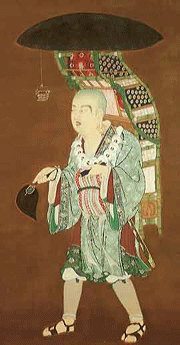
History through the Eyes of . . . Xuanzang: Indian Life, 7th Century AD

Randall Stephens

From 629 to 645 AD the Chinese pilgrim Xuanzang wandered through Central Asia and India. His observations provide some insight into the customs, religious beliefs, and life in general in that land. He sailed down the Ganges, hobnobbed with Indian royalty, and traveled extensively on the subcontinent.

He developed a considerable reputation as a scholar in India. Much of his time there he spent studying at the Nalanda monastery, a well-known religious scholarly community. He would translate the sacred texts of Buddhism from Sanskrit into Chinese.

In the passages excerpted here, Xuanzang observes the towns, streets, customs, and behaviors of some of the sites he visited in India.

Si-Yu-Ki: Buddhist Records of the Western World, Vol 1, Samuel Beal, trans. (London, 1906), 73-74, 83, 85.

Towns and Buildings

The towns and villages have inner gates; the walls are wide and high; the streets and lanes are tortuous, and the roads winding. The thorough fares are dirty and the stalls arranged on both sides of the road with appropriate signs. Butchers, fishers, dancers, executioners, and scavengers, and so on, have their abodes without the city. In coming and going these persons are bound to keep on the left side of the road till they arrive at their homes. Their houses are surrounded by low walls, and form the suburbs. The earth being soft and muddy, the walls of the towns are mostly built of brick or tiles. The towers on the walls are constructed of wood or bamboo; the houses have balconies and belvederes, which are made of wood, with a coating of lime or mortar, and covered with tiles. The different buildings have the same form as those in China: rushes, or dry branches, or tiles, or boards are used for covering them. The walls are covered with lime and mud, mixed with cow's dung for purity. At different seasons they scatter flowers about. Such are some of their different customs. . . .

Manners, Administration of Law, Ordeals

With respect to the ordinary people, although they are naturally light-minded, yet theyare upright and honourable. In money matters they are without craft, and in administering justice they are considerate. They dread the retribution of another state of existence, and make light of the things of the present world. They are not deceitful or treacherous in their conduct, and are faithful to their oaths and promises. In their rules of government there is remarkable rectitude, whilst in their behaviour there is much gentleness and sweetness. . . .

Forms of Politeness

There are nine methods of showing outward respect— (1) by selecting words of a soothing character in making requests; (2) by bowing the head to show respect; (3) by raising the hands and bowing; (4) by joining the hands and bowing low; (5) by bending the knee; (6) by a prostration;29 (7) by a prostration on hands and knees; (8) by touching the ground with the five circles; (9) by stretching the five parts of the body on the ground.

Of these nine methods the most respectful is to make one prostration on the ground and then to kneel and laud the virtues of the one addressed. When at a distance it is usual to bow low; when near, then it is customary to kiss the feet and rub the ankles (of the person addressed).

See also, Richard Bernstein, Ultimate Journey: Retracing the Path of an Ancient Buddhist Monk Who Crossed Asia in Search of Enlightenment (Alfred A. Knopf, 2001); Sally Hovey Wriggins Xuanzang: A Buddhist Pilgrim on the Silk Road (Boulder: Westview Press, 1996); and D. Devahuti, ed, The Unknown Hsuan-Tsang (Oxford University Press, 2001).

Sailing through California History

Randall Stephens

I've taken students on the occasional field trip to Boston. I've never sailed up the coast with them. (It's hard enough for me to navigate the cow path streets of Beantown.)

Rick Kennedy, professor of history at Point Loma Nazarene University, spent ten days on a sailboat this
May, teaching California history to eight students. (I interview Kennedy in the Youtube video here. We talk about how he teaches the class, the curriculum, and the experiences of students.) The class sounds like a blast. According to Kennedy's syllabus:

The course is not like a classroom course; rather, it is an extended fieldtrip. As such it strives to enhance a student's attentiveness to surroundings and ability to see layers of history at particular sites. On walking tours we want to have a heightened awareness of human history in geography, architecture, and town planning. The sailing will encourage awareness of the wind, currents, and tides that, in the past, had much influence on human hopes, plans, and accomplishments. Fieldtrips should help us learn to see the historical evidence that surrounds us, to read the ways topography pushes people in certain directions, the ways architecture proclaims intentions, and the ways a point jutting into the Pacific draws sailors to its lee.


We read and write too. We center the class on a great classic: Two Years Before the Mast, written by a student who sailed away from college in order to go to California in 1835. The book describes California during an era of political instability when a small number of Californios were trying to figure out what to do with a hard-to-get-to but increasingly
desirable land.

The class is largely, but not exclusively, designed for those thinking about careers in
teaching or tourism (parks, museums, and historic preservation). Emphasis throughout the class is on methods of thinking about local history that help us understand larger issues of world history, European history, American history, Native American History, missionary history, and varieties of cultural history. We also look for opportunities to cross disciplines into navigation, astronomy, and cartography.

Sign me up, prof!

There's much this class can accomplish. I was particularly interested in how a course like this can get students to think about the hardships and day-to-day lives or those who have gone before us. Sailing up and down the coast was a common enough experience for Californians. Re-enacting that, I think, gives history students new insight, even empathy.

Now, if I can just master that tiny sailboat on the Charles River . . .

Summer Travels in Roman Western Europe

Randall Stephens

In time for the summer travel season Elaine Sciolino writes an interesting piece on "Roman France" in the NYT travel section.

Over the years, I have discovered traces of Roman civilization throughout the country, from Arras in the north to Dijon in the center and Fréjus in the south. My hunt for Roman Gaul has turned up treasures in the oddest places, including the middle of wheat fields, the foundations of churches and the basements of dusty provincial museums. . . .

If French history books tend to underplay ancient Roman rule, local politicians and entrepreneurs in the south do not. In the summer, area restaurants offer “Roman” menus with 2,000-year-old recipes: dishes prepared with cumin, coriander, mint and honey.

The article features a map with key sites marked out and a slide show. Related pieces include: "Traces from When Paris Was Roman" (May 17, 2009); and "Amid the Glory of France, the Grandeur that Was Rome" (May 17, 2009).

There's plenty to see across the channel, too. About a year ago Kevin Rushby wrote about a short trip he and his four-year-old daughter made to Hadrian's Wall and the Housteads fort, "England's Great Wall" Guardian, March 29, 2008. The serpentine wall is UN World Heritage site and a fascinating window into the distant past.

Built around AD124 in a commanding position on a swathe of the dramatic Whin Sill escarpment, Housesteads is one of the most important sites of Roman remains in Britain, in its day the last decent bath house before the great unwashed of Caledonia. . . .

Many interesting finds have come from the fort, even more from the settlement of hangers-on clustered below its walls. Two counterfeiting coin moulds from the 3rd century AD were discovered next to the remains of a house, the forger's den. Under his floor were two skeletons, one with a knife still stuck in the ribs.