Showing posts with label Archives. Show all posts

The Day the Archives Walked in the Door

Eric B. Schultz

Alan Lomax (left) with Richard Queen of Soco
Junior Square Dance Team at the Mountain
Music Festival, Asheville, North Carolina,
mid century. Courtesy of the Library of Congress.
I loved Randall’s latest post, which mixed music and archives, and reminded me how tricky it can be to capture and preserve historic “sound.”  It also brought to mind the story of Alan Lomax (1915-2002), one of America’s great music folklorists and archivists.  From 1937 to 1942, Lomax was a director in the newly-formed Archive of Folk Song in the Library of Congress, eventually collecting and preserving thousands of important and unique field recordings.

In 1938, Lomax sat Jelly Roll Morton (Ferdinand Joseph LaMothe 1890-1941) down in a small auditorium at the Library and asked him if he knew how to play “Alabama Bound.”  Morton was in the twilight of his career, many years removed from his formative days in New Orleans, and prone to invention—including a birthday that made him old enough to have, as he proclaimed, “invented jazz.”  Lomax was skeptical of Morton in particular and of jazz in general, which he saw at the time as a destructive force threatening to overwhelm his beloved American folk music. 

Morton began playing “Alabama Bound” and Lomax was stunned, saying later that Morton “played me the most beautiful ‘Alabama Bound’ that I had ever heard.” 

Recognizing suddenly the talent that had walked into his archives, Lomax charged up-stairs, secured fifty blank aluminum discs from his boss, the Chief of the Music Division, grabbed a bottle of whiskey in his office to place on Morton’s piano for motivation, and returned to the auditorium.  Lomax’s next question, “Jelly Roll, where did you come from and where did it all begin?” would result in over twelve hours of recordings that included tales of New Orleans, names of the many musicians Morton remembered (or wanted us to think he remembered), and wonderful, marvelous music.  The recordings today can be purchased in an award-winning CD boxed set, or on-line in digital form.

Those who listen will know that Morton was not only a fount of knowledge and a gifted musician, but most appreciative of the whiskey, commenting throughout his interviews on its high quality.  (Ah, for the days when one could grab a loose bottle of whiskey from his office for the unexpected guest.)

The following year, Frederic Ramsey and Charles Edward Smith published Jazzmen, the essential building block for much of the written jazz history to follow.  Interviewing “every living jazz musician who could contribute factual material,” the authors collected stories and first-hand accounts, all of which turned out to be colorful and instructive, and some of which even turned out to be true.  They were diligent in their quest, moving from “the dives of Harlem, Chicago and New Orleans, to the rice fields of Louisiana, to Storyville, the now legendary red-light district of New Orleans, to reform schools, even to the last stopping place of at least two jazz pioneers, a hospital for the insane.”  In particular, they located and relied heavily upon Willie Geary “Bunk” Johnson, a brilliant early New Orleans cornetist who was rediscovered driving a truck for $1.75 a day during rice season in Louisiana, and nearly starving the rest of the year. 

It was the creation of this oral history by Ramsey and Smith that also led to the rediscovery of “King” Buddy Bolden, acknowledged by some of the very early New Orleans musicians as the first to play music that would come to be called jazz.  Morton’s famous assessment of Bolden: he was “the blowingest man since Gabriel.”

It seems clear from Lomax’s writings that in 1938 jazz had not yet attained status as a great American art form.  By 1950, however, he had begun to appreciate its power, writing, “Perhaps nothing in human history has spread across the earth so far, so fast as this New Orleans music.  Thirty years after its genesis it was as popular and understandable in New York, Paris, Prague, and Shanghai as in its own hometown.”

Thanks to Lomax’s fine ear and musical open-mindedness, and Morton’s superb rendition of “Alabama Bound,” we can download today on iTunes (speaking of things that spread rapidly across the earth!) Jelly Roll’s history and recordings of the great American art form.  Then, unlike Randall’s “cold basements with little sunlight,” we can sit in our sunny family rooms or apartments and enjoy selections from one of America’s finest musical archives.

Know Your Archives: The Center for Popular Music

Randall Stephens

It takes a certain temperament to be a historian.  For example, you have to, at least on some level, enjoy rummaging through dusty manuscripts and spending hour upon hour hunting down sources, reading, rereading, and conducting keyword searches until your fingers become arthritic claws.

I don't enjoy that last one, but I do enjoy visiting archives.  Some more than others.  I've been to a variety of amazing collections over the years.  Maybe only one of those, the Reading Room of the Library of Congress, matched shear beauty with the amazing scope of materials.  (Getting tired of reading through that bound volume of brittle 19th-century newspapers?  Have a stretch and look up at the beautiful dome.) For the most part, historians don't visit archives for the lovely vistas. Quite a few archives are situated in cold basements with little sunlight and flickering, humming florescent lights.  An ideal setting for a troglodyte, but not a vitamin-D-deprived historian.

Downtown Nashville, summer 2012
This past summer I went on the road to do some initial research for my next book project, currently titled The Devil's Music: Rock and Christianity from Elvis to Larry Norman.  It was a great experience.  All the archivists and assistants I encountered proved terrifically helpful.  I visited some really stunning collections.  Wheaton College's Billy Graham Center may lay claim to being the best place to study all things related to 20th-century Protestantism, and evangelicalism in particular.  (Don't let their hopelessly outdated 1990s website make you think any less of the place.)  To the south of Wheaton I trekked to the Southern Baptist Historical Library. The staff their gave me numerous tips and helped me track down obscure pamphlets, documents, and letters that I could never have imagined even existed.  As a bonus, the Southern Baptist Historical Library is in Nashville.  Music nuts can take a break by boot-scooting over to the Country Music Hall of Fame or dropping some greenbacks at the Ernest Tubb Record Shop, founded in 1947.

My favorite collection that I visited on this cross-country trip was the Center for Popular Music at Middle Tennessee State University in Murfreesboro, TN. Seldom has research been more fun.  I perused dozens and dozens of books on rock history, gospel, and pop music.  (It was hard not to fall down an rabbit hole.) I listened to a rare, 1956 acetate interview with Elvis Presley from a Texas radio station.  Girls screamed in the background as a flustered Elvis answered with his typical "yessir." I thumbed through anti-rock diatribes from the Carter years.  Through it all I got a better handle on my topic. 

The Center holds acres of records, tapes, magazines, books, manuscripts, and much more. (Search there extensive collection here.)  And the staff at this place, the gem in its crown, could not have been more helpful.  With their aid I found enough research material to keep me working away for months. 

In the Know Your Archives interview embedded above, I speak with Dale Cockrell, Director, and Martin Fisher, Curator of Recorded Media Collections.  They describe the materials the Center collects, the kinds of research being done there, and pretty much explain why anyone doing anything on music history should make the trip to MTSU. 

The Ranney Letters Are Going Online

Dan Allosso

As I was doing research toward my dissertation in Ashfield, Massachusetts, last year, I came across a series of family letters written by a set of eight brothers (they had one sister, but she apparently wrote no letters).  The Ranney brothers were all born between 1812 and 1833 in Ashfield, but all of them except the third son Henry went west—some farther than others.  They wrote each other regularly for more than fifty years, and over a hundred of their letters are preserved at the Ashfield Historical Society.  The collection probably includes most of the letters Henry Sears Ranney  received from his brothers (he was apparently a very meticulous record-keeper, and served as Ashfield’s Town Clerk for fifty years!), but not all.  For example, there is no mention of the death at age 25 of younger brother Lyman, who was working for a merchant in Tahlequah and had written several letters home with interesting observations of the South and the Indian Nation.  And unfortunately the collection does not include copies of letters Henry wrote.  That’s unfortunate, but not unexpected.  Although blotter-books were widely used in this period to make copies of handwritten letters, this practice was usually reserved for business correspondence.
   
A collection of a hundred family letters spanning half a century is treasure for a historian interested in the lives of regular people.  Because the writers were all brothers, there is very little time wasted on empty formality—they get right to the point and write about what’s most important to the family.  Reading the letters, we get a rare glimpse at the interests and concerns of a fairly normal American family, as they experienced life in the nineteenth century.    

The Ashfield Historical Society has been great about letting me transcribe and post these letters, which I have begun to do at www.ranneyletters.com.  In the long run, I hope they can become a resource for teachers looking for primary material on the Yankee Migration to the northwest, and for anyone interested in the voices of regular Americans in the nineteenth century.  When I’ve completed the set (something over a hundred letters and several background essays on local history, research, etc.), I’m going to self-publish them into a paperback volume.  As I prepare the material, I’m hoping to get feedback from people on what is useful and interesting; I’ll use this when I prepare the final version for print.  So if you get a chance, please take a look or tell people you think may be interested.  And stay tuned, letters will be posted more or less daily. 

The story begins in May, 1839, with a three-page letter from twenty-four year old Lewis George Ranney to his younger brother Henry.   Lewis begins with the most important news: “our folks are well as usual.” Their parents had moved most of the family to Phelps New York in 1833.  Henry, sixteen at the time, had stayed behind in Ashfield.  In early 1838, George Ranney bought 105 acres in Phelps for $5,000; a year later he bought another hundred acres for $2,800.  Eldest son Alonzo Franklin Ranney had a two acre house lot in town, worth $500, and Lewis was living at home in 1839 when he wrote to Henry—but he had already decided by this time that he was going on to Michigan.  

The contents of the letter reveal the topics that interested Lewis, that he knew his brother would want to hear about.  First, news of both the immediate and extended family.  In response to Henry’s letter, Lewis lists the birth dates of all the siblings.  Their mother, Achsah Sears Ranney, had eleven children in the 21-year period between age 23 and 44, and then lived to age 80.  Nine of the children were alive in 1839.  Lewis goes on to mention a couple of Ashfield acquaintances, and then tells Henry that their father wants him to send money.  Funds will be tight in Phelps until the harvest, several months away, and their father “has had none from Michigan.”  This is a very interesting point, because it shows that the family is not only in contact over half the continent, but is financially connected as well.  Money and information (and, as we’ll see later, merchandise) flows in both directions between family members all over North America.  We’re mistaken if we assume that when people moved west, they cut their ties with family and went on their own.  This web of continuity and connection is one of the most interesting aspects of the collection.

Knowlton’s Books

Dan Allosso

I recently made a trip over to the Franklin County Courthouse in Greenfield, Massachusetts, to see if they had any documents in their Probate Office on the families I’ve been researching.  I should have done this a long time ago, but I never managed to get around to it.  Now that I’m leaving the area, I had to get over there or lose the chance.  It was worth the trip.  I found wills and estate inventories for several of my people.  Most importantly, I found a huge folder for Dr. Charles Knowlton (1800-1850), including the will and inventory, an inventory of items sold in the estate sale (and who they were sold to!), and guardianship papers and accounts for the minor children Knowlton left behind.  You can learn a lot about your subject from these documents.  Who were his friends?  Who did he trust to look after his children?  Who owed him money?

One of the most interesting things for me, so far at least, has been the inventory.  It lists everything from horses and buggies (how did he get around when seeing patients?) to featherbeds and mustard spoons (what did the house and furnishings look like?).  The list of medical devices was surprising, and suggests (I’m going to check with a couple of historians of medicine to be sure) Knowlton was at the cutting edge of his profession.

And then there are the books.

By cross-referencing between the inventory and the estate sale documents, I think I’ve managed to identify nearly all of the books in Charles Knowlton’s library.  The majority of them are medical texts, as might be expected.  There are 72 titles I was able to identify, but many of them contained multiple volumes (largest being Braithwaite's Retrospect with 18 vols.), so the actual count was easily over a hundred books.  This seems like quite a large collection for a country doctor.  And interestingly, they aren’t all dated around the period when Knowlton was studying medicine (the mid-1820s).  Several of them were brand new at the time of his death (1850), which again validates the idea that Knowlton was trying to stay up to date on the very latest procedures and techniques.  In addition to the texts, he subscribed to several regional and national medical journals – one of which, The Boston Medical and Surgical Journal, he was a regular contributor to.

I don’t know enough yet about these medical texts to say whether this collection represents a particular medical point of view, but I notice there are a lot of anatomy texts and a lot of texts on treating women.  This makes sense, given Knowlton’s interest in birth control, women’s health, and women’s rights in general.  Interestingly, one of the books in what I’m calling the Freethought section of his library is Mary Wollstonecraft's Vindication of the Rights of Woman.

Which brings us to the non-medical portion of the collection.  The general library contained 28 titles, many of which (such as Peregrine Pickle) were probably books used in the education of the Knowltons’ three children or for family entertainment.  The Freethought library, in contrast, contained 43 titles.  I’m making value judgments here, assigning texts to one category or another.  Clearly, Knowlton’s medicine was influenced by his philosophy.  And clearly, even a book like Noah Webster’s An American Dictionary of the English Language could be political.  But also obviously, the Thomas Paine texts belong in Freethought, as do the histories of religion (Knowlton liked to understand the other position, and anticipate his opponent’s argument in debate).  And I’ve also put Democracy in America and Weld’s American Slavery As it Is in this section, because I think Freethought was very political for Knowlton, and his ideas about America were tightly bound to this perspective.

Charles Knowlton died in 1850, so of course we don’t see one of the foundational texts of contemporary secularism, Darwin’s Origin of Species. Robert Chambers’s Vestiges of The Natural History of Creation, however, is right where it ought to be on Knowlton’s shelf.  This is remarkable, and it demonstrates not only Charles Knowlton’s incredible coolness, but that if anything, James Secord underestimated the importance of Chambers’s anticipation of Darwin’s theory of evolution in his book, Victorian Sensation.

To see the list of Knowlton’s books, complete with links to the Google or Archive.org viewable copies, check out to my post at here.

Lessons From the Archives

Philip White


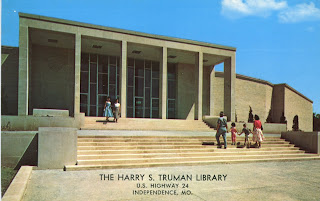
This past weekend, I spent a pleasant morning at the research room of the Harry S. Truman Library & Museum in Independence, Missouri. It was my third trip there, and the first for a new Book Project That Cannot Be Named. In the past couple of years, my research has also taken me to the National Churchill Museum in Fulton, Missouri (the town where Winston Churchill delivered his "Iron Curtain" speech in 1946), University of Missouri-Kansas City and, more exotically, the Churchill Archives Centre (yes folks, that’s the British spelling) in Cambridge, England.

I am far from a master researcher, but I have picked up some tips from others who’ve been on the road, and through sheer, exasperating trial and error. Here are a few of these:

1) Take a Digital Camera, Extra Battery, Tripod and Clicker Thingy

The days of me taking my crappy old Canon point-and-shoot camera, with its tiny lens that can’t take in a full legal size document even if I was suspended from the ceiling (think Tom Cruise in Mission Impossible) and manually adjusting the angle each time, are over. I’m going to invest in a "superzoom" model, tripod, extra battery and the clicker thingy that lets you take pics without touching the camera. I saw two guys using this technique recently and one told me that creating such a setup was the best advice a professor ever gave him. Bravo, prof! By using it, the guy avoided using the photocopier (you’re only allowed to photograph the first page of original, multi-page docs) and took each snap quickly, almost like he was some kind of hyper-efficient researching humanoid. Me? My POS Canon ran out of battery half way through, and I had to resort to reproducing multi-page letters through shorthand. Aaarrghhh! Never again.

2) Form a Relationship with an Archivist

I’m not suggesting a romantic dalliance, but rather a courteous professional exchange between the seeker of knowledge and the one who knows where it resides. If the archivist is on your side they can suggest boxes and folders (and sometimes even specific documents), pull these for you in advance so you can get going as soon as you arrive, and follow up with further suggestions later. Just don’t treat them like Google or act imperious, and do send follow up thank you notes and e-mails. Archivists are there to help respectful researchers, but they’re not part of a servant class

3) Avoid Rabbit Holes

This is a case of "do what I say, not what I do." Even going into an archive room with a tightly focused, organized wish list is no guarantee of a successful session. The trouble – or, at least, my trouble, is that every document, memo and letter is interesting in its own way. It’s all too easy to get sidetracked and look up at the clock to find you’ve burned an hour going down a fascinating yet completely useless path that in no way advances your project. Focus, I say, focus!

4) Process Your Materials ASAP

When you’ve worn your brain to a frazzle with several hours or, if you have a forgiving spouse/partner/whatever, days of intensely focused research, it’s tempting to throw your hard won materials in a box and forget about them for a few weeks. The problem with this is that even if you’ve taken solid notes and prioritized your harvest, you will forget certain intangibles and details that you’d recall if you knuckled down for a while and scanned and/or filed what you’ve found in the appropriate manner. Following the first two steps of an efficient research and writing process – capture and organize – in quick succession makes it easier to get to the third step – retrieve – in the best possible way. The same goes for online research and the use of tools such as Evernote, which I find most useful if I create folders and use tags/keywords.

5) Keep Your Research Away From Small Children

Let’s just say that you’ll only let your five-year-old and two-year-old get into your archival materials once. Hopefully they won’t tear, eat or throw away what they find. Research commandment # 5: Thou shalt lock thy office door at all times.

Real-time

Dan Allosso

Boy oh boy, there are a lot of stories out there! It continues to amaze me, how everyplace I look, there's interesting, compelling history that could potentially turn into serious projects. Yes, okay, maybe I have a short attention span and maybe I need to complete some things (like my dissertation) before taking on any new projects. I’ll give you that.

So what I’m trying to do is get a little bit of info, when I find these topics, so I can get back to them later. In a sense, maybe this is how authors worked in the days when they were doing the final edits on one manuscript while writing the next, proposing the one after that, and looking for the projects after those. In the world of self-publishing, the steps are a little different, but maybe the principal is the same.

The one thing that has really struck me, as I’ve been getting down to writing one project that I’ve been thinking about for a couple years, is how wasteful it is to go over the same ground again and again simply because I didn’t complete the job earlier. I have file folders, backup hard drives, and memory sticks filled with documents. I’ve downloaded hundreds of pdfs from Google or the Internet Archive. I have a stack of index cards nearly four inches high, two partial bibliographies in Endnote and one in Sente. And I have a half dozen outlines and drafts.

It’s good that I’ve been thinking about this project as long as I have been, and it will probably be a better end product because of it. But next time, I’m going to try to be a little more careful about identifying the material I’m collecting, and writing about it as I’m collecting it. In real-time.

Maybe I thought I wasn’t ready to actually start writing this, or maybe I was just lazy – or too excited about the research. You know how it is: one link leads to another, and soon you’ve got gigabytes of great material. But now that it’s writing time, I need to go back over all this material, rediscovering the paths I followed that led me to these records and relearning how they all fit together. Makes me think if I could have been a little more detail-oriented on the front end.

So I’m trying to build a single bibliography for this new, potential project I’ve just discovered. I’m connecting the documents to the entries in Endnote, so I’ll know where they are (and I won’t have to wonder where the most recent ones are!) I’m writing little abstracts and synopses now, so when the time comes I’ll understand how it all fits together and where each record fits in the story. I’ve even got a timeline and a cast of characters, that I can add to anytime between now and whenever I really start this project.

Wish I would’ve started this sooner! The original project I came to grad school thinking about is still out there on a back burner. That folder on the backup drive measures about 29 gigabytes, and some of the files date back to 2006. It will be fun revisiting all that stuff someday. But very expensive.

"The Past . . . It's Here": NYPL Trailer

Randall Stephens

Ah . . . the adventures of the archives. The thrill of the dusty old book hunt. The joy of finding that seldom-seen document. Have a look at this fun video that the NYPL has put out there to capture the wonderful world of research. (H/t to Susan Watkins, director of ENC's Nease Library.)

Some background from the good people at the NYPL:


Here in the Milstein Division we are very excited to finally show off our movie trailer-style promo video that debuted this week on YouTube. We loved some of the videos that other divisions and branches of the library were making, especially Jefferson Market’s Haunted Library, so we knew that we had to make our own. After writing a script, we contacted some great people in the film and television industry that were willing to help us out.

Our hero, played by actor Ronan Babbitt, uses several library resources to help him discover his family secrets. We first see him receive library materials from our page, Sarah, which means that he filled in a call slip after consulting the library catalog. Our hero then flips through the card catalog drawers. Since we no longer use the old card catalog drawers for our books, what you will find here are three sets of indexes: one for coats of arms, one for images of passenger ships, and one of New York City illustrations.>>>

Editing over the Decades

Randall Stephens

I've worked, at most, 7 years on a single project. But, I'm just one person, toiling on my books and articles. The scholars at the Jefferson Papers--Bland Whitley is one of them--have been editing away for over 60 years. I wonder how long the researches at Yale have been doing the same with the Jonathan Edwards Papers? There must be a record for longest ongoing project. 100 years? 200 years? 1,000 years?

See the June 6 article in the NYT, "After 90 Years, a Dictionary of an Ancient World," by John Noble Wilford. Writes Wilford: "Ninety years in the making, the 21-volume dictionary of the language of ancient Mesopotamia and its Babylonian and Assyrian dialects, unspoken for 2,000 years but preserved on clay tablets and in stone inscriptions deciphered over the last two centuries, has finally been completed by scholars at the University of Chicago."

And the dictionary is more of an encyclopedia than simply a concise glossary of words and definitions. Many words with multiple meanings and extensive associations with history are followed by page after page of discourse ranging through literature, law, religion, commerce and everyday life. There are, for example, 17 pages devoted to the word “umu,” meaning “day.”

The word “ardu,” for slave, introduces extensive material available on slavery in the culture. And it may or may not reflect on the society that one of its more versatile verbs was “kalu,” which in different contexts can mean detain, delay, hold back, keep in custody, interrupt and so forth. The word “di nu,” like “case” in English, Dr. Cooper pointed out, can refer to a legal case or lawsuit, a verdict or judgment, or to law in general.>>>

The dictionary set costs a fortune, but can be downloaded for free in PDF form. So, if you're hankering to know what the earliest recorded wisdom was on love, food, work, law, and more, browse away!

Foxed Paper and the Slight Smell of Mold: Reading, Browsing Actual Print Periodicals

I cross-post this modified bit on archives and the work in the paper trenches, which is at Religion in American Culture.

Randall Stephens

Last week I visited the Midwestern Baptist Theological Seminary Library in Gladstone, Mo, just north of Kansas City. The staff was terrific and a bonus was an enormous collection of discarded books for sale--$1 or 50 cents/ea. I picked up Tim LaHaye's Battle for the Mind, and, oddly enough, a copy of Gordon Wood's Empire of Liberty.

Ideally, I hoped to browse through some denominational magazines and periodicals from the 1950s and 1960s for my next project on Christianity and rock/anti-rock. I was pleasantly surprised. The library had loads of Baptist and SBC serials dating back to the early years of the Cold War. Some of the titles I browsed through: Baptist Quarterly Review; Home Life; Baptist Training Union Magazine; The Student (A Baptist-style Jesus People-ish magazine, which Sam Hill actually wrote in). In addition to all that there were extensive runs of Christianity Today and Christian Century, along with quite a few other gems.

The Southern Baptist Periodical Index was a real help. But blast the indexers for not cataloging what I wish they had! (Page after page after page on "Missions.") I have seldom used the Index to Religious Periodical Literature (Chicago: American Theological Library Association.) But it's a tremendous resource for work on post-war American religion. And it gives a pretty good indication of the more popular magazines and journals that circulated at the time. See below the first page of the edition for 1971, listing a range of publications. (Click to enlarge.)

So, here are a few questions for all the HS blog research nerds and archive troglodytes out there: What do you suppose were the largest circulating and/or most influential denominational or public opinion periodicals of the 1950s and 1960s? Which ones are the best for getting a sense of what men, women, and children in the pews, suburbs, and cities were thinking? Why?

There’s Something to Be Said for Love

Dan Allosso

Archives or online? Thankfully, we can have both. As Heather has mentioned recently, the fact that a lot of archival material is finding its way onto the internet means that it will be more accessible to researchers with families, who can’t spend months away from home. And to people in remote locations, who may have different points of view. And to people who can’t quit their “day job,” but want to learn about a particular aspect of the past. And to amateurs: people who do history for the love of it.

Since we’re talking about archives and amateurs, I thought I should mention an amateur archive that has been invaluable to me, but that may not be well-known to people who haven’t done research in upstate New York. It’s a multi-terabyte database of historical newspapers from New York state, that goes by the unintuitive name “Old Fulton NY Post Cards.” I was told about it by the Records Management Officer in Ontario County. She said, “you’ve searched Fulton already, of course.” And I, of course, said, “what?”

Run by a former IT professional named Tom Tryniski, the site has grown from a small collection of digitized post cards, to a collection of over 15 million newspaper pages, covering 342 newspapers, spanning the entire nineteenth and twentieth centuries (1797-2004). The largest collections are from Onondaga and Cayuga Counties; Oswego County (where Fulton is located) has 25, Oneida 27, and other western counties are well represented. But so is Manhattan, with 17 papers including the New York Sun (1843-1945).

The site is free. On the instruction page, there’s a link to a page where you can donate via Paypal, complete with a snapshot of the website’s staff, which consists of Tom wearing four different costumes. The newspapers have been scanned with “production grade Wicks and Wilson Microfilm scanners,” from films obtained from the State of New York Newspaper Project. The instruction page also announces “More Data Is Added Every Sunday Night,” which based on the volume of material here, must be true.

The interface is whimsical, but the search functions are state-of-the-art and powerful. And you can download the newspaper pages as pdfs. The instruction page describes the use of search terms, wildcards, and more complicated issues like phonic searching, stemming, and variable term weighting. There’s also a graphic, clickable index of newspapers, which can be downloaded as an Excel spreadsheet complete with date ranges. Old Fulton NY Post Cards is clearly a labor of love. We’re very lucky there are people who love doing this kind of thing, both professionally and also nights and weekends!

Archives and History: Notes from the New England Archivists Conference

Dana Goblaskas

Archives and history have always been fields that are closely intertwined; without archives, historians would suffer a loss of many valuable primary sources, and without a sense of history, archivists would have no context in which to place their collections. Without history, frankly, archivists would be out of a job.

Or would they?

The idea of a divide between the disciplines of archives and history may seem unimaginable to many involved in those fields, but according to James O’Toole, the Charles I. Clough Millennium Chair in History at Boston College, a split may already be forming.

This “archival divide” was mentioned a few times during the recent spring conference of the New England Archivists, held at Brown University, April 1-2. One of Saturday morning’s first sessions, titled “Is Archival Education Preparing Tomorrow’s Archivists?” featured a lively discussion (as lively as a room full of archivists can be at 9 am, anyway) about how the field is changing and how education is changing in response. To sum up: as records shift from paper to electronic formats, archival education is beginning to stress competence in digital preservation, database management, and knowledge of web architecture and social media. Some members of the profession are concerned that a rift is growing between students interested in the digital realm of archives and those more attracted to the “analog” side of things—the manuscripts, photographs, and other ephemera that spring to mind when one thinks about an archive.

After an hour’s worth of conversation about how to bridge that gap between digital and analog spheres, O’Toole—formerly a professor of archival studies at UMass Boston—broached the question: Where does history fit into all of this? Based on what had been covered in the session so far, it seemed like the whole idea of history was taking a backseat to the new technical aspects of the profession. O’Toole expressed concern that archival educators may be growing so obsessed with teaching new technologies that they’re no longer placing emphasis on understanding historical context.

Silence filled the room as veteran and fledgling archivists alike reflected on what this observation could mean for the future of the profession. Maybe it was just me, but there seemed to be a very faint sense of panic in the air, especially when another session attendee wondered aloud what would happen in twenty years when many “classically trained” archivists retire, leaving the young technical turks in charge.

Before any lurking sense of doom could take over, a voice from the back of the room spoke up, identifying herself as a student enrolled in the library science and history dual-degree Master’s program at Simmons College. With several fellow students beside her nodding in agreement, she explained that there’s no need to panic quite yet; there are still some archivists-in-training who feel that history is hugely important, not only in order to have an understanding of context, but also to know how to conduct historical research, which has the added bonus of helping archivists better understand and assist researchers.

Though this enthusiastic Simmons student helped to quell the panic a little bit, O’Toole’s point is still a distressing one. Later that day, at the conference’s closing plenary session, he discussed how some archival neighbors, such as historians, aren’t “in the neighborhood” anymore, and how the profession needs to hold on to its roots as it explores new and exciting technologies. I certainly hope the educators in the crowd—and the mentors, students, and others working in the field—heard his message. The digital vs. analog divide may be more popular in archival discussions these days, but the sneakier split growing between archives and history may be the one that proves deadly to the profession if left unchecked.

Seward Was an Upstate Lawyer

Dan Allosso

I was looking through the materials I photographed on my last trip to the American Antiquarian Society. This trip was mostly about acquiring background on the places where the people I’m researching lived. Although there are a LOT of old newspapers now available online, as Heather has recently pointed out, there are many that are not yet. The American Antiquarian Society has a huge collection of early papers, as well as broadsheets, political pamphlets, and books.

I photographed a lot of material, which is my strategy when I go to archives like this. Whenever digital photography is allowed, I focus on locating and recording as much in the archives as I possibly can in the time I have. There’s never enough time, but this strategy allows me to go home with more material than I’d ever be able to read, sitting at the desk in the archive. It amazes me that just a decade or so ago, people had to sit in these places for months and months—and then in many cases they still only managed to scratch the surface of what was available.

That’s not to say that past researchers haven’t done fabulously, getting to the meat of an issue and finding the relevant material. But I suspect it limited the time they had to look around the information they were seeking, to see, for example, what else might have been on people’s minds on the particular day a specific newspaper article they were looking for was printed. Not to mention, what might have been in the advertisements on the edge of the page.

For example, I was looking at a table of New York Bank Note discounts, in the Lyons NY Countryman for Tuesday, March 2nd 1830. The table was in the fifth column of page four. After I photographed it, I noticed there was a notice about the sale of a defaulted property in Lyons at the top of column six. So I shot a quick photo of it and moved on. It wasn’t until I reviewed my photos at home, that I read it through and found that, in addition to being an interesting example of a notice, complete with a detailed property description and a little more background information to add to my knowledge of people in Lyons, the final line answers an unresolved question from my earlier research.

As I was putting together all the legends that surround my subjects in upstate NY, I ran into a story that claimed they had spent a lot of time trying to build a ship canal around Niagara Falls. There were obviously good precedents to support the idea of an additional “internal improvement” in upstate New York. But it would take government money to build it, so they needed a patron. There was a brief mention of a long, late-1850s carriage-ride one of my subjects had with New York Senator and former Governor William Henry Seward, during which my guy bent Seward’s ear about the project and received the response that it would never happen until there was a change in administration. Which he took to be Seward’s way of saying “when I become President.”

I liked this story, and had always planned on using it. But the accidental newspaper discovery makes it much more plausible. The 1830 lawyer handling the default sale in Lyons, whose name appears at the bottom of the advertisement was none other than “Wm. H. Seward, Att’y.” A reminder that my guys, even though they were merely upstate businessmen, had a completely credible connection with the man who went on to become a key member of Lincoln’s “Team of Rivals.” Too often we forget that many of the “great men” who stride through the big histories, started somewhere as regular people. Unexpected material from the archives can not only provide background for a narrative, but from time to time, it can provide unexpected clues about meaning and context.

Using Primary Sources: Credit Reports

Dan Allosso

Unlike many of the records that I’ve been using so far in my research, credit reports like the R.G. Duns collection at Harvard’s Baker Library are a primary source that seems to stay much more in the background of many research projects. Partly this may be due to the Baker Library’s rules: no photography of the materials, no direct quoting of the reports without prior approval. But a much more reserved, qualified use of these credit reports probably also comes from the mediated form of the information in them.

As Christopher Clark described them in The Roots of Rural Capitalism, reports like those in the R.G. Duns books began to be used after the Panic of 1837, and became much more extensive after the Panic of 1857, to provide a way of evaluating the credit-worthiness of (mostly rural) borrowers for the benefit of (mostly urban) creditors. This geographic distance is key to the value of the reports; since the credit agencies employed local correspondents who reported facts, opinions, and rumors about their subjects that would have been common knowledge in the local business community. But we don’t know much about these reporters: the correspondents identified themselves in the bound volumes by code numbers, so the sources of these judgments are not at all transparent. This anonymity and the use of coded language (which as Clark points out, tends to apply contemporary “moral principles to business”) adds to the appearance of unanimity, authority, and consistency of judgment. But a closer look at the reports, especially those of long duration, casts some doubt on this supposition.

I’ve been to the Baker a couple of times to look at the R.G. Duns books. The librarians are very helpful; they bring the books out to your work table, one at a time, and can get additional volumes quickly, if your research takes an unexpected turn. One of my subjects, in Michigan, for example, did not turn up in the Kalamazoo book when I expected him to be there. Going back to the book for St. Joseph County (south of the city), I found reports of his business activities in his home community long after the “official story” of his life had him moving to the big city. The Duns reporters also wrote about him being involved in businesses that never came up in the other materials I’ve looked at, which gives me a whole new trail to follow in my investigation.

But while they are helpful for pointing to holes in my information, I think the Duns reports are most interesting for the way they describe changing attitudes toward the behavior (or “character”) of businessmen in these rural areas, and the expectations of urban creditors. It’s important to remember, when reading reports like these, that the correspondents were writing from the point of view of their distant clients. Tensions over the relative power of the local and distant parties to these credit relationships, as well as changing standards of personal and business conduct, are a central element of these narratives.

The contrast between the two brothers I’m studying in upstate New York is dramatic. They lived in adjacent towns, but in different counties covered by different Duns correspondents. They had been partners for decades, but later in life they became competitors. The younger of the two became the richest man in his county, and developed a reputation for credit-worthiness and stability that was amply recorded by his local Duns reporter. He set up his son as a banker, guaranteeing the young man’s credit with his own. When the son became an alcoholic and needed to be institutionalized, his father made good all the bank’s investors and depositors, and transferred the business to his younger son and two daughters. All these details are recorded, with very little personal judgment, in the Duns book.

In contrast, this man’s older brother seems to have pioneered the borders of financial respectability, by continually crossing them. The Duns reporter who covered his file for many years stressed the fact that the older brother was “fond of litigation,” tended to pay only after an “execution” by the court, and “cannot be trusted out of sight.” Like his respectable younger brother, this upstate businessman also started a bank, which he used primarily to finance his own business. This business was ultimately successful in a competitive national and international market, in part because its owner was willing to take substantial risks and go much farther out on a financial limb than his Duns correspondent was comfortable with. These conflicts of interest between the businessman’s activities and the standards of the Duns reporter suggest a changing dynamic of rural and urban financial power. As, I think, does the increasingly adversarial tone taken over time in several accounts. After a while, many of my local subjects seem to become less compliant with demands for information by their local Duns correspondents. It may even be a mark of financial success for them that some are able to completely stop cooperating with these reporters. In that case, the negative personal tone of the later entries in some of these credit narratives might be read as evidence of rural financial independence, rather than failure to conform in an increasingly urban credit regime.

Reading Primary Sources: Estate Inventories

Dan Allosso

One of the things that fascinates me about doing historical research, is that it doesn’t always involve long trips to exotic archives or well-known historical sites. For example, wills and estate inventories going all the way back to the earliest days of settlement are often kept in the county records office. Whether you are trying to find information on a particular family or individual, or looking for background material to help you rebuild the world your subjects lived in, probate documents can be a really interesting window into the material culture of the past, and into the attitudes and values of people long ago.

I went to the western Massachusetts town of Northampton a while back, to look at estate information for the town of Ashfield. Hampshire County encompassed the area which is now Franklin County until 1811, so I went to Northampton expecting to find Ashfield documents up to that time. In fact, I found several later than 1811, suggesting that people in the habit of going down to the Northampton Courthouse to conduct their business were not turned away. Sometime soon, I’ll make a similar trip to Greenfield, and see what they have in their files.

Wills are public records, so you don’t have to provide any credentials to look at them—but I don’t imagine they get a lot of use. In Northampton, there’s an old-fashioned card catalog where you can find the names you want to ask for, and a simple form you hand to the records clerk. The January 3, 1811 will and April 10, 1811 inventory of Joseph Clark is typical of what I found. Most of the old documents are folded into palm-sized packages, often bound with string. The inventory, taken by Clark’s executor Japhet Chapin, lists everything of value that Clark owned. First and most important, of course, are “Fifty acres of land including the buildings valued at $800.” Everything else Clark owned was worth about $159, including six cups and saucers valued at 12 cents, a vest worth 42 cents, and seven sheep and two lambs whose $13.50 value suggests they may have been newly introduced Spanish Merinos.

In his will, which Clark executed four months before his death, he first specifies “I would have all my just debt paid.” Next, Clark orders the division of his remaining assets. He specifies cash settlements to be paid “within one year after my decease” to his five daughters; fifty-five dollars to each of the unmarried, and five dollars to the married woman, who had probably received the fifty when she wed. He gives fifty dollars to his son Otis, and “to my dearly beloved wife” Clark orders “she should have a comfortable maintenance out of my estate so long as she remains my widow then the income of one third of my estate during her natural life.”

Clark’s widow’s income and maintenance would come out of the balance of his $959 estate after the $275 in cash bequests and whatever went to pay his debts. This balance was to be split equally between his two remaining sons, Joseph and Loring, who would presumably either work the farm together, split it into reasonably equal halves, or find a way for one to buy out the other’s equity. There was a practical limit to how small a farm could be and remain viable; if all fifty acres were “improved” cropland, they may just have been able to split the property. On the other hand, one or both of the brothers may already have owned other property, before their father’s death.

The will and inventory raises several questions that can help direct my further investigation. I can check the town’s Vital Records book (there’s one for every town in Massachusetts, covering births, deaths, and marriages up to 1850), to determine the ages of the family members in 1811. Town “valuations” (tax lists) will tell me what land the sons may have owned already, if they lived in town, and possibly whether either of them had cash on hand to meet the “within one year” requirement of the cash bequests. Since Clark left no cash and I believe he had no large sums owed him (I don’t know for sure, but I assume there are none because the two notes he held were crossed out at the bottom of the inventory list, suggesting they had been settled), the brothers would have needed to raise over three hundred dollars relatively quickly, to satisfy their siblings’ and provide for their mother.

In addition to these particulars of the Clark family, the documents tell me several things about Ashfield, that I can check against historians’ understanding of similar places at this time, to get a better sense of the town. Clark writes affectionately of his wife and leaves her not only a widow’s maintenance, but a third of the income of his estate, suggesting that he valued her contribution to the family's fortunes. The inventory is witnessed by Ebenezer Smith Jr., son of the Baptist minister and grandson of the town’s first settler, suggesting Clark (who was a member of the Congregational Society) was on good terms with neighbors outside his denomination. The will itself is witnessed by Polly Chapin and Margaret Wood, who signed their own names, suggesting that among Clark’s friends, both men and women were relatively well educated. It would be interesting to know exactly where the farm was, what type of land it was on, and how many buildings were on it; since the $800 valuation makes up the majority of Clark’s estate and seems a little high for the times. Finally, the list of items Clark owned is very valuable, not only for the relative values of the items, but as an inventory of the items that surrounded him during his life. The combination of indoor and outdoor tools, the three cows and three heifers, four dining chairs and four pewter plates, all help set the scene and give us clues about Clark’s life. They also suggest ways he may have been connected to extended family and neighbors. Ten “cyder barrels” but no press: so who pressed his apples? No plow and team: did one of his sons have one? One axe: how much of Clark’s land was cleared? This will and inventory give a fascinating glimpse into both the physical and social world in which Joseph Clark lived and died in 1811.

Reading Primary Sources: Indentures

Dan Allosso

One of the most exciting and interesting things we do as historians is look at old documents. Exciting because we get to use all our “detective” instincts, and we’re never sure what we’re going to find. Interesting because along with the data we’re looking for, there’s often a lot more. Sometimes this additional information takes the form of a surprise that completely changes our idea of what happened; more often, it broadens and enriches our understanding of the setting, the people involved, and the times they lived in.

I recently had an opportunity to look at nineteenth-century land deeds, or “Indentures” in upstate New York. My goal was to establish when the people I was studying had arrived in the region. I went to the county records office and got permission to use their computerized database of indentures. This saved me the trouble of pulling a dozen old books off the shelves, since deeds were recorded in the order they were executed, so you need to find them in the index and then go to the appropriate “Liber” and page.

As I expected, the pile of documents I was able to find and print for a nominal fee, told me a lot about when my subjects had arrived in the area, but also a lot more that I hadn’t expected. For example, I found an 1842 record of an agreement between one of my subjects, Roswell Ranney, and Spencer Hildreth and Elijah Bement, “and Julia his wife.” Ranney bought a 106.25-acre parcel of land from these two men, “for the sum of Ten Dollars to them in hand,” as well as “payment & satisfaction of twelve hundred and fifty dollars being a part of a mortgage heretofore executed by Samuel H. And Henry Baggerly and their Wives to the New York Life Insurance and Trust Company for twenty seven hundred dollars.” The location and dimensions of this land were described in great detail, which allows me to not only plot it on a map and know where Ranney lived, but suggests that an acre of prime farmland in Phelps was worth about $12 in 1842, if this sale was at the market price.

But I don’t know that for sure, yet. Because, reading on, I find that there had been a previous mortgage, dating from 1838, between George Ranney, Roswell’s brother, and the late Russell Bement, whose exact relationship to Elijah I don’t yet know. George and Russell, I already knew, both came to Phelps around 1833 from the same town in Massachusetts. George Ranney died about six months after this indenture was recorded, so this land sale may have been part of an attempt to put his affairs in order. But now, to understand the sequence of events, I’d like to know why the Baggerly brothers had a mortgage with New York Life. Actually, until I saw this indenture, I wasn’t aware that the New York City company was involved in real estate lending in this small upstate village—so that’s definitely worth finding out more about.

In a footnote to the indenture, the county official appended a note witnessing the signatures and stating that in a private interview, Elijah Bement’s wife Julia “acknowledged that she executed the within deed freely and without any fear or compulsion of her said husband therefore let it be recorded.” It’s an interesting glimpse at the changing status of wives in 1842 New York, that although she clearly does not have the rights of the men, society is concerned about Julia’s willing participation in this sale.

The Original Live-Blogging: On the Ground with Antinuclear Activists in 1979

Morgan Hubbard

Professionals of all stripes know that some workdays are better than others. Much of the historian's task is tedious and thankless—slogging through reams of records that may or may not be important for the puzzle she's looking to solve, or the argument she's looking to build. Some days end up being totally useless.

Some days, though, are windfalls.

The Alternative Energy Coalition was an alliance of anti-nuclear and environmental activists in New England in the late 1970s. The AEC, together with the better-known Clamshell Alliance, staged a series of “actions” against the Seabrook Station Nuclear Power Plant in eastern New Hampshire. Some were more intense than others, and a few made national headlines. When the AEC dissolved in the early 1980s—members moved to affiliated groups or dispersed—the organization's papers lay fallow. In the 2000s, they were given to the University of Massachusetts-Amherst Special Collections.

Many of the AEC's records are run-of-the mill: mostly catalogs, routine correspondence, heaps of newspaper clippings. But tucked into one folder, fastened unceremoniously with a single staple, was something remarkable, a historian's goldmine: a sheaf of papers on which AEC protesters had logged, hour by hour, the events of a massive blockade action at the Seabrook plant in October 1979. (Click on the image of the log to enlarge.) The document is special not only for the intensity of its scribbled notes (“8:30 a.m., police dogs and water hoses are visible. Action before noon.” “10:00. Verified macing and clubbing.”) It's special because it's a step closer to historical reality than historians can usually get.

Most of the time, we have to reconstruct the past obliquely. But documents like this allow us to witness the past almost as its participants did, play-by-play, on the ground. Obviously, there's much missing from a written account: the smell of teargas, the overhead chop-chop-chop of police helicopters, the fervency of a protest at the height of the anti-nuclear movement's momentum. But documents like this—a live-blogging before there was such a thing—demonstrate that with the right sources, we can recapture some of the potency and urgency of the past.

Archeologists and Historians at Work

Randall Stephens

What do historians do? How do they go about their work?

The work of a historian is not entirely unlike that of an archeologist. Both see through a glass darkly. (Maybe that's more "darkly" for an archeologist.) They look at primary source materials (material culture and texts), make comparisons to corroborate evidence, think about the context of one era compared to that of another, and use secondary literature to give them a bigger picture.

A great deal of interpretation and analysis informs the work of archeologists and historians. What's more, archeologists often disagree with each other just as historians do. Questions still remain open for debate. And debates can easily become politicized, tied into issues of national identity, or personal.

The hard work of archeology is spelled out clearly in a wonderful piece in the latest issue of National Geographic: Robert Draper, "Kings of Controversy: Was the Kingdom of David and Solomon a Glorious Empire—or Just a Little Cow Town?" National Geographic (December 2010)

See, for instance, how Draper sets up the nature of controversies:

In no other part of the world does archaeology so closely resemble a contact sport. Eilat Mazar is one of the reasons why. Her announcement in 2005 that she believed she had unearthed the palace of King David amounted to a ringing defense of an old-school proposition under assault for more than a quarter century—namely, that the Bible's depiction of the empire established under David and continued by his son Solomon is historically accurate. Mazar's claim has emboldened those Christians and Jews throughout the world who maintain that the Old Testament can and should be taken literally. Her purported discovery carries particular resonance in Israel, where the story of David and Solomon is interwoven with the Jews' historical claims to biblical Zion.

Draper also sheds light on how texts are used (or misused) to ground the material evidence. Pieces of the puzzle are put together slowly over decades:

The books of the Old Testament outlining the story of David and Solomon consist of scriptures probably written at least 300 years after the fact, by not-so-objective authors. No contemporaneous texts exist to validate their claims. Since the dawn of biblical archaeology, scholars have sought in vain to verify that there really was an Abraham, a Moses, an Exodus, a conquest of Jericho. At the same time, says Amihai Mazar, Eilat's cousin and among Israel's most highly regarded archaeologists, "Almost everyone agrees that the Bible is an ancient text relating to the history of this country during the Iron Age. You can look at it critically, as many scholars do. But you can't ignore the text—you must relate to it."

Of course, historians don't use hard science or equipment in the same ways that archeologists do--carbon dating, chemical analysis, shock-proof computers that can handle intense heat and dirt. Historians don't typically study prehistorical cultures. And, historians spend their time digging, mostly, in the comfort of air-conditioned archives.

Still the similarities and points of contact between the two fields is quite interesting. We read evidence, whether that be in the form of pottery shards and olive pits stuck in the side of a Palestinian hill or 18th-century English newspapers and court records.

Does the ambiguity of the archeological record produce controversies that burn hotter than historical controversies? After reading the National Geographic article, I could not think of historical debates that rage with the same intensity.

London Calling Librarians

This guest post comes from Dana Goblaskas a former student of mine who works at the MIT library. Dana stuck out to me from the start because of her intellectual curiosity and because she was into pop music history, punk, and indie rock. Pluses in my book. Here she tells of her two-week trip across the water as a participant in University College London’s Librarianship Summer School.

Dana Goblaskas

As a self-proclaimed history nerd and an Anglophile, it’s hard for me to be giddier than when I’m immersed in the tangible history of England. And if I can earn credits toward my degree for that immersion, well, let’s just say the happy dances abound.

Last month, I took part in the inaugural session of University College London’s Librarianship Summer School, co-sponsored by the University of North Carolina’s School of Information and Library Studies. The two-week seminar examined the past, present, and future of Britain’s libraries and the field of librarianship, and featured daily field trips to museums, libraries, and archives throughout the city and beyond. Lectures by librarians, historians, and UCL faculty provided background for what my classmates and I saw during tours, and behind-the-scenes peeks into the workings of such places as the British Library and Bodleian Library at Oxford set our future-librarians’ hearts a-racing.

For the history nerd in me, there was plenty of “past” to learn about and see firsthand. Lectures about medieval manuscripts and eccentric pioneers of cataloging were coupled with glimpses inside Wren’s Library at Trinity College Cambridge (built in 1695), the Natural History Museum, and viewings of treasures like the Domesday Book at the National Archives.

Perhaps even more exciting than getting to drink all that in was seeing how much effort these institutions are presently putting into making their historical collections available to the world. With help from foundations like JISC (Joint Information Systems Committee), many of the places I visited were in the midst of massive digitization, indexing, or retrospective cataloging projects. Inspired by the popularity of the BBC’s Who Do You Think You Are? TV program, several libraries and archives were focusing on increasing public accessibility to the parts of their collections that could be used for genealogical research.

As for the future of Britain’s libraries, I think they’re heading in the right direction. Facing questions about libraries’ continuing relevance to society head-on, they are adapting to the communities around them and showing that they’re in it for the long run. A new “chain” of libraries called Idea Store is springing up around London, abandoning confusing catalog classifications and offering a wide variety of classes to support continuing education in their neighborhoods. The libraries in the London borough of Haringey recently won a grant that placed free medical clinics and wellness centers alongside their book stacks.

And in addition to focusing on expanding digital content and accessibility, some institutions are appealing to the public to help develop their collections. Projects such as Transcribe Bentham at UCL and Oxford’s First World War Poetry Archive rely on crowd-sourcing to create and identify materials, as well as on social networking tools like Twitter and Flickr to get the word out to wider circles of volunteers.

Coming back down to reality after two weeks spent doing not much more than hanging around inside and gawking at cool old libraries—or cool new libraries—was a little difficult. But coming back with great experiences, thousands of pictures, and a head full of ideas lessened the blow of the transition. And I’m excited by the prospect of so much more incredible content being made widely available. Now I just have to finish my research paper to earn those credits, and I think the happy dances will abound once again.

Throwing Caution to the Wind: The Surprising Results of a History Class Project

Randall Stephens

I’ve never been big on class projects. The careful, OCD part of me sees millions of things that could go wrong. I’ve also not been much of a fan of student presentations. Ditto from above. Imagine hours and hours of classroom time eaten up by: “Webster’s Dictionary defines the Cold War as . . . In this presentation I plan to try to discuss why Khrushchev was so mad at America.” Or: “Mr. Abraham Lincoln stood head and shoulders above his contemporaries. According to Wikipedia, Abe was best known for writing down the emancipation renunciation . . .”

In recent years, though, I’ve begun to let go of past prejudices. With the right prep work and with plenty of guidance, student presentations can be educational, if not top notch, and they can be a wonderful end-of-semester exercise. So, on to class projects, I thought.

Eastern Nazarene College is right next to the Josiah Quincy House (built in 1770). It’s a beautiful colonial home and a national treasure sitting right in our backyard. But none of the students in my class even knew where it was located. So for my course on historiography, methods, and the practice of history I decided to have the students help me build a resource website for this storied home. The result was pleasantly surprising.

The students were interested in the project, if not wildly enthusiastic about it. We started with an early-March guided tour of the house. Eyes lit up when our guide Leah Walczak spoke of prominent visitors to the home: Benjamin Franklin, the Marquis de Lafayette, and, of course, John and John Quincy Adams. (The Quincys and the Adamses had a little rivalry going on, which added a dash of drama to the project.) The students invested considerable time in tracking down sources and finding out about this amazing colonial home and its remarkable history over the ages.

We tried to make the site a useful little guide for anyone who might be interested in the mansion and the illustrious Quincy family. So, along with some general information about the house and the Quincys, we've included architectural information; an extensive bibliographical page (the students went to town on this!); a JQ family line; hi res photos of the house; numerous maps, prints, and paintings; a video interview with Leah Walczak (chief curator); and a variety of links dedicated to local and regional history. We have also included links to as many full-text books, articles, and manuscripts related to the family and the mansion that we could find. I was impressed with student initiative. They were tracking down items and working on leads that had escaped me.

I plan to do it again. Next time around, though, we’ll be building a resource website on the now-destroyed second Josiah Quincy Mansion. That Victorian edifice once actually stood on our campus. (It was leveled in 1969 to make way for a Cold-War-styled modernist religion building. Sorry business.)

But, in the end, what do students take away from such a project? What use is it? Well, they certainly seemed to hone their research skills. They also have thought about how best to present history to a broader public. We discussed the layout of the website, the order and title of subpages, and more. I have hoped students come away from a class like this with renewed curiosity. I have also hoped they will think more about how history connects to the world around them. Among other things, their work on the Josiah Quincy site, it seems to me, linked past to the present quite effectively.