Showing posts with label Lessons from the Past. Show all posts

Gorgeous Hussies and Parlor Politics

Joseph Yannielli*

One of the advantages of digital history is that it allows its practitioners to comment on public events in real time and achieve a potentially broader and more immediate impact. And what event could be more gripping than a big old scandal? Scandals tap into a seemingly universal appetite for tawdry drama. In times of great crisis or division, they serve an important cultural function. Brimming with prurient details, amplified by politicians and the media, public scandals are manufactured distractions. Really good scandals also have the capacity to shake revered institutions to their core—to disturb and expose powerful elements that are normally obscure or hidden.

Of all the endless varieties of public embarrassment, the sex scandal holds a special place for its ability to shed light on subterranean social anxieties. The latest example offers up a juicy blend of the military, politicians, the CIA, and the FBI (and the East Tuscaloosa Junior Marching Band, and Kevin Bacon, and your mom, and who knows how many others by the time the investigation is concluded). But the story is as old as America . . . or at least as old as Old Hickory.

The Petticoat Affair that almost derailed Andrew Jackson's first term as President was perhaps the first major American sex scandal. And like the still-unraveling Petraeus Affair, it disgorged fascinating information about the inner workings of power in what would become the world's mightiest military machine.

A 19th century cigar label depicting
the scandalous Peggy (O'Neal) Eaton
In her groundbreaking book Parlor Politics: In Which the Ladies of Washington Help Build a City and a Government, historian Catherine Allgor points to the crucial role of elite women in the political culture of the federal government. Long before winning the right to vote powerful women, Allgor says, hosted influential social events, followed political debates, and conferred with their husbands. In doing so, they created the vibrant intellectual and social spaces necessary for democratic politics to function. Of course, plenty of ordinary women also made a political splash during this same period (check out marvelous new books by Stacey Robertson and Carol Faulkner, for example). These women tended to be less conservative, or from different religious backgrounds, or less economically privileged than the Washington elite. Among them may be counted Margaret "Peggy" Eaton.

Without delving into a complicated biography, it will suffice to say that Eaton was an intelligent and ambitious young women who attracted the attention of politicians and military officials in the nation's capital (Senator Andrew Jackson was an early admirer). When her first husband, a naval officer, died at sea, rumors circulated that he had killed himself as a result of his wife's alleged infidelities. Her marriage to Senator John Eaton shortly thereafter added further grist to the gossip mill, and when Jackson appointed Senator Eaton as his Secretary of War in 1829, Washington erupted. Floride Calhoun, wife of Vice President John C. Calhoun, led a campaign to ostracize the Eatons from important social and political gatherings. The
President became involved and eventually his entire cabinet split into factions. After an excruciating media circus, Secretary Eaton and the rest of the cabinet resigned and the government persevered. And Peggy Eaton lived in infamy, later immortalized by Hollywood as The Gorgeous Hussy (oh, Hollywood).

The Petticoat Affair, as it came to be known, says a lot about class, gender, and sexuality in the Early Republic. But it also says a great deal about American political culture. Compared to other other sex scandals involving 19th-century politicians, it was unusually potent and destructive. The connection between the Jefferson and Hemings families, which rivals the Petticoat Affair for media-fueled speculation, did not significantly impair Thomas Jefferson's presidency. Indeed it took almost 200 years, Annette Gordon-Reed, and DNA evidence for historians to take the relationship seriously. Richard Mentor Johnson, a Jacksonian Democrat and Vice President under Martin Van Buren, made no secret of his relationship with the enslaved Julia Chinn. Although it damaged his career, and opponents published racist, sexually-charged cartoons, it did not have a lasting impact on the government. James Henry Hammond's omnivorous sexual appetite, which ranged from his college friends to his teenage nieces, resulted in a minor setback for his political ambitions, but it did not derail his career as a pro-slavery pamphleteer or his appointment to the Senate in 1857. And yet a dispute between Floride Calhoun and Peggy Eaton spiraled into a moral panic that almost brought the Jackson administration to its knees. Why did the coercive and brutal actions of slaveholders matter less than the hasty marriage of a widow?

James Akin, Newburyport, MA, c. 1804
The recent Petraeus scandal differs significantly from the original Petticoat Affair. For one thing, the sexual infidelities attributed to the Eatons were based on rumor and innuendo, while Petraeus's indiscretions have been amply and authoritatively confirmed by Google and the FBI. It may be more useful to compare Petraeus to his CIA predecessor, Allan Dulles, "a serial adulterer" whose rampant womanizing did nothing to impede his career. Although President Obama has been drawn into the controversy, making for an inauspicious start to his second term in office, it does not seem likely to destabilize his administration. At the same time, this latest scandal points to a hidden world of power and influence. Paula Broadwell, Petraeus's alleged paramour, is an ambitious scholar-soldier who earned unprecedented access to the General. Jill Kelley, the object of Broadwell's jealousy, is a wealthy volunteer ambassador with routine access to the highest ranking leaders of the United States military. Broadwell seems to have developed a relationship with Petraeus based on mutual respect and admiration. She followed him to Afghanistan, wrote his biography, and offered sympathy and companionship. She is a proud athlete and a public intellectual who performed 60 pushups on stage in front of a live studio audience. Kelley, in contrast, appears to be a classic parlor politician, operating behind the scenes, facilitating social events for the military elite, and building influential contacts. When confronted with allegedly harassing messages from Broadwell, she did not hesitate to mention the matter to a personal friend in the FBI, who then passed the information to Washington politicians, including House Majority Leader Eric Cantor.

It may be too soon to attempt to draw conclusions from this unfolding drama. But a few things are evident, even at this early stage. The media, which eagerly pounced on the story, has presented a narrative that might be described as Gorgeous Hussies: The Sequel. Major news outlets are scrambling for any scrap of information about Broadwell and Kelley, despite their own painfully obvious desire to stay out of the spotlight. Like the public commentators who fretted over Peggy Eaton's polluting influence on the Jackson administration, there has been much hand-ringing about the "pillow talk" between Broadwell and Petraeus. Interestingly, according to Allgor, contemporaries depicted Peggy Eaton in similar terms, as a dangerously powerful "courtesan." The coverage of Kelley has been especially severe, if not voyeuristic. A feature article on CNN focuses on her "smart canary yellow dress" and "hot pink handbag," and quotes "a senior official" describing her as a "bored, rich socialite." There is a point in every scandal, perhaps, when the coverage passes from the real to the absurd. The Daily Show, mocking the media descent into tabloid gossip, has suggested that the military institute a ban on heterosexuals.

Even so, it might be worth asking why this scandal, like the Petticoat Affair, has caused so much consternation. Generals Petraeus and Allen, the establishment figures at the center of the controversy, have presided over a military-intelligence complex responsible for funneling over $1 trillion in tax revenue into wars that have cost countless lives. No senior military or intelligence official resigned over the disgrace of Abu Ghraib. Yet marital infidelity (admittedly sleezy and reprehensible) is career suicide. That could be the biggest scandal of them all.

______________

* Joseph Yannielli is a doctoral student in History and contributes to the blog Digital Histories at Yale.

A Nation of Minorities

Chris Beneke  

With the present birthrate, the Nordic stock will have become a hopeless minority within fifty years, and will within two hundred have been choked to death, like grain among weeds. Unless some means is found of making the Nordic feel safe in having children we are already doomed.
- Hiram Wesley Evans, “The Klan’s Fight for Americanism” (1926)

When Evans, the Ku Klux Klan’s Imperial Wizard and Emperor, offered this non-scientific demographic projection in the pages of the respectable North American Review in 1926 he wasn’t far out of the mainstream. Two years earlier, the U.S. Congress had passed an immigration restriction bill that severely narrowed the gates through which immigrants from eastern and southern Europe passed. The impending, relative decline of the Nordics was a leading justification for the measure.

Evans’ apoplexy contrasts with the relative equanimity that greeted the recent news that non-white births now outnumber white births in the U.S.—presaging a non-white majority by midcentury.* While the initial frenzy of reporting dripped with anticipated angst, the nation largely managed to keep its composure.
Interestingly, much of Evans’ vitriol—and much of the contemporary KKK’s general vitriol—was aimed at the Roman Catholic church. Anti-Catholicism didn’t come to an immediate end when the Klan imploded in the late 1920s. But it never again reached such heights.
While religion and ethnicity are very different social categories, and early 21st domestic and international politics much different than those of pre-Great Society, Cold War America, we can still discern some revealing parallels between the conditions under which white Catholics were successfully integrated into American society and those now surrounding the growing Hispanic population. In other words, we have a historical precedent for the accommodation of a large block of new immigrants in the U.S., despite the hyperbolic fury of the extreme right and the dour pessimism of the extreme left.
Setting aside the fact that nearly one-third of all U.S. Catholics are now Hispanic, there are at least five easily identifiable parallels between 21st-century Hispanics and 1920s-era Catholics:

1. As early 20th-century Catholics were a diverse group bound together by an ancestral  faith, so are Hispanics from a variety of backgrounds bound together by an ancestral  language; 
2. Hispanics are approaching one-fifth of the U.S. population—as were Roman Catholics in the first decades of the 20th, but their birth rates are likely to level off as they did for 20th-century Catholics; 
3.The Hispanic population now includes a predominant nationality (Mexican American) that will, like Irish American predominance among early 20th-century Roman Catholics, diminish as illegal immigration slows; 
4. Hispanics are marrying members of other ethnic groups at a rate comparable to 20th-century Catholic religious exogamy; 
5.Explicit prejudice against Hispanics is increasingly confined to the extreme, economically marginal right—just as it was for early-mid-20th-century Catholics.

This ad-hoc collection of rough analogies doesn’t guarantee anything about the next few decades of course. The investment firm’s stipulation that past performance is no guarantee of future results also goes for social change. And we should worry about the effects that the return of pre-World War II-levels of economic inequality might have.  Still, the case of early 20th century Catholics is instructive and  encouraging. 
______________
* There are problems with the accounting, mainly because those Hispanics who identify as whites were included in the “non-white number.”  On this see Jeff Jacoby’s piece in The Boston Globe and Matthew Yglesias’s piece in SLATE.

The Titanic and the “Tip of the Iceberg”

Steven Cromack

April 15, 2012 marks the one-hundredth anniversary of the sinking of the R.M.S. Titanic. In honor of the centennial, events are taking place across the world—in Belfast, in Southampton, in New York, and even in Branson, Missouri. James Cameron re-released his 1997 blockbuster in IMAX 3-D, and there are a slew of new books appearing on the shelves. What is it about the Titanic that makes it so captivating? The answer, I believe, is that the many stories, all of which compose the master story, have a universal and generational appeal. They resonate with the deepest elements of who we are as human beings, or the “collective unconscious” articulated by Carl Jung, beneath the surface of our iceberg-like minds.

In terms of maritime history, the Titanic does not hold any special records—it was neither the largest ship to sink, nor did it claim the most lives. Yet, no other maritime disaster in history has captivated the public’s attention more so than the Titanic’s sinking. The academy as a whole does not consider the ship significant in the grand scheme of examining change over time. Indeed, of the many books on the subject published very few come from academic presses. Historians consider the Titanic story merely as “popular history,” or a history in which the “past is mobilized for a wide variety of purposes including . . . profit-making entertainment.”[1]

The tale of the Titanic, however, is more than “popular history” or “profit-making entertainment.” The Titanic endures in the same way that Shakespeare’s works, or even those of Sophocles or Euripides, endure. It lives on, even a century later, because the narrative contains stories of heroes and villains, “what if” scenarios, secrets, mysteries, stories of romance, and of heart-wrenching loss. It warns of the dangers of hubris and is an example of Edward Lorenz’s “Chaos Theory” and “Murphy’s Law.” It is a Petri dish in which historians, sociologists, anthropologists, and psychologists can examine and argue over the deepest elements of human nature: what happens when human beings find themselves in a dire scenario.

The story of Titanic is an intricate masterpiece of characters, narratives, and sub plots upon sub plots. There is story that everyone can admire or anguish over. Perhaps it is the character of the “Unsinkable” Molly Brown, who took an oar herself, something undoubtedly Susan B. Anthony would have done, and insisted that her virtually empty lifeboat go back and pull survivors out of the water. Such an act would have put her and others at risk of being capsized. Or, maybe, it is the awesome love which Ida Strauss showed her husband, Isidor Strauss, the co-owner of Macy’s Department Store, when she refused to leave her husband to die on the ship. Another person, at some point during the night, went down below and released the passengers’ dogs from the kennel.

All of these mini stories weave together to form the “big picture,” or the master story. Robert Ballard, the discoverer of the wreck, said that the disaster was “truly a tragedy worthy of Shakespeare himself” because:

Mankind, in all its hubris, designs an unsinkable ship that goes down on its maiden voyage. Where the captain evokes the British ideal and instructs the crew to stand at their station and die while the band plays on even as the owner sneaks into one of the few lifeboats and gets away. Where women and children go first, unless you are third class, and where a rescue ship [the Californian] stands by and does nothing.[2]

The Titanic is also Greek tragedy, in line with those works of Euripides or Sophocles. It recalls a tragic hero, caught between the always-dueling forces of the nomoi and physis (pronounced foo-sys). The nomoi are the human traditions, conventions, and laws created and enforced by humans. Physis is “nature”—those forces and laws that do not originate in human will and are outside of human control (fate, chance, or fortune). The ship was a human creation of greed, avarice, and humankind’s attempt to dominate the ocean. At the same time, so many factors outside the control of those on board conspired, much like the Greek Gods, to seal the vessel’s fate. The sea was dead calm that night, making it nearly impossible to see the base of the iceberg. The binoculars went missing, the steel was not designed for the frigid waters of the North Atlantic, and according to one new astronomy theory, the moon’s position that year affected the ice pattern.

Such a tragedy “worthy of Shakespeare,” or of the Greeks, resonates with the deepest elements of the human psyche. Our minds, ironically, are like icebergs, in that we only use a small portion of our brains. Beneath the surface, beneath the layers of baseball trivia, historical timelines, and mathematical theorems is the “unconscious.” There, anything goes. It is where our feelings, the ones we cannot control, and the ones that shape society—love, passion, desire, etc—reside. In 1934, Carl Jung articulated the idea of a “collective unconscious,” or the thought that thousands of years of human history exists inside of every person. We, as humans, choose to make things sacred (and unsacred), shape and mold society according to these passions and feelings that rise from the unconscious to the surface.[3] Jung wrote in his Psychology of the Unconscious, “This world is empty to him alone who does not understand how to direct his libido toward objects, and to render them alive and beautiful for himself, for Beauty does not indeed lie in things, but in the feeling that we give them.”[4]

The stories of love and loss, mystery and fate, all interwoven together in the Titanic live on in 2012 because they appeal to our deepest emotions. The Titanic story will undoubtedly live on for another century. In many ways, the ship itself was just the “tip of the iceberg.”
______________

1. Peter Sexias, Theorizing Historical Consciousness (Toronto: University of Toronto Press, 2004), 10.

2. Interview with Robert Ballard, University of Rhode Island Department of History, Online at: http://www.uri.edu/news/ballard/quest.htm#2

3. Victor Daniels, Handout on Carl Gustav Jung. Sonoma State University. Online at: http://www.sonoma.edu/users/d/daniels/Jungsum.html

4. C.G. Jung, Psychology of the Unconscious (Mineola: Dover Publications, Inc., 2002), 193.

Board Games, Capitalism, and Piracy

Heather Cox Richardson

It’s fairly widely known that the game Monopoly was developed in America in the late nineteenth century to illustrate the evils of land monopoly. Rising prices, especially in the cities, in the 1870s and 1880s brought fortunes to a lucky few and misery to many. Ideas for negotiating this rough transition to a modern economy sprouted from all sorts of fertile minds, but few held the popularity accorded to Henry George’s Single Tax plan. George had lived both in California and New York during land booms and argued that land values rose through public development, rather than through individual enterprise. To restore equality, he argued, the government should take this unearned wealth back from the pockets into which it fell by taxing the value of the land.

This seemed a remarkably easy way to address the problem of growing inequality. Henry George clubs sprang up across the U.S. and even spread to Europe. George came close to winning the mayoralty of New York City in 1886 (he won more votes than newcomer Theodore Roosevelt). And Elizabeth Magie invented The Landlord’s Game, Monopoly’s forerunner, to explain the principles of land monopoly to potential Single Tax acolytes.

As anyone who has endured a rainy afternoon as a child knows, playing Monopoly was also a brutal lesson in the harshest form of capitalism. Invariably, one player emerged early as the canniest trader, or was lucky enough to capture Boardwalk and Park Place. S/he would slowly bleed the rest of the players dry over the long, painful course of hours. The only real option for a losing player was to rob the bank (something that, sadly, I didn’t figure out until I watched my children play the game). As someone said to me today, a young loser did not figure out the game was rigged, but rather assumed s/he was just bad at the game.

The structure of “land monopoly” and the internalization of failure, of course, were what Henry George’s followers were trying to highlight.

In contrast to the long, slow death of Monopoly stands the original Pirateer, a game that took the toy world by storm in 1994. It was produced independently, very briefly, by the Mendocino Game Company. In 1996, it won the Mensa Select Award for board games. In Pirateer, four gangs of pirates compete to collect a treasure from the island at the center of the board. They must then get it back to their own harbor before their ships are sunk by the other pirates, tacking according to wind patterns and the roll of dice. It is a rollicking game, essentially a free-for-all, but one that is bounded by natural laws (the wind), limited elements of luck—the roll of dice—and by a player’s strategic skill.

Crucially, anyone can win Pirateer right up to the very last play of the game. A clever four-year-old seeing the patterns of the board differently than his opponents can beat a seasoned player. No one can have a lucky break that determines the entire cast of the game. Everyone stays enthusiastic. No one gets an early advantage that means success four painful hours later. And the resentments at the end of Pirateer are correspondingly minor compared with those after Monopoly.

The contrast between these games hit me today when someone suggested that the true secret to the success of capital accumulation was protecting goods from piracy. The discussion was of the 1400s and the importance of walled cities, but it seems to me to hold true for colonial settlements in America, and even for modern-day attempts to regulate the internet.

Monopoly and Pirateer. Worth thinking about.

London’s Burning! (And History’s Repeating Itself)

Dana Goblaskas


When I first heard about the riots that broke out in London’s Tottenham neighborhood on Saturday, I couldn’t help thinking that the situation sounded a little familiar. It all began peacefully as people protested the death of a young man at the hands of local police, and allegedly the chaos erupted after a 16-year-old girl threw a rock at police officers. That proved to be the spark that lit three days’ worth (so far) of riots all over London, as well as in Birmingham, Bristol, Liverpool, and Manchester.


The niggling thought that the riots reminded me of something bounced around in my brain for a few hours until it hit me—the Notting Hill Carnival riot of 1976. On August 30th of that year, the annual West Indian carnival descended into violence as youths threw bricks and rocks at police and set cars afire. I had heard about it from several interviews with The Clash’s front man Joe Strummer, who sang about the effect the riot had on him in the song, “White Riot.”


Strummer, along with Clash bassist Paul Simonon and manager Bernie Rhodes, was at the carnival when the riot broke out. As Strummer remembered in an interview in 1999, “Paul, Bernie and I [saw] this conga-line of policemen coming through the crowd. . . . Someone threw a brick at them, then another, [then] all hell broke loose.” (quote from The Complete Clash [2003] by Keith Topping) According to the BBC, the trouble started when police tried to arrest a pickpocket and “several black youths came to the pickpocket’s aid.” Relations between the police and London’s black community had been unstable all summer, and the Carnival ended up being the tipping point.


Fast-forward 35 years to the present. The Metropolitan Police, as part of Operation Trident—a unit dedicated to investigating gun crime in London’s black communities—have supposedly been increasing the number of stop-searches made on members of the community. As a result, suspicion of and resentment for police is bubbling under the surface. Unemployment rates in Tottenham are double the national average, and the neighborhood has one of the highest concentrations of poverty in the country. Then on August 4th, 29-year-old Mark Duggan was shot and killed by police during an attempted arrest. That lit the tinderbox.


Both the riots of 1976 and 2011 were prefaced by stark economic climates (as Strummer growled in “White Riot:” “All the power in the hands of the people rich enough to buy it”), high unemployment, and tense race relations. All it took each time was one moment of perceived injustice for the violence to erupt. Though it feels cliché to say it, these riots happening in London are a perfect example of history repeating itself. But whereas the Notting Hill riot lasted only one day, the current chaos in London has been going on for three, and has spread to other cities.


If people continue refusing to recognize what can happen if we don’t learn from history, how bad will the riots be a few decades down the road?

Bloody Sundays

Dan Allosso

I was driving home from work the other day, listening to music instead of audiobooks for a change; randomly playing the “top-rated songs” from my iPod. It’s surprising how songs you forgot you’d loved show up there from time to time. I found myself driving along to the snare-drum beat of U2’s 1983 hit, “Sunday Bloody Sunday,” which got me thinking about the events behind the song and about popular protest.

The U2 song refers to the 1972 shooting of unarmed protestors in Derry, Ireland. But the name Bloody Sunday has also been used to describe the reaction to the first Selma March (1965), police violence against unemployed protestors in Vancouver, BC (1938), a 1905 St. Petersburg massacre that helped spark the Russian Revolution, and two other days of violence in the Irish conflict (1920, 1921). The original Bloody Sunday was a November 1887 demonstration in London that was routed by the Army and Metropolitan Police.

The issues that led to 1887’s Bloody Sunday included the 1885-86 Irish Coercion Acts, but the demonstration was really a culmination of tensions brought on by England’s “Long Depression” of the 1870s. East Londoners had been demonstrating against unemployment and poverty in their section of London for several years. The difference in November of 1887 was, they marched westward with their protests, to Trafalgar.

The 1887 East End protestors were not the first to march on London’s centers of power. In 1848, Chartists had planned to march on Parliament, and had only been turned away when the Duke of Wellington placed cannons on the Westminster bridge over the Thames. But less than a generation later, Britain’s Reform League led demonstrations that brought hundreds of thousands of protestors to Trafalgar Square and Hyde Park in 1866, and to the Agricultural Hall and Hyde Park again in 1867. These protests had been declared illegal by government authorities. So how did the reformers “get away with” these massive demonstrations?

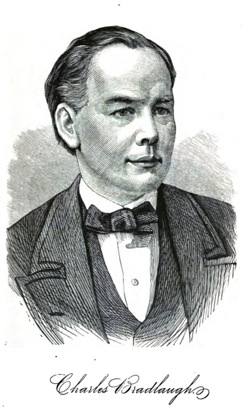
The leaders of the Reform League demonstrations had learned from the 1848 intimidation of the Chartists. Charles Bradlaugh was an East Londoner who had been beaten by police at age 15, while leading an East London sympathy demonstration on the day the Chartists surrendered to Wellington. Bradlaugh was subsequently posted to County Cork with the British Army, where participating in the eviction of starving Irish peasants helped to radicalize him, and where he learned cavalry battle techniques and tactics. Bradlaugh insisted on public protests, against the wishes of many of his fellow Reform League leaders, and personally led them with the military discipline he had learned in Ireland.

200,000 Londoners marched on Hyde Park in July 1866. Home Secretary Spencer Walpole had outlawed the protest a few days earlier, and threatened military action. Bradlaugh and his radical allies in the Reform League leadership declared the government’s position unconstitutional, and announced they would challenge Walpole’s illegal attempt to bar peaceful, free assembly. Of course, in order to be legal, Bradlaugh realized the protest would have to be peaceful. And, aside from the famous destruction of some railings around the “Marble Arch” gate, which marchers led by a carriage of Reform League executives were prevented from entering by a troop of 1,600 police and soldiers, the demonstration was disciplined and nonviolent. Bradlaugh wasn’t at the railings, he was leading another column of protestors across Knightsbridge toward Hyde Park at the time.

To make a long story short, Spencer Walpole resigned in disgrace and the Reform League’s demonstrations established the right of Londoners to march, occupy public parks and squares, and demonstrate for their political rights. In 1868, the Reform Act passed, extending voting rights to working-class people for the first time in British history. And yet, twenty years later, Bloody Sunday. What had changed?

In 1887, Charles Bradlaugh was not at the head of the demonstration. He was exhausted and ill, following a six-year battle to take the seat in Parliament he’d been elected to in 1880. And he had doubts about the programs proposed by the Social Democratic Federation, which was sponsoring the protest. Bradlaugh advised readers of his National Reformer to stay away, and warned SDF and Fabian Society leaders to be cautious and consider the security of their people. Believing the precedent set by the Reform League had established their rights once and for all, Annie Besant, George Bernard Shaw, and the other leaders of the demonstration defied the government and marched. The results were disastrous.

Men, women, and children marchers were beaten by London police. Over two hundred people were hospitalized. Three were killed. Infantry and cavalry troops were on hand, with fixed bayonets; but luckily were not called into action. Several of the march’s leaders were arrested and held behind bars for six weeks.

It’s difficult to pinpoint all the factors that had changed, between 1866 and 1887. There was a new government, with new people in key positions—although in both cases, the Tories were in power. Chicago's Haymarket riot of 1886 was fresh in the minds of both the protestors and the government. The radicals who had been united behind the Reform League had split into factions. Socialists who seemed to be gaining ground in London political circles offered utopian ideals but had little connection with actual working people (the Labour Party was established in 1893, partly in response to these issues). But it’s possible that the key difference was the 1887 leaders’ belief that their right to protest, established 20 years earlier, was inviolable.

The lesson of Bloody Sunday, it seems to me, is that we can’t take our rights for granted. If we are not prepared to defend them, they can be taken from us. Like Charles Bradlaugh and his fellow reformers, we have to be resolute, disciplined, and nonviolent—but prepared to defend ourselves. It’s not insignificant that when Bradlaugh died four years after Bloody Sunday, one of the mourners at his simple secular funeral was twenty-one year old Mohandas Gandhi.

Half-Breeds, Stalwarts, and Contingency

Heather Cox Richardson

A year or so ago, a graduate student studying for her comprehensive exams asked me if I could explain the difference between Stalwart and Half-Breed Republicans in the nineteenth century. I could, I said, so long as she understood that no one cared.

I went on to explain that the difference between Stalwarts and Half-Breeds crystallized in the Republican national convention in 1880. In that contest, Stalwarts, led by Roscoe Conkling and Don Cameron, wanted to secure the nomination for former president U. S. Grant. Half-Breeds backed James G. Blaine.

What was at stake in the nomination was really nothing other than a personal feud. Conkling and Blaine had hated each other since the war years. Conkling had become Grant’s right-hand man during his presidency, and he hoped to become the crucial figure in a renewed Grant government, handing out patronage to his supporters in New York. Blaine had a different set of friends, and they pushed his nomination in the hope that he would cut out the Conkling men.

The nomination process did not proceed as either camp hoped. A significant body of delegates refused to support either Grant or Blaine. They threw their votes to a dark horse, James Garfield of Ohio. The Blaine delegates, willing to vote for anyone but Grant, followed. Garfield won the 1880 nomination, and the 1880 election.

I told my friend that the distinction between Stalwarts and Half-Breeds didn’t matter because there was little daylight between the actual policy positions of Conkling and Blaine. The ascendancy of either would not have changed the course of the Republican Party, or the legislation it supported. For the purposes of the country they were interchangeable, and so, for that matter, was Garfield. The difference between Stalwarts and Half-Breeds was rather like the difference today between John Boehner and Eric Cantor: a difference in style, to be sure, but not such a great difference that one can imagine history graduate students in 2130 being asked to explain its significance.

Today, as I wrote about this fight, I rethought that flippant dismissal.

In order to quiet the angry Stalwarts, the Republican convention put Stalwart Chester Arthur into the vice presidency. But then, to calm the Half-Breeds, President Garfield named James G. Blaine himself to the position of Secretary of State in the new administration. This was the most powerful position in the Cabinet, and Stalwarts—led, as ever, by the insatiable Roscoe Conkling—cried foul.

When Garfield offered the fabulously lucrative position of collector of the port of New York to an appointee without consulting Conkling, the fat was in the fire. Conkling, a famously touchy character, was undoubtedly personally affronted. But he claimed to oppose the appointment on the grounds that the Senate’s power to advise and consent gave Senators the power of appointment. Garfield was usurping power, he insisted; senators had ultimate say over who received government appointments in their home states. What was really at stake, though, was whether or not Conkling would control New York.

To force the issue into the open, Conkling resigned his position in the Senate. New York’s other senator, Thomas Platt, joined him (thereby earning the memorable nickname “Me Too” Platt). They were confident the New York legislature would reelect them, thus slamming Garfield and returning the Stalwarts to the top position in the government. They were wrong. New Yorkers had had enough of Conkling’s dictates and were not willing to endorse the idea that senators should hold sway over the president’s appointments. The legislature turned to entirely new senators.

Traditional historians who even tried to find any significance in this teapot tempest blamed the fight between Conkling and Blaine for the assassination of President Garfield two months later. In July, Charles Guiteau shot President Garfield in an apparent attempt to put Stalwarts in power after all. From this the nation got civil service reform, but, as I told my scholarly friend, no real change in governmental policies.

Here is where histories generally drop the Stalwarts and Half-Breeds.

But I came to realize today that there was, in fact, a terrifically significant event to come out of this clash: Roscoe Conkling was out of a job.

With his political career suddenly gone, Conkling had to find a way to rebuild his fortunes. He had always been a brilliant orator, and he turned naturally to the law. The first client through his door was Jay Gould, the railroad magnate. Conkling used his great popularity and fame as a legislator to become one of the nation’s premier litigators for big business. It was in that capacity that he argued the case of San Mateo County v. Southern Pacific Railroad in December 1882. In this case, Conkling argued that a county tax on the railroad violated the due process clause of the Fourteenth Amendment. He insisted, based on his position as a congressman who had participated in the framing of that amendment, that when it adopted the Fourteenth Amendment, Congress had intended for it to protect corporations as well as individual persons. The court did not explicitly comment on Conkling’s really quite outrageous claim in 1882, but in 1886, it announced that Conkling’s doctrine was so definitive that it would not hear arguments to the contrary. The principle that corporations were protected by the Fourteenth Amendment limited government regulation of business well into the twentieth century.

And therein lies the great historiographical revelation of my current project. I have always seen political history as the story of competing ideas, but again and again I find small personal quirks changing the course of history. If only Thurlow Weed had not wanted to protect William Henry Seward we would not have gotten President Andrew Johnson; if only Charles Sumner hadn’t been so snobbish the Grant presidency would have succeeded.

And if only Stalwarts and Half-Breeds had been on speaking terms, corporations might never have been protected by the Fourteenth Amendment.