Showing posts with label Museums. Show all posts

Paean to the Museum of the Fur Trade Quarterly

Heather Cox Richardson

One of my favorite publications—historical or otherwise—is the quarterly magazine of Chadron, Nebraska’s Museum of the Fur Trade. A yearly membership at the museum is $15, and it’s worth every penny, even if, like me, you live two thousand miles away from Chadron, Nebraska. It’s worth it because you get this nifty little magazine.

Nicotiana rustica
The journal is sixteen pages of totally cool information about the artifacts of the fur trade and daily life on the Plains before the twentieth century. It’s always stuff you had never even thought to wonder about. The Fall 2011 issue, for example, has an article by James Hanson on the use of “Circassian Tobacco” in nineteenth-century Russian America. This was apparently an important trade good, exceedingly popular with the Alaskan natives. Turns out it was the same form of tobacco originally cultivated in eastern America. That species, Nicotiana rustica, had been replaced in Virginia by 1620 by a milder South American species, but when eastern Americans abandoned it, Nicotiana rustica traveled to Asia and Europe where its biting flavor remained popular. The article follows Nicotiana rustica through Ukraine and back to Russian America. Five pages of text and photographs and you have learned something you never even thought to wonder about.

But the big news for me—and for anyone who teaches the history of the American West—in the Fall 2011 issue was a wonderful article by W. Raymond Wood exploring the enormous importance of cats on the frontier.

Apparently, the brown rat, also known as the Norway rat, came to the American West with Euroamericans and quickly infested local Indian communities and the frontier forts in their vicinities. In the 1830s, a man at one fort recorded the numbers of rats he trapped: in February 1836 alone he got 89. Mind you, these are just the ones he caught.

In the West, rats and the native field mice decimated stored food. One military leader complained that every day the rats ate five bushels of his fort’s corn supply. Even worse, perhaps, their tunnels undermined any man-made structure, from Mandan earth lodges to military forts.

A detail from George Caleb Bingham's painting
Such a destructive rodent infestation put a premium on cats. Quite literally, for a settler a cat could make the difference between a successful career on the frontier and bankruptcy, because only a cat could protect expensive food supplies. Cats became among the most valued of frontier possessions, as Laura Ingalls Wilder suggested when she recounted the aftermath of a rodent chewing off her father’s hair while he slept. She entitled a chapter of Little Town on the Prairie “The Necessary Cat,” and told how her father paid a small fortune for a newborn kitten to beat back the advancing mice. Thanks to Wood’s article, that passage from Wilder fits into a larger squirming, squeaking story. Now, too, George Caleb Bingham’s famous painting “Fur Traders Descending the Missouri” (1845) makes a great deal more sense . . . and it’s clear that the animal hunched on the bow is a cat, not, as some would have it, a fox.

This magazine is a little gem. I look forward to every issue.
Lessons From the Archives

Philip White


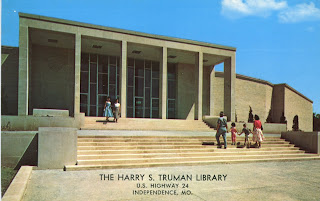
This past weekend, I spent a pleasant morning at the research room of the Harry S. Truman Library & Museum in Independence, Missouri. It was my third trip there, and the first for a new Book Project That Cannot Be Named. In the past couple of years, my research has also taken me to the National Churchill Museum in Fulton, Missouri (the town where Winston Churchill delivered his "Iron Curtain" speech in 1946), University of Missouri-Kansas City and, more exotically, the Churchill Archives Centre (yes folks, that’s the British spelling) in Cambridge, England.

I am far from a master researcher, but I have picked up some tips from others who’ve been on the road, and through sheer, exasperating trial and error. Here are a few of these:

1) Take a Digital Camera, Extra Battery, Tripod and Clicker Thingy

The days of me taking my crappy old Canon point-and-shoot camera, with its tiny lens that can’t take in a full legal size document even if I was suspended from the ceiling (think Tom Cruise in Mission Impossible) and manually adjusting the angle each time, are over. I’m going to invest in a "superzoom" model, tripod, extra battery and the clicker thingy that lets you take pics without touching the camera. I saw two guys using this technique recently and one told me that creating such a setup was the best advice a professor ever gave him. Bravo, prof! By using it, the guy avoided using the photocopier (you’re only allowed to photograph the first page of original, multi-page docs) and took each snap quickly, almost like he was some kind of hyper-efficient researching humanoid. Me? My POS Canon ran out of battery half way through, and I had to resort to reproducing multi-page letters through shorthand. Aaarrghhh! Never again.

2) Form a Relationship with an Archivist

I’m not suggesting a romantic dalliance, but rather a courteous professional exchange between the seeker of knowledge and the one who knows where it resides. If the archivist is on your side they can suggest boxes and folders (and sometimes even specific documents), pull these for you in advance so you can get going as soon as you arrive, and follow up with further suggestions later. Just don’t treat them like Google or act imperious, and do send follow up thank you notes and e-mails. Archivists are there to help respectful researchers, but they’re not part of a servant class. 

3) Avoid Rabbit Holes

This is a case of "do what I say, not what I do." Even going into an archive room with a tightly focused, organized wish list is no guarantee of a successful session. The trouble – or, at least, my trouble, is that every document, memo and letter is interesting in its own way. It’s all too easy to get sidetracked and look up at the clock to find you’ve burned an hour going down a fascinating yet completely useless path that in no way advances your project. Focus, I say, focus!

4) Process Your Materials ASAP

When you’ve worn your brain to a frazzle with several hours or, if you have a forgiving spouse/partner/whatever, days of intensely focused research, it’s tempting to throw your hard won materials in a box and forget about them for a few weeks. The problem with this is that even if you’ve taken solid notes and prioritized your harvest, you will forget certain intangibles and details that you’d recall if you knuckled down for a while and scanned and/or filed what you’ve found in the appropriate manner. Following the first two steps of an efficient research and writing process – capture and organize – in quick succession makes it easier to get to the third step – retrieve – in the best possible way. The same goes for online research and the use of tools such as Evernote, which I find most useful if I create folders and use tags/keywords.

5) Keep Your Research Away From Small Children

Let’s just say that you’ll only let your five-year-old and two-year-old get into your archival materials once. Hopefully they won’t tear, eat or throw away what they find. Research commandment # 5: Thou shalt lock thy office door at all times.

Native American History and Culture Roundup

"Native American tribe worries pipeline will disturb graves," Washington Post, March 26, 2012

OKLAHOMA CITY (AP) — As President Barack Obama pushes to fast-track an oil pipeline from Oklahoma south to the Gulf Coast, an American Indian tribe that calls the oil hub home worries the route may disrupt sacred sites holding the unmarked graves of their ancestors.

Sac and Fox Nation Chief George Thurman plans to voice his concerns this week in Washington. He said he fears workers placing the 485-mile Keystone XL pipeline that would run from Cushing to refineries on Texas' Gulf Coast could disturb holy ground without consideration of the tribe. He and another tribe member say the pipeline's route travels through areas where unmarked graves are likely buried>>>

"Bowers Museum Opens ‘Sacred Gold’ Exhibit," Antiques and Arts Online, March 27, 2012

The Bowers Museum's newest exhibit, "Sacred Gold: Pre-Hispanic Art of Colombia," opens to the public March 31 and remains on view through July 1.

This rich exhibit traces the legacy of gold in pre-Hispanic Colombia in more than 200 exceptional objects, supplemented by text, map, chronology and photographs that put in context the pieces that make up this collection from the Museo del Oro and the Banco de Republica, Bogotá, Colombia.>>>

Ray Mark Rinaldi,"Anschutz Collection of Western art to open to the public in 2012," Denver Post, March 27, 2012

The Anschutz Collection, one of the country's most-respected collections of Western paintings, will open its doors to the public full-time later this year, adding another attraction to Denver's growing portfolio of small, quirky art museums. . . .

The Anschutz Collection is built around the biggest names in Western art, starting in the early part of the 19th century, and includes works by such standard bearers as Frederic Remington, George Catlin and Charles Marion Russell.>>>

Sarah Yager, "Making New Promises in Indian Country," Atlantic Monthly, March 23, 2012

On December 2, President Obama delivered the keynote address at the third annual White House Tribal Nations Conference. His adoption into the Crow Tribe on the 2008 campaign trail had been a historic step in the relationship between the federal and tribal governments, and that warmth still lingered in the applause that greeted his appearance onstage.

That morning, Obama announced, in his administration's latest effort to reduce obstacles facing Indian communities, he had signed an executive order to lower the dropout rate and start closing the achievement gap for Native American and Alaska Native students. "Standing in this room, with leaders of all ages," he said, surveying the densely packed auditorium at the Department of Interior headquarters, "it's impossible not to be optimistic about the future of Indian Country.">>>

Stephanie Taylor and Dana Beyerle, "Warning issued to Alabama Historical Commission," Tuscaloosa News, March 21, 2012

MONTGOMERY | The sponsor of a bill that would change the underwater artifacts law warned members of the Alabama Historical Commission after a commission employee sent an email opposing the bill.

At stake is what lies at the bottom of Alabama's waterways and who it belongs to — the state or to the private divers who uncover artifacts.>>>

Exhibits, Shows Roundup

.
A Day in Pompeii, Nichols Gallery, Boston Museum of Science, through Feb 12, 2012

Get a glimpse of daily life in Pompeii, one of Imperial Rome's most cosmopolitan cities. Hundreds of artifacts —
including body casts of the volcano's victims — bring to light the vibrancy of this bustling resort town, but the darkening skies ahead and violent sounds of Vesuvius spewing ash and debris signal imminent danger.>>>

Passages, Oklahoma City Museum Of Art, through Oct 16, 2011

Passages is a 14,000-square-foot interactive, multimedia exhibition for all ages. It features some of the most exquisite and rare biblical manuscripts, printed Bibles, and historical items in the world. These cultural treasures include a Dead Sea Scroll text, ancient biblical papyri, beautifully illuminated manuscripts, early printed materials, including a portion of the Gutenberg Bible, and multiple first editions of the English Bible through the King James Version.>>>

Cleopatra: The Search for the Last Queen of Egypt, Milwaukee Public Museum, Opens October 14

Cleopatra: The Search for the Last Queen of Egypt features nearly 150 artifacts from Cleopatra’s time and helps visitors experience the present-day search for the elusive queen, which extends from the sands of Egypt to the depths of the Bay of Aboukir near Alexandria.>>>

1968 Exhibit, Minnesota History Center, Opens October 14
The Vietnam War, protests and assassinations were on the news. Peace signs, love-ins and psychedelic rock were on the scene. From the darkest hours to the incredible highs, the year 1968 comes alive in this extraordinary new exhibit.>>>

Celebrate TV, National Media Museum, Bradford, UK

This half term we're celebrating television. Journey back in time to see how TV began, what it looked like, and watch a selection of programmes we all loved. Fast forward to the future and see crystal clear images with our Super Hi-Vision TV.>>>

Art of the Americas

Randall Stephens

The Boston MFA opens its new Art of the Americas Wing this week. (Watch a video on the space.) The extension represents the most significant public art project in America today. With a price tag of over $500 million, it will display a portion of the museum's massive South and North American collections. It ranges from the pre-Columbia to the 20th century. Some critics have complained that the wing will lack some of the MFA's best post-war pieces. That seems like a minor issue though.

WBUR reports:

And while this is a big cultural moment for Boston, the rest of the world is paying attention, too.

“Museums all over the country have expanded over the last decades and this is the MFA’s entry in the ‘space race,’ ” said arts writer Judith Dobrzynski, who has reported on the MFA’s expansion for the Wall Street Journal and the New York Times.


“And because it’s a beautiful space, and because it’s chock-a-block with art from the Americas, which is different. This is very important and I think it probably going to raise the profile and the stature of the MFA.”


Dobrzynski is impressed by the MFA’s fundraising effort, and the $504 million represents a feat for Boston. Other cities — bigger cities, she said — including Los Angeles and Chicago, have not been as successful in raising money for their own museum campaigns. Or as strategic. The MFA’s new construction cost about $340 million — much of the rest sits in an endowment.
“You know the MFA was very ambitious here,” she said, laughing, “but at the same time a bit conservative by going for a building fund and an endowment fund at the same time. I shouldn’t say conservative. I should say responsible here.”>>>

As far as North American artists, highlights will likely include:

Washington Allston
John Singer Sargent
Gilbert Stuart
Frederic Edwin Church
Martin Johnson Heade
Fitz Henry Lane
Thomas Eakins

John Singleton Copley
Childe Hassam
Frank Benson
Edmund Tarbell
Winslow Homer
Mary Cassatt
Ellen Day Hale
Gretchen Rogers
Lilian Westcott Hale
Georgia O’Keeffe
Arthur Dove

National Park Service, the New American Revolution Center, and Bruce Cole

Randall Stephens

Wilfred McClay has alerted us to a new National Park Service initiative under Bruce Cole's leadership (more below). The Historical Society is proud to announce the appointment of Cole to its Board of Governors. Cole, who served as chairman of the National Endowment for the Humanities from 2001 to 2008, presently serves as the president and chief executive officer of The American Revolution Center. During his tenure at the NEH, he launched a number of programs to improve the teaching of history and the humanities, including We the People and Picturing America. Cole is distinguished professor emeritus of comparative literature at Indiana University.

The National Park Service has issued the following news release just in time for the fourth!

AMERICAN REVOLUTION CENTER WORKS WITH NATIONAL PARK SERVICE TO RELOCATE TO HISTORIC PHILADELPHIA

PHILADELPHIA – July 1, 2009 – Secretary of the Interior Ken Salazar and the American Revolution Center (ARC) today announced that the National Park Service (NPS) has reached a historic agreement to develop a national museum dedicated to the American Revolution. The National Park Service signed a land-exchange agreement with ARC to establish this museum at Independence National Historical Park.

“This is wonderful news for both the National Park Service and the American Revolution Center,” said Secretary of the Interior Ken Salazar. “Visitors to our Nation’s birthplace will now be able to enjoy a world-class museum dedicated to the story of the American Revolution within the shadow of Independence Hall.”


The new American Revolution Center will be located at 3rd and Chestnut Streets in downtown Philadelphia, within the 55-acre park. In exchange for the site, the National Park Service will receive a 78-acre parcel of private land owned by the Center within the boundary of Valley Forge National Historical Park.


“The American Revolution Center is a critical project for our Nation, and I am extremely pleased with this latest development,” said H.F. “Gerry” Lenfest, Chairman of the Board of Directors of ARC. "We have expended extraordinary time and resources to locate the Center in Valley Forge, and I believe that our vision there could have been achieved. We now believe that it is in our best interest to begin a new chapter for ARC, and I cannot think of a more appropriate setting than at Independence National Historical Park in Philadelphia.”


At Independence National Historical Park, the National Park Service manages several sites associated with the American Revolution, including the Liberty Bell Center, the National Constitution Center and Independence Hall. ARC will work together with these and other institutions around the country and the world to further the understanding of the American Revolution.


The American Revolution Center will be the first national museum to commemorate the entire story of the American Revolution. The museum will display its distinguished collection of objects, artifacts and manuscripts from the American Revolution era and will offer educational programming, lectures, symposia, and interactive learning for teachers, students, and the general public.


“I applaud the mission of The American Revolution Center and fully support the decision to relocate,” said Governor Edward G. Rendell. “I am thrilled that Gerry Lenfest, Dr. Bruce Cole and ARC’s Board have selected Philadelphia, Pennsylvania for the new home of this national museum and I believe it will be a terrific complement to Independence National Historical Park area.”


“The National Park Service has long supported the concept of The American Revolution
Center,” said Dan Wenk, acting NPS Director. “What better place than Philadelphia, the ‘cradle of liberty’ for a museum about the American Revolution.”

“This is a promising time for The American Revolution Center,” said Dr. Bruce Cole, ARC’s new president and chief executive officer. “We are committed to the creation of a living memorial to the American Revolution. We look forward to developing a museum to commemorate the legacy of the American Revolution in our Nation’s birthplace.”

Representatives from The American Revolution Center and the National Park Service will work jointly on appraisals, title searches, surveys, and other matters to move the land exchange process forward as quickly as possible.


About The American Revolution Center:

The American Revolution Center (ARC) will establish the first national museum to commemorate the entire story of the American Revolution. The Museum will display its distinguished collection of objects, artifacts and manuscripts from the American Revolution era and will offer programming, lectures, symposia, and interactive learning for teachers, students, and the general public.

The History of Memorial Day and the National World War One Museum, Kansas City

Randall Stephens

As Americans cram their faces with hot dogs and swill cheap beer, many will also reflect on the heroic efforts of countless men and women who have served their country over the years. Parades, concerts, and ceremonies across Boston will turn our attention to those who fought and died for their country. The National memorial Day Concert in Washington, D.C., will draw a massive crowd of observers in the capitol and TV viewers.

According to the Library of Congress it all began in 1868 when:

Commander in Chief John A. Logan of the Grand Army of the Republic issued General Order Number 11 designating May 30 as a memorial day "for the purpose of strewing with flowers or otherwise decorating the graves of comrades who died in defense of their country during the late rebellion, and whose bodies now lie in almost every city, village, and hamlet churchyard in the land."

The first national celebration of the holiday took place
May 30, 1868, at Arlington National Cemetery, where both Confederate and Union soldiers were buried. Originally known as Decoration Day, at the turn of the century it was designated as Memorial Day. In many American towns, the day is celebrated with a parade.

One of my favorite history museums in the country, the National World War One Museum in Kansas City, will be open on Monday. A visit to it would make a perfect outing for the holiday. Open since 2006,

and designated by Congress as the nation’s official World War I Museum, the new state-of-the-art complex uses an incredible collection and highly-interactive technology to bring this global history to life, and to foster timely discussions of ethics, values, decision making and conflict resolution.

See also, Jeffrey S. Reznick, "Memorial Day, the Great War, and America’s Last Surviving World War I Veteran," History News Network, May 26, 2008; and Adam Cohen, "What the History of Memorial Day Teaches About Honoring the War Dead," New York Times, May 28, 2007.