Showing posts with label Civil War. Show all posts

The Kansas Gold Rush

Dan Allosso

Map of Kansas and Nebraska Territories, 1854
Kansas! For most East and West-coasters, it’s one of those flyover states.  Even for Midwesterners like me, it’s most frequently remembered as a long flat stretch of driving, on the way to someplace else.  With apologies to Kansans, for many other Americans Kansas is either a band from the 70s (“Point of Know Return,” remember? “Dust in the Wind”?), the gray place Dorothy lived before being swept into Technicolor Oz, or the scene of an early, bloody civil war that helped push the nation over the brink between the 1854 Kansas-Nebraska Act and statehood in 1861.

So I was surprised today, when I discovered in a January, 1859 Ranney Letter that “more than two hundred persons in this county” in southern Michigan were planning to go to Kansas in search of gold the following summer.  It hadn’t occurred to me–maybe because I’m familiar with the flat, drive-through Kansas you can see on current maps–that the Nebraska and Kansas Territories extended to the Rocky Mountains and contained quite a bit of what is now Colorado and Wyoming, as well as a big section of the northern foothills (including the Black Hills) that in 1861 would become the Dakota Territory.

In other words, Gold Country.  Between 1854 and 1861, Kansas and Nebraska were part of The West in a way they no longer are.  Fort Laramie, the site of the 1868 Treaty between the U.S. and the Lakota, Dakota, and Arapaho nations, was originally in the Nebraska Territory.  Pikes Peak, now 100 miles south of Denver and 30 miles west of Colorado Springs, was in Kansas.

“How did I miss this?” I thought, with some alarm.  But when I flipped through the pages of books from the “Western” part of my library, such as Patricia Nelson Limerick's The Legacy of Conquest, I find a Kansas and Nebraska embroiled in Stephen Douglas’s expansionism.  Similarly, on my “Impending Crisis” shelf, David Potter’s book of that name devotes many pages to the 1854 Act and to the Lecompton Constitution.  But Lecompton is in the northeastern corner of present-day Kansas, and Stephen Douglas was from Illinois.  The free-state revolutionaries of Topeka and the Bleeding Kansas border war with Missouri were likewise situated on the eastern borders of the present state.

Published by Oliver Ditson, Boston, 1856
On the pages of the Kansas Historical Society’s website, I learned that the people of Kansas were apparently divided in 1859 over whether their state should be a “Big Kansas” including the western gold region, or a “Little Kansas” without it.  Kansas entered the Union in January, 1861, during the (extremely) lame-duck session between Abraham Lincoln’s election and his inauguration, with a population of 107,206.  William Seward had introduced a bill in the Senate in February, 1860, to admit “Little Kansas” under its free-state Wyandotte Constitution, which fixed the border at 102 degrees west longitude, excluding the Rockies.  The bill was defeated by Democrats who opposed Kansas as a free state; but they also objected to the “Little Kansas” borders, saying the Wyandotte convention had exceeded its authority in changing the territorial boundaries.  Were they afraid that the country around Pikes Peak would soon have sufficient population (the target was 93,000) to become yet another free state?

It just goes to show, I guess, how much complex and interesting detail lies just under the surface of the broad brushstrokes we use to integrate local and regional histories into American History.  The Kansas State Historical Society’s site includes a reprint of a 1967 article from their journal written by Calvin A. Gower of St. Cloud (MN) State University, titled “‘Big Kansas’ or ‘Little Kansas,’” which describes the Pikes Peak gold rush and the controversy over Kansas’ borders.  We’re lucky to have more and more of these resources online at our fingertips.  Does their availability obligate us to rethink the relationship between the broad strokes and the details–at least for the regions where we live, write, and teach?

The Last Confederate General to Lay Down His Arms

Heather Cox Richardson

It is a pet peeve of mine that most people think the Civil War ended at Appomattox Court House on April 9, 1865, when General Robert E. Lee surrendered to General U. S. Grant.

It didn’t.

Brigadier General Stand Waite
General Lee surrendered only his own Army of Northern Virginia that day. There were still more than a hundred thousand Confederate soldiers in the field. True, everyone knew that Lee’s surrender marked the beginning of the end. But the last major Confederate army did not quit until May 26, when General Kirby Smith surrendered his Army of the Trans-Mississippi to Major General Edward Canby in Louisiana.

But here’s another little-known fact related to the end of the war that seems to me should be as widely known as the events at Appomattox: The last Confederate general in the field to surrender was Brigadier General Stand Watie, who did not lay down his weapons until June 23, 1865.

Why is this significant? Because Stand Watie was a member of the Cherokee Nation. He commanded the First Indian Brigade of the Confederate Army of the Trans-Mississippi.

It’s a stretch to say that Indians were at the heart of the American Civil War, but it’s not at all a stretch to say that the West was. Eastern Americans from the North and the South fought to control the economic system the nation would impose on the West. Easterners had lived with slavery in their midst since the very beginnings of European settlement on the Atlantic coast; it was only when the slave system threatened to spread across the lands of the old Louisiana Purchase that the inhabitants of the two eastern regions came to blows.

Indian Frontier to 1890 (from Bedford St. Martin's). Click to enlarge.
The West over which the North and South fought was not, of course, uninhabited. The people who had lived there for generations had a profound interest in the national events of 1861-1865, and participated accordingly. Once the easterners had stopped smashing at each other, the Indians continued to be active participants in American events whether they wanted to be or not. Many Plains Indian bands went to war with the U.S. government in the post-Civil War years, but even those that didn’t found themselves tangled in eastern concerns. The question of who would be welcome as a citizen in the rebuilding nation was hotly contested, and in that contest Indians became important players (the Fourteenth Amendment, anyone?).

When Stand Watie took for himself the status of being the last Confederate general to surrender, he claimed the historical significance of the West and of Indians in the American Civil War.

That, it seems to me, is worth noting in the same breath that we use to talk about what happened at Appomattox.

History and Memory of American Slavery Roundup

Eastman Johnson, "A Ride for Liberty: The Fugitive," 1862
.
"Piecing Together Stories Of Families 'Lost In Slavery,'" NPR, July 16, 2012

For decades, slavery tore apart African-American families. Children were sold off from their mothers, and husbands were taken from their wives. Many desperately tried to keep track of each other, even running away to find loved ones. After the Civil War and emancipation, these efforts intensified. Freed slaves posted ads in newspapers and wrote letters — seeking any clue to a family member's whereabouts.

In Help Me to Find My People, author Heather Andrea Williams examines the emotional toll of separation during slavery and of the arduous journey many slaves took to reunite their families.
>>>

Christian Boone, "Controversial slavery mural gets new home," Atlanta Journal-Constitution, July 16, 2012

A controversial mural depicting slavery that until recently greeted visitors to the Georgia Department of Agriculture will be back on display starting in August.

The Georgia Museum of Art, located on the University of Georgia campus, has rescued the painting — part of a series of murals produced by Atlanta-based artist George Beattie in 1956 chronicling the state's agricultural history — from a state storage facility and will debut the collection Aug.
1.>>>

Amy Wimmer Schwarb, "U.S. conference highlights slaves' southern path to freedom," Reuters, June 20, 2012

With the North Star as the guiding light for runaway slaves and Canada as the Promised Land, the underground railroad that U.S. schoolchildren read about in textbooks points to freedom in just one direction - the north.

But scholars gathering this week for the National Underground Railroad Conference will head south to St. Augustine, Florida, home to the former capital of Spanish Florida and a flight-to-freedom story rooted in the 17th century that is unknown to most Americans.
>>>

Ira Chernus, "Slavery and 'Big Government': The Emancipation Proclamation’s Lessons 150 Years Later," History News Network, July 12, 2012

One hundred fifty years ago today, on July 13, 1862, Abraham Lincoln went out for a carriage ride with his Secretary of State, William Seward, and his Secretary of the Navy, Gideon Welles. Lincoln told them (as Welles recalled it) that he had “about come to the conclusion that it was a military necessity absolutely essential for the salvation of the Union, that we must free the slaves.” That was the seed of conception for the Emancipation Proclamation, which came to birth five and half months later, giving Lincoln his greatest legacy: “He freed the slaves.” It’s a story everyone knows.

But it’s not quite accurate. Only the slaves in the Confederate states were emancipated. Citizens of the Union could still own slaves.
>>>

Dawn Turner Trice, "First lady's ancestry an American story," Chicago Tribune, June 18, 2012

Many Americans are fascinated by the family history of Michelle Obama, a descendant of slaves who is the nation's first African-American first lady.

You've learned a lot about her ancestry in this newspaper. Now, add to that a new book due out Tuesday, "American Tapestry: The Story of the Black, White, and Multiracial Ancestors of Michelle Obama."
>>>

The Plot That Would Have Changed America

Steven Cromack

Last April was the 150th anniversary of the start of the American Civil War. High school social studies teachers of the subject, and many American textbooks for that matter, tend to outline it as a conflict between North and South. In reality, the Civil War was a Western war, and one that redefined an entire nation: North, South, and most importantly, West.

Left out of the history books, and almost completely faded from historical memory, is the curious character of Asbury Harpending (who forgets a name like that?), and a plot by Southern elites that, if it was successful, would have delivered California to the Confederacy in a single move. Such an event would not only have ensured a Confederate victory, but would have fundamentally altered the course of American history.

By the 1860s, San Francisco was the heart of California. In only a decade’s time, San Francisco was the largest city on the West Coast. One historian noted, “What had taken New York 190 years to accomplish, or Philadelphia 120 and Boston 200, San Francisco had achieved only in 8.”[1] The city held three-fourths of the state’s resources and one-fourth of its population. Its manufactures generated significant amounts of goods and its businesses, farms, industries, and merchants, employed the most workers.[2] Finally, making San Francisco vital to California and the Union was the amount of gold leaving the San Francisco Bay. Each ship that left the Bay for the east coast of the United States, carried anywhere from $1 million to $3 million worth in gold. Ulysses S. Grant said, “I do not know what we could do in this great national emergency were it not for the gold sent from California.”[3]

Asbury Harpending arrived in California with nothing more than a revolver and a 5-dollar note. His memoirs, which he wrote at the end of his life, told a tale of a secret society formed San Francisco in 1861. One day, thirty men, all Southern sympathizers, gathered in the home of an unknown wealthy San Franciscan. After swearing an oath of secrecy, the unnamed leader, whom they all called “General,” gave them their orders. Each man was to assemble a band of one-hundred men and “organize an army of Southern sympathizers, sufficient in number to beat down any armed resistance.”[4] Then, together, they would seize the arsenal at Benicia, which housed all of California’s arms and munitions, and Alcatraz Island—the largest military fort west of the Mississippi.

At the start of the war, the Commander of the Pacific was General Albert Sydney Johnston. Johnson was born in Kentucky, a hero of the Texas revolution, and was in a position to hand over the entire Western coast to the Confederacy. Harpending later wrote, “This was the man who had the fate of California absolutely in his hands. No one doubted the drift of his inclinations (35).” Johnson, however, had heard rumors of a plot. According to the Congressional Record, for safekeeping, he ordered the 10,000 muskets, 150,000 rounds of ammunition, and percussion caps located at Benicia Arsenal moved to Fort Alcatraz.

If this plot had been successful, it would have meant a complete capitulation from the people of San Francisco and would have fundamentally altered the course of the war. Putting California in play during the Civil War would have altered Union strategy. Union generals would need to divert troops to California, a lengthy journey by land, and an even longer one by sea, taking soldiers away from the South. In that time, the secessionists could have consolidated their numbers, prepared for their defense, and sat and waited for the Union army. It also would have torn apart California politics, as the Democrats and Copperheads had an active presence in San Francisco and other California cities. With military might behind them, there could have been the possibility for another situation similar to bleeding Kansas. With Alcatraz and Fort Point in the hands of secessionists, nothing remaining could have protected the West Coast. In addition, the gold that exited the Bay would not have made its way to the Northern lines, but down through Arizona, New Mexico, and into Texas and the Confederacy.

Such an event would have altered the course of American history because the Confederacy might have won the war. With the plot dead, the Committee of Thirty disbanded, each going their separate way. “And the rest,” as the cliché goes, “is history.” For other stories from the life of Asbury Harpending, his memoirs, The Great Diamond Hoax and Other Stirring Incidents in the Life of Asbury Harpending, is available on Google Books.

______________

[1] Rodger Lotchin, San Francisco, 1846-1856 (New York: Oxford University Press, 1974), 30.

[2] T.F. Cronise, The Natural Wealth of California (San Francisco: H.H. Bancroft, 1868), 80. For extensive descriptions of virtually every manufacture, see Chapter XI, page 596.

[3]
Qtd. in Leonard Richards, The California Gold Rush and the Coming of the Civil War (New York: Alfred Knopf, 2007), 230.

[4]
Asbury Harpending, The Great Diamond Hoax and Other Stirring Incidents in the Life of Asbury Harpending (San Francisco: James H. Barry Co., 1913), 26-30.

The Battle of Olustee, February 20, 1864

Heather Cox Richardson

Monday was the anniversary of the Battle of Olustee, the largest Civil War battle fought in Florida. Although few people today have even heard of it, Olustee was crucial in convincing Civil War era Americans to accept black freedom.

On February 7, 1864, Federal troops landed in Jacksonville. Carving Florida off from the rest of the Confederacy had several obvious advantages. First, the Confederacy was hurting for food, especially cattle. When the Union took the Mississippi River, it cut off the Texas herds from the rest of the South. The cattle herds in Georgia, Alabama, North Carolina, and South Carolina could not fill the gap. If the Union could cut the lines for moving the Florida cattle that still fed the South in 1864, it would be closer to starving the South into submission. One general estimated in 1864 that 20,000 head of cattle and 10,000 hogs a year went from Florida to feed the Southern armies.

President Lincoln also wanted to reorganize Florida out from under the Confederacy as a free state much as he was trying to do in Louisiana. Opponents carped that he was trying to get Florida back into Congress so he could count on more electoral votes in the 1864 election, although there were obvious reasons to want Florida back on the Union side even without the president’s reelection fight looming on the horizon.

Finally, an excursion into Florida promised to attract black recruits to fight for the Union. And in 1864, new soldiers would be quite welcome to the battle-thinned Union ranks.

Brigadier General Truman Seymour, the head of the expedition, had strict orders not to move far from Jacksonville. Instead, Union troops under Colonel Guy V. Henry of the Fortieth Massachusetts mounted quick raids that destroyed supplies and reconnoitered the Confederate army. Their operations among the poor and dispirited people were successful and relatively painless: they suffered few losses.

It was perhaps the ease of the raiding to that date that made General Seymour decide on February 17 to march his 5,500 men 100 miles west to destroy the railroad bridge over the Suwanee River. Seymour did not know that Confederate officers had surmised the danger to Florida and had moved troops quickly to prevent Union troops from gaining a foothold in the interior. Five thousand Confederates under Brigadier General Joseph Finegan were encamped on the road Seymour’s men would take, near the railroad station at Olustee, about fifty miles from Jacksonville.

When the two armies came together in mid-afternoon on February 20, Seymour threw his men in without much forethought, apparently believing he was up against the same ragtag fighters Henry had been smashing for weeks. But Finegan’s men were experienced troops. They trained their cannons and held their ground. The Union lost more than 1800 men to the Confederacy’s 950. Most of the surviving Union soldiers ran from the field to hightail it down the road back to Jacksonville.[1]

The Union rout did not turn into a panic solely because the remnants of the Massachusetts 54th and the 35th U. S. Colored Troops held the Confederates back to cover the retreat. The soldiers of the Massachusetts 54th had earned their reputation for bravery in the assault at Fort Wagner, near Charleston, South Carolina the previous July. At Olustee, the black soldiers from the 54th and the 35th held their ground until past dark, enabling the white troops to get safely out of range, before they received their orders to move back toward Jacksonville.

Few people now remember Florida’s major Civil War battle, but it made a searing impression on President Lincoln. “There have been men who have proposed to me to return to slavery the black warriors of Port Hudson & Olustee to their masters to conciliate the South,” he told visitors in August 1864. “I should be damned in time & in eternity for so doing.” (AL to Alexander W. Randall and Joseph T. Mills, August 19, 1864, in Roy P. Basler, Collected Works of Abraham Lincoln, volume 7, pp. 507.)
___________

[1]
The New York Times noted that the Colonel Henry had three horses shot out from under him during the battle, but was himself unhurt. His luck would not hold. Henry continued to serve in the army until 1892. He fought in the Apache campaign before joining the Sioux Wars. He was shot in the face in the Battle of the Rosebud, losing part of his cheek and one eye. He later led the Ninth Cavalry in the events surrounding the Ghost Dance and Wounded Knee Massacre.

Civil War Soldiers and Conversation Hearts

Heather Cox Richardson

Valentine’s Day is synonymous with Sweethearts Conversation Hearts, those heart-shaped sugar candies with the messages on them: “Be Mine,” “I’m Yours,” and now, “E-mail Me.” The hearts are made in Revere, Massachusetts, at the New England Confectionery Company. Necco makes them from late February through mid-January of the following year for the Valentine’s Day market. They manufacture about 100,000 pounds a day, making more than 8 billion of the hearts every year.

Conversation hearts are the holiday version of the perennial Necco Wafers. Rumor—in the shape of an NPR story, a Boston Globe story, and hundreds of references on the internet—says that Union soldiers carried Necco wafers, which were called Hub Wafers in those days, in their haversacks. To write a lecture on the growth of industry during the Civil War, I set out to verify that little tidbit.

It was harder than you would think.

The histories on the Necco website and the Reference For Business website explain that Necco is the oldest candy company in America. In its earliest incarnation, it was founded in 1847 by an English immigrant to Boston, Oliver B. Chase, and his brother. Chase invented a device that would cut a simple candy, made of sugar, gelatin, and flavoring, into wafers. These early candies were called “Hub Wafers” (“Hub” was the nineteenth-century nickname for Boston). They were surprisingly popular, since they were cheap, durable, and lasted a very long time. This made them easy to ship and to carry, and thus, a likely thing for Civil War soldiers to take with them on their long marches.

But these histories don’t mention the Civil War. To solve my problem, I decided to try the company directly. Telephone calls to the Necco headquarters netted me only answering machines and an email to the company went unanswered.

So I turned to Civil War reenactors. Surely, in their quest for accuracy, they would know whether or not Union soldiers had carried Hub Wafers. Two hours of trolling through reenacting outfitters, newsletters, and educational websites about what Civil War soldiers carried netted me fascinating glimpses of army life (the US Army Center of Military History has a great website on haversacks and mess gear), but nothing on Hub Wafers. A telephone call to a reenactor yielded a fun chat, but no information on Hub Wafers. He had never heard of them.

Turning to primary sources on-line offered more information. In fact, Hub Wafers—or Necco Wafers, as they were sometimes known by the twentieth century, since both words were on the wrapper—seem to have become very visible and very popular in 1913-1915. Both advertising images and original wrappers are available from this era, some for purchase. The ads promise apothecary owners that the wafers will increase profits; they assure mothers that the candies are healthy and a good addition to afternoon tea. It turns out that this timing makes sense. According to the company history, Necco launched an aggressive advertising campaign in 1912; and in 1913, made much of the fact that Arctic explorer Donald MacMillan took Necco Wafers along on his journey, “using them for nutrition and as rewards to Eskimo children.”

By the 1930s, the candies had a huge following. During the Depression, they were cheap enough to be a treat, and well-loved enough that Admiral Richard Byrd took two tons of Necco Wafers on his own polar expedition. By the time of Pearl Harbor, they were the nation’s premier portable candy: the US government requisitioned the entire output of the Necco factory during WWII.

I never did find a historical source for the information that Civil War soldiers carried Hub Wafers. My guess is that some Boston boys did, as they would have carried other foods from home, but that it was hardly systematic. Instead, my search taught me that before modern techniques of refrigeration enabled people to keep chocolate from melting and spoiling, portability was such an important quality in a sweet that Necco was able to turn its wafers into the nation’s leading candy. While eclipsed now by newer products, Necco Wafers still exist, sold in a wrapper almost identical to that of 100 years ago.

Not bad for a candy that may—or may not—have been carried by Civil War soldiers.

The Conspirator Roundup

.
The Conspirator
, a 2011 film about the plot to kill president Lincoln, is now out on DVD and Blu-ray.

Peter Rainer, "The Conspirator: movie review," Christian Science Monitor, April 15, 2011

Robert Redford’s workmanlike “The Conspirator” is about Mary Surratt (Robin Wright), a Confederate sympathizer who was
executed for her complicity, which she denied, in the plot to assassinate Abraham Lincoln. Tried in a military court as a civilian along with eight other alleged conspirators, she became the first woman to be executed by the United States federal government.
>>>

Anthony Lane, "Casualties of War," New Yorker, April 18, 2011

Of the many questions posed by “The Conspirator,” and left unresolved, the most pressing are these: How much did Mary Surratt (Robin Wright) know of the plot to kill Abraham Lincoln? How could she not have known of it, given that some of it was hatched within the respectable boarding house that she ran in Washington, D.C.? If her son John (Johnny Simmons), who certainly did know of the plot, had surrendered to the authorities, rather than remaining on the run, could he have saved his mother’s skin? Why did Andrew Johnson, the new President, reject the last-minute, late-night application by Surratt’s lawyer for a retrial? And was there ever any likelihood, considering the public revulsion at the murder, that she would receive a fair trial in the first place?>>>

Jason Solomons, "The Conspirator – review," Guardian, July 2, 2011

Almost by decree, British actor Tom Wilkinson turns up in mutton chops to play an American senator in Robert Redford's starchy period piece The Conspirator. Has Tom pinched those whiskers from the Hollywood props cupboard, forcing studios to cast him in every historical movie just so they might wrench them back off him during make-up? He's clearly too quick for them. I swear Tom Conti did a similar thing and nicked the FilmFour moustache back in the 1980s. He never gave it back either – he just secretly handed it on to Alfred Molina. I hear the 'tache now lives in Malibu and has its own agent.>>>

Rex Reed, "Movie Review: The Conspirator is Redford’s Best Film in Decades," New York Observer, April 12, 2011

As an iconic actor, conscientious director and liberal political activist, Robert Redford loves history lessons. Everybody knew about white-collar crime in the White House during Watergate, but nobody knew anything about the two reporters who exposed the story until Mr. Redford and Dustin Hoffman played them in All the President’s Men, in the interests of the great profession of journalism. In The Conspirator, Robert Redford the director addresses another footnote to American history that’s left out of textbooks: the little-known story of Mary Surratt, an innocent woman caught up in the U.S. government witch hunt following the assassination of President Abraham Lincoln. It’s an exhaustively researched, brilliantly scripted, carefully made film that cautiously avoids preachy propaganda of yesteryear, while unavoidably reflecting the similar anxiety, tension and fear of a polarized nation today. What goes around, Mr. Redford seems to be saying, comes around.>>>

Alabama Claims, Economic Development, and a Possible Thesis Topic

Heather Cox Richardson

Like most other good, red-blooded Americans, I have spent much time lately thinking about the Alabama Claims.

After the Civil War, the American government demanded that the British government pay damages in reparation for the destruction caused to American shipping by warships built for the Confederacy in England. International arbiters threw their weight behind the American argument, and in 1872 Britain paid America $15.5 million to settle the cases.

A paragraph or two on the Alabama Claims shows up in every textbook on the American Civil War, and scholars always refer to them when discussing the foreign policy issues of those dramatic war years. Sometimes we even mention them when we talk about postwar trading patterns, explaining that the burning anger Northerners developed for England during the war encouraged them to look for new trading partners in the Pacific to enable the nation to sever ties with Europe.

But it came to my attention this summer that I had never seen a discussion of what ultimately happened to that $15.5 million. In the references I’ve seen, it simply stops dead when it goes to the United States.

It turns out that’s not at all the way it played out.

I had a conversation this summer with an elderly woman who mentioned that her prominent family’s financial start had come from the lump sum her seafaring great grandfather had received from the U. S. government because he had been “captured by pirates.” This didn’t quite add up, since I couldn’t figure out why the government would reimburse a sea captain for a pirate attack, and because the dates the man lived didn’t coincide with any major pirate activity on the American East Coast, where he sailed. My friend knew the name of his ship, enabling me to chase down what had happened to it. A quick search of on-line newspapers revealed that the “pirate” who had captured and plundered his ship was Rafael Semmes, captain of the C. S. S. Alabama, and the ship had been taken during the Civil War. Her great grandfather received a cut of the Alabama Claims money, and it was enough to enable him to establish a store, hotel, ice cream parlor, and bowling alley in his New England town. To this day, his heirs remain a leading family in the community.

Was it unusual that her family had received enough cash to establish them as prominent citizens in their New England town? I started to poke around a bit, and at the Yarmouth Historical Society discovered the history of Alfred Thomas Small, the master of the Lafayette. Semmes captured this ship on February 23, 1862, and held the captain and crew in chains for several days before sending them back to Boston in another of his prizes. He then burned the Lafayette to the waterline.

On June 10, 1875, Captain Small received a settlement of $6,712.91 from the Alabama Claims, along with $3,391.51 in interest since the taking of his ship, netting the captain a tidy sum of more than $10,000. It was enough to set him up as a local magnate in a thriving seaport. After thirty-five years at sea, Captain Small settled in Yarmouth, Maine, and managed the Yarmouth Manufacturing Company that generated electricity for the town. He quickly became a leading citizen.

Two stories of wealth brought into New England towns through the Alabama Claims do not a pattern make, but they are suggestive. Has anyone ever traced down what happens to reparations claims in general? How do they affect economic development? In the end, who pockets the cash, and what do they do with it? And what about the Alabama Claims in particular? Since the ships taken by Confederate raiders largely came from New England, did the Alabama Claims have a noticeable effect on postwar development in small New England towns?

Seems to me like a thesis begging to be written. Any takers?

Historians in the News Roundup

.

Ta-Nehisi Coates, "The Civil War Isn't Tragic Cont.," The Atlantic, August 16, 2011


Anyone who's going to deal in Civil War studies really needs to take a moment to grapple with James McPherson's This Mighty Scourge. I doubt that this was McPherson's intent, but the first essay in the book is really what set me on the path of questioning the "Civil War as American Tragedy" narrative on to the "Civil War as American Revolution" line of thinking.


I suspect McPherson might not agree with my reframing--I'm probably being a bit too pat. Nevertheless, his essay demonstrates that the idea of the Civil War as avoidable tragedy didn't materialize out of thin air; it comes not just out of American popular memory, but right out of American historiography.>>>


Charlotte Higgins, "Historians say Michael Gove risks turning history lessons into propaganda classes," Guardian, August 17, 2011


Leading historians are to hit out against Michael Gove's plans for history teaching, saying they risk "going down the route of propaganda".


Gove has said history in schools ought to "celebrate the distinguished role of these islands in the history of the world" and portray Britain as "a beacon of liberty for others to emulate".


But Tom Devine, professor of history at the University of Edinburgh, said: "I am root and branch opposed to Gove's approach. It smells of whiggery; of history as chauvinism. You cannot pick out aspects of the past that may be pleasing to people.">>>


Karen Valby, "Black Women Historians come out against 'The Help,'" Entertainment Weekly, August 11, 2011


The Association of Black Women Historians released a statement today, urging fans of both the best-selling novel and the new movie The Help to reconsider the popular tale of African American maids in 1960s Jackson, Miss., who risk sharing their experiences with a young white journalist. “Despite efforts to market the book and the film as a progressive story of triumph over racial injustice, The Help distorts, ignores, and trivializes the experiences of black domestic workers,” the statement read.>>>


David Barrett, "Historian Starkey in 'racism' row over riot comments," Telegraph, August 14, 2011


Dr Starkey cited Enoch Powell’s infamous “Rivers of Blood” speech from 1968, which criticised Commonwealth immigration, and suggested it had been “absolutely right in one sense”.


He was described as a “racist” and accused of “tribal bigotry” for his provocative comments.


Referring to last week’s riots, Dr Starkey told BBC2’s Newsnight: “But it was not inter-community violence, this is where he (Powell) was completely wrong.>>>


Richard Florida, "The inchoate rage beneath our global cities," Financial Times, August 16, 2011


. . . . Then there is this: our greatest cities are not bland monocultures but the very features that make them dynamic also contribute to their instability. Eric Hobsbawm, the Marxist historian, long ago noted that a combination of density and the poor being close to centres of political power transformed old-style cities into centres of insurrection. It is no accident that the most innovative US cities also have the highest levels of protest and among the lowest levels of social capital and cohesion. Much the same is true of London.>>>

.-- .... .- - / .... .- - .... / --. --- -.. The Telegraph and the Information Revolution

Heather Cox Richardson

On May 24, 1844, Samuel Morse sent his famous telegraph message, “What hath God wrought?” from the U.S. Capitol to his assistant in Baltimore, Maryland. (See the dots and dashes in the title.) Morse had begun his career as a painter, but, the story goes, keenly felt the problems of communication over distance when his wife took ill and died while he was away from home. By the time he got the hand-delivered note warning him that she was sick, she was already buried.

While it had been a personal crisis that inspired Morse to pursue the telegraph, the importance of the new machine reached far beyond families. The telegraph caused a revolution in the spread of information in America. The information revolution, in turn, changed politics.

Notably, historians have credited the telegraph with hastening the coming of the Civil War. Before the time of fast communication, politicians could cater to different voters by making contradictory promises. Antebellum Democrats and Whigs could endorse slavery in the South and attack it in the North. Since news rarely traveled far, their apostasy seldom came back to haunt them.

The telegraph changed all that. It offered voters a new, clear window on politics. Now reporters could follow politicians and send messages to editors back home.

But faster communication did not necessarily mean accuracy. On the contrary, partisan editors tried to position their journalists in critical spots so they could control the spin about what was going on. They happily spun stories that would discomfit politicians they opposed. As the sectional crisis heated up, the telegraph enabled partisan editors to portray far away events in ways that bolstered their own prejudices.

On-the-spot reporting took away politicians’ ability to ignore the gulf between North and South. It forced white Southerners to defend slavery, and made Northerners sensitive to the growing Southern power over the government. The political parties could not remain competitive nationally, partisanship rose, and the country split. The result was bloody.

Information might come faster with the telegraph, but it was not necessarily more accurate. The same could be said about radio and television, which provided more information than ever, but still used a strong editorial filter.

Now a new tool has the potential to deliver the accuracy the telegraph promised. The internet provides even faster and more thorough information, with far less editorial filtering than ever before. This has given us instant fact-checking, in which politicians who vehemently deny saying something often find one of their statements with those very words posted to YouTube. It also gives us immediate commentary by specialists on a subject under discussion, judging the value of a proposed policy.

The internet has also given us a sea of bloggers who follow local developments and produce verifiable information that would never make it onto an editorial desk but that might, in fact, turn out to be part of a larger pattern. Joshua Marshall at www.talkingpointsmemo.com put such information together during President G. W. Bush’s second term to uncover the U.S. Attorney removals, a story the mainstream press initially missed altogether.

The web has the potential to break down editorial partisanship, but this accuracy has an obvious stumbling block. Will readers be willing to investigate politics beyond their initial biases to entertain a range of ideas and reach clear-eyed decisions about policies? Sadly, studies so far indicate the opposite, that people use the internet to segregate themselves along partisan lines and reinforce their prejudices rather than to tear them down.

The telegraph initially promised to break the close relationship of politics and the press by giving people access to events unfiltered by partisan editors. It failed. The telegraph only increased the partisanship of the news Americans read. Now the internet has the potential to break the ties between the press and politics for real. But can it, in the face of entrenched political partisanship?

One hundred and sixty seven years after the telegraph tapped out its famous words, we’re still struggling with the same questions.

A New Old Look at Mother’s Day

Heather Cox Richardson

While I’m as happy as the next mom to get chocolate on Mother’s Day—or on any other day, frankly—I can’t help pointing out that “Mother’s Day,” did not originate as a way to encourage people to be nice to their mothers. It was part of women’s empowerment and social reform in the late nineteenth century. Rather than starting in 1908 when Anna Jarvis decided to honor her mother, it was an impassioned effort by women in the late nineteenth century to end war forever.

The Civil War years taught naïve Americans what carnage meant in a modern war. Soldiers who had marched jauntily off to war discovered that long-range weapons turned the inaccurate volleys of the past into murderous waves of death. Their romantic notions of brave battle and either a victorious return or a clean end died even before the men did. They saw their friends trampled into blood-soaked mud, piled like cordwood in ditches, turned into emaciated corpses after dysentery had drained their lives away.

The women who had sent their men off to war were also haunted by its results. They lost fathers, husbands, sons. If their menfolk did come home, they brought scars: wounds, missing limbs, and psychological trauma.

Modern war, it seemed, was not a game.

Out of the war came not only the horror of war, but also a new sense of empowerment for Union women. During the war, they had bought bonds, paid taxes, raised money for the war effort, managed farms, harvested fields, worked in war industries, reared children, nursed soldiers. When the war ended, they were eager to continue to participate in national affairs. Resenting that the Fourteenth Amendment did not establish that women, as well as African-American men, were citizens, women in 1869 organized the National American Woman’s Suffrage Association and the American Woman’s Suffrage Association to promote women’s right to have a say in the direction of the country.

Julia Ward Howe was a key figure in the American Woman’s Suffrage Association. She was a Boston lady drawn to women’s rights because current laws meant that if she broke free from her abusive husband, she would lose any right to see her children (a fact he threw at her whenever she threatened to leave him). She was not a radical in the mold of Elizabeth Cady Stanton. Rather, she believed strongly that women, as mothers, had a special role to perform in the world.

For Howe, the Civil War had been traumatic, but that it led to emancipation might have justified its terrible bloodshed (a theme she developed in her “Battle Hymn of the Republic”). The outbreak of the Franco-Prussian War in 1870 was another story. As she remembered:

I was visited by a sudden feeling of the cruel and unnecessary character of the contest. It seemed to me a return to barbarism, the issue having been one which might easily have been settled without bloodshed. The question forced itself upon me, “Why do not the mothers of mankind interfere in these matters, to prevent the waste of that human life of which they alone know and bear the cost?” (Julia Ward Howe, Reminiscences, pp. 327-328)

Howe had a new vision, she said, of “the august dignity of motherhood and its terrible responsibilities.” She sat down immediately and wrote an “Appeal to Womanhood Throughout the World.” Men always had and always would decide questions by resorting to “mutual murder.” But women did not have to accept this state of affairs, she wrote. Mothers could command their sons to stop the madness.

Arise, women! Howe commanded. Say firmly:

We will not have great questions decided by irrelevant agencies. Our husbands shall not come to us, reeking with carnage, for caresses and applause. Our sons shall not be taken from us to unlearn all that we have been able to teach them of charity, mercy and patience. We, women of one country, will be too tender of those of another country, to allow our sons to be trained to injure theirs.” (Laura E. H. Richards, et al., Julia Ward Howe, vol. 1, pp. 302-303)

Howe had her document translated into French, Spanish, Italian, German, and Swedish, and distributed it as widely as her extensive contacts made possible. She believed that her Women’s Peace Movement would be the next great development in human history, ending war just as the anti-slavery movement had ended human bondage. She called for a “festival which should be observed as mothers’ day, and which should be devoted to the advocacy of peace doctrines” to be held around the world on June 2 of every year, a date that would permit open-air meetings.

Howe organized international peace conferences; American states developed their own Mothers’ Day festivals. But Howe quickly gave up on her project. She realized that there was much to be done before women could come together on such a momentous scale. She abandoned her grand vision of world peace and turned her attention to women’s clubs “to constitute a working and united womanhood.”

Perhaps Anna Jarvis remembered seeing her mother participate in an original American Mothers’ Day, and decided to honor her own mother’s idealism. In moving the apostrophe to turn Mothers’ Day into Mother’s Day, though, she changed the meaning of the holiday profoundly.

While we celebrate Mother’s Day, it’s worth also remembering Mothers’ Day, and Julia Ward Howe’s conviction that women must make their voices heard in politics.

The National Park Service Takes an Expansive Look at the Civil War

.
Today's timely guest post comes from Todd Arrington, a history Ph.D. candidate at the University of Nebraska-Lincoln. His dissertation looks at Civil War-era Republicans.


Todd Arrington

The 150th anniversary of the Civil War began on April 12 with a ceremony at Fort Sumter National Monument in South Carolina. Fort Sumter was, of course, the site of the war’s first military engagement. Today, the National Park Service (NPS) administers Fort Sumter, along with more than 75 other Civil War-related sites. These locations will all be very busy over the next four years as America commemorates the sesquicentennial of its most traumatic event.

When the nation celebrated the Civil War’s 100th anniversary in 1961-65, visitors to NPS sites like Manassas, Shiloh, Antietam, Gettysburg, Vicksburg, and others learned a great deal about Civil War strategy and tactics. Park Rangers regaled them with tales of forced marches, frontal assaults, and unbelievable acts of valor. However, because “Lost Cause” ideology still dominated popular interpretation of the war, visitors did not learn why Northerners and Southerners had taken up arms in the first place. Difficult conversations about race, slavery, emancipation, and civil rights were taking place in academic circles (and increasingly on the evening news), but the National Park Service did not engage the public on these issues at Civil War battlefields and historic sites.

Over the past decade or so, the NPS has drastically changed how it interprets the Civil War. In 1999, Illinois Congressman Jesse Jackson, Jr., initiated a movement to require the Service to “interpret the unique role that slavery played in the cause of the conflict” at all Civil War sites. Not long after, David W. Blight published his brilliant and influential 2001 book Race and Reunion: The Civil War in American Memory (Belknap Press of Harvard University Press). This volume examines how and why the slavery issue was pushed to the background by postwar Northerners and Southerners alike and makes it clear that a narrative of “soldierly valor” that completely ignored slavery’s role in causing the war dominated Civil War history for decades. This at least partially explains why Rangers at NPS sites were so good at interpreting army maneuvers but completely ignored the issues that led to those very maneuvers ever being necessary.

Congressman Jackson’s initiative and Professor Blight’s book caused a fundamental re-thinking of how the NPS presents the Civil War era’s history to visitors. Today, the agency seems determined to avoid the mistakes of 1961-65. Those interested in the military history of the war still find much to excite them at NPS Civil War sites. However, Park Ranger interpretive programs also now deal with the issues that led to war. In other words, today slavery is openly examined, discussed, and debated at NPS sites. Understanding why the nation went to war with itself—and what the war’s stakes truly were—can only increase visitor appreciation of these sites and, ultimately, the sacrifices made upon those fields.

The NPS has just published a new official commemorative handbook for the 150th anniversary. Titled The Civil War Remembered, the book’s contents page makes it clear that this is not your father’s (or grandfather’s) Civil War history. Noted historians have contributed essays on nearly every aspect of the war itself as well as the pre- and post-war periods. James McPherson provides the Introduction; James Oliver Horton writes on “Confronting Slavery and Revealing the ‘Lost Cause.’” Ira Berlin tackles “Race in the Civil War Era,” while Allen C. Guelzo looks at “Emancipation and the Quest for Freedom.” Essays on the experiences of women, civilians, and the Border States appear. The war’s impact of westward expansion, industry, and economy are explained. Eric Foner contributes on “Reconstruction,” Drew Gilpin Faust on “Death and Dying,” and David W. Blight examines “The Civil War in American Memory.” Those still fascinated by the war’s military history will enjoy “The Military Experience” by Carol Reardon.

By publishing such an eclectic set of essays by noted scholars of the Civil War era, the NPS has demonstrated its commitment to a better understanding of the full scope of the era. This has not been done at the expense of interpreting military history; rather, the agency’s willingness to examine not only how the North and South conducted the war but also its causes only adds to a better public understanding of the war and its complicated legacy.

More on Our Virginia: Past and Present

Randall Stephens

The new issue of Harper's Magazine includes some of the findings of a "Report on the Review of Virginia’s Textbook Adoption Process, the Virginia Studies Textbook Our Virginia: Past and Present, and Other Selected United States History Textbooks." Heather blogged about the controversy surrounding the adoption of the textbook and some of its pseudohistory here. Now we return to it with more on the text's creative or unknowing anachronisms . . . I didn't see anything in the report about John Quincy Adams being a founding father.

The reviewers of the text included: Christopher Einolf (DePaul University); Mary Miley Theobald (Retired: Virginia Commonwealth University); Brent Tarter (Retired: Library of Virginia); Ronald Heinemann (Retired: Hampden-Sydney College); Lauranett L. Lee (Curator of African American History, Virginia Historical Society).

A note to any future textbook writers out there: Check your sources and then check them again. Or, at least have sources. Don't make things up.

I include below a sampling of the official critique. The items in quotes are from Our Virginia:

“In 1607 Queen Elizabeth sent three ships to found Jamestown, Virginia.” That would have been difficult, since Queen Elizabeth died in 1603, and neither she nor her successor, King James, “sent” any ships. They approved when a private company, the Virginia Company, sent ships to Jamestown, and no doubt King James approved when the colonists astutely named the town after him.

“They had been terribly persecuted and had seen friends killed.” I would like to know the source for this statement. I’ve never heard of Pilgrims being killed in England. Mostly they left England because they wanted to get away from the bad influences of the established Anglican Church. The statement seems over-the-top, but I can’t prove or disprove.

“Very few people in colonial America could read . . .” This is a myth. The overwhelming majority of white colonists were literate. In New England, literacy rates were higher than elsewhere because there were more schools and there was an emphasis on learning to read the Bible, but even in Virginia and other Southern colonies, almost all white men and even most white women could read in the eighteenth century. Percentages change over time, always growing larger, but even in the seventeenth century, about 60% of men in Virginia could read and about a quarter of the women. Figures are higher for the northern colonies. At no time in American history did “very few people” know how to read (unless one is talking about African Americans or
Native Americans).

“. . . until you realize that it hurt America’s tea makers, whose tea already had a heavy tax.” America didn’t have any tea makers; the climate isn’t suited to growing tea. American had merchants who sold smuggled tea, avoiding the tax. Again, I understand it is hard to explain a complicated issue in simplistic terms, but this treatment of the Tea Act isn’t accurate.

“Washington and French General Lafayette inspect troops before the Battle of Morristown in New Jersey.” First of all, there was no Battle of Morristown. Morristown was where Washington and his troops wintered in 1777 (January 6- May 28). Second, Lafayette was not a general until July 31, 1777 and didn’t even meet George Washington until August 10, 1777, long after Morristown, so they wouldn’t have been reviewing any troops.

“Cyrus McCormick’s young grandson was there on the day the reaper was tested.” (then the book quotes the grandson’s “eyewitness ” account). Since Cyrus McCormick was 22 in 1831 when he first tested his reaper, it is unlikely his grandson was present. The reason this grandson’s account is quoted is to “prove” that a black slave, Jo Anderson, helped invent the reaper. While the slave helped with all the farm work, including building a reaper, he should not be credited as a co-inventor, as some Politically Correct people would like. It is a serious mistake to title this section “Anderson and McCormick’s Reaper.” It was Cyrus McCormick’s reaper. http://www.virginialiving.com/articles/lion-of-the- hour/index.html

“The Quakers, a religious group, believed that all people were created by God.” A rather unnecessary sentence, don’t you think? What religious group does not believe that all people were created by God? It doesn’t say anything about the Quakers’ beliefs. It might be better to note that they were Christian pacifists who believed all people were equal, even women, Indians, and blacks.

“Evenings were spent playing cards or checkers, writing letters to loved ones, reading old worn newspapers, and playing baseball by torchlight.” That would be some trick, playing baseball by torchlight, since you couldn’t see to catch a ball. Torches give off almost no light beyond a few feet from the flame. I have never seen any mention of playing baseball by torchlight.

“Atlanta, Georgia, was one of the South’s largest cities. It was an important railroad hub . . .” Yes, Atlanta was a railroad hub, but it was one of the smaller cities in the South. In the 1860 census, Atlanta ranks 99th among American cities, with a population of 9,000. The South had many, many cities larger than Atlanta, including Baltimore at 212,000, New Orleans at 169,000, Louisville at 68,000, Richmond at 38,000 (25th), etc. Georgia alone had three cities larger than little Atlanta: Savannah, Augusta, and Columbus. http://www.census.gov/population/www/documentation/twps0027/tab09.txt

Map showing Fort Necessity (which is spelled wrong as Neccesity) locates the fort in the wrong state. Fort Necessity is in Pennsylvania, not Ohio. Fort Duquesne is also in Pennsylvania, not Ohio. (The text accurately states that Fort Duquesne is near Pittsburgh, but the map positions it in Ohio.)

St. Louis is always written as St., not Saint.>>>

The History of National Thanksgiving

Heather Cox Richardson

Anyone who cares about the history of Thanksgiving generally knows that the Pilgrims and the Wampanoags shared a feast in fall 1621, and that early American leaders periodically declared days of thanksgiving when settlers were supposed to give their thanks for continued life and—with luck—prosperity.

The story of how Thanksgiving became a national holiday is fuzzier. I’ve always heard that Lincoln proclaimed a national holiday in 1863, but just how and why was never clear.

The answer is that Lincoln appears essentially to have been pushed into declaring a national holiday in 1863. With that pressure behind him, he recognized that he could use a holiday for an important political statement. Consummate politician that he was, he did so. But he did not stop there. Lincoln pivoted his political statement to express a larger vision of what America should stand for.

Here is how it happened:

An astonishing seventeen state governors declared state thanksgiving holidays in November and December of 1862. The war was going badly for the Union, but the armies still held. Leaders recognized the need to acknowledge the suffering, and yet to keep Americans loyal to the cause. New York governor Edwin Morgan’s widely reprinted proclamation about the holiday reflected that the previous year “is numbered among the dark periods of history, and its sorrowful records are graven on many hearthstones.” But this was nonetheless a time for giving thanks, because “the precious blood shed in the cause of our country will hallow and strengthen our love and our reverence for it and its institutions. . . . Our Government and institutions placed in jeopardy have brought us to a more just appreciation of their value.” (NYT, 11/27/1862, p. 8)

The following year, ahead of the many expected state proclamations, President Lincoln declared a national day of Thanksgiving. He issued his proclamation on July 15, and the relief in the document was almost palpable. After two years of disasters, the Union army was finally winning. Bloody, yes; battered, yes; but winning. At Gettysburg in early July, Union troops had sent Confederates reeling back southward. Then, on July 4, Vicksburg had finally fallen to U. S. Grant’s army. The military tide was turning.

President Lincoln wanted Union supporters to give thanks for the recent successes. He was also aware of faltering enthusiasm for the devastating war and the wavering loyalty of Democrats who were eager to make peace with the Confederates. A national day of thanksgiving for military success and for the protection of the Union would wed religion, thanksgiving, and the Union war effort. So the President declared a national day of thanksgiving.

But the nation’s first national Thanksgiving was not in November. The date President Lincoln set was Thursday, August sixth.

On that day, ministers across the country pointed out that the celebration was most apt, as they listed the signal victories of the U.S. Army and Navy in the past year. It was now clear that it was only a matter of time until the Union won the war, they told their congregations. Their predictions reinforced the war effort, of course, just as Lincoln had almost certainly intended.

While the roots of the national holiday we celebrate lie in the war years, though, the holiday we celebrate does not center on giving thanks for American military victories.

In October 1863, President Lincoln declared the second national day of Thanksgiving. It is this one that we celebrate, and its purpose was much broader than that of the first.

In the past year, Lincoln declared, the nation had been blessed:

In the midst of a civil war of unequaled magnitude and severity, which has sometimes seemed to invite and provoke the aggressions of foreign States, peace has been preserved with all nations, order has been maintained, the laws have been respected and obeyed, and harmony has prevailed everywhere, except in the theatre of military conflict, while that theatre has been greatly contracted by the advancing armies and navies of the Union. The needful diversion of wealth and strength from the fields of peaceful industry to the national defence have not arrested the plow, the shuttle or the ship. The ax has enlarged the borders of our settlements, and the mines, as well of iron and coal as of the precious metals, have yielded even more abundantly than heretofore. Population has steadily increased, notwithstanding the waste that has been made in the camp, the siege and the battle-field; and the country, rejoicing in the consciousness of augmented strength and vigor, is permitted to expect a continuance of years with large increase of freedom.*

The President invited Americans “in every part of the United States, and also those who are at sea, and those who are sojourning in foreign lands” to observe the last Thursday of November as a day of Thanksgiving.

It is this one, the celebration of peace, order, and prosperity, that became the defining national holiday.

Andrew Johnson Sworn in as President

Heather Cox Richardson

It always surprises me how much I think I know about Civil War history that I really don’t.

What did it mean that Georgia was “remanded to military rule” in 1869? I always thought that phrase indicated that troops marched into the state and took control. That’s wrong. Actually, what being “remanded to military rule” meant was that Congress did not seat the elected representatives from Georgia that session.

What did it mean that President Rutherford B. Hayes “removed the troops from the South” in 1877? That always sounded to me like the soldiers packed up and moved out. That’s wrong, too. Actually, in April 1877, the president removed federal troops from around the South Carolina State House, permitting Wade Hampton’s men to take control of the government from Republican incumbent Daniel Chamberlain. (There were very few troops in the South at that point, in any case, since many had been moved to the northwest plains to fight the Lakota and Northern Cheyenne in 1876. More moved out in summer 1877 to combat the Great Railroad Strike.) Federal troops remained in the South for years after 1877, a nominal number, but enough to be a thorn in the side of Southern Democrats.

Knowing that much we “know” is wrong, I’ve always wondered if Andrew Johnson was actually president during Reconstruction, or if he was only acting president—a legal distinction, to be sure, but an important one.

It turns out that this is a story we’ve gotten right. Johnson did, indeed, take the oath of office and become president, not simply acting president, of the United States.

On Monday, April 17, 1865, the New York Times ran a stark account of the event, the very sparseness of the language conveying some of the reporter’s shock at what had transpired in the past two days.

Shortly after President Lincoln breathed his last at 7:22 on April 15, Attorney General James Speed visited Vice-President Johnson at his rooms in Kirkwood House on Pennsylvania Avenue. The newspaper reporter simply recorded that Speed delivered a message informing Johnson of Lincoln’s death and impressing upon him that “the emergency of the government” required that he take the oath of office immediately. What he did not say was that James Speed was the older brother of Lincoln’s best friend Joshua Speed, and that he was quite likely both in shock and in tears.

Johnson replied that he would take the oath at 10:00 in his rooms.

At that hour, eleven men arrived at Kirkwood House for the ceremony. Curiously, they presented a fair representation of Lincoln’s presidency.

Lincoln had close friends there from the early years in which he had learned his profession and built a political following. James Speed attended, undoubtedly remembering the younger Lincoln who had roomed with his brother and visited the older James at his law office in Kentucky to talk business. Two of Lincoln’s friends from his early days in Illinois also came: Senator Richard Yates, with whom a young Lincoln had plotted for political advancement, and General John F. Farnsworth, who was a fan of the off-color jokes Lincoln used to appeal to rural voters.
There were wartime political rivals like Salmon P. Chase, whom Lincoln had recently neutralized by appointing him Chief Justice of the Supreme Court, who arrived to administer the oath of office to Lincoln’s successor.

There were political associates who understood the difficulties Lincoln had suffered under for the past four years, and who had wished him well. Frank and Montgomery Blair, father and son, former Democrats and strong Lincoln supporters from border regions had come; hot-tempered Montgomery had been Lincoln’s Postmaster General for three years. Also there was Secretary of the Treasury, Hugh McCulloch, who had seen Lincoln the morning of the assassination and was relieved to see that that war-weary president seemed happier and more cheerful than McCulloch had ever seen him.

Solomon Foot, president pro tem of the recently adjourned Senate, and Senator Alexander Ramsey of Minnesota, who was not especially close to the president, lent the gravitas of the party organization to the occasion.

Newcomers eager to underline their connection to the famous president were represented by Senator William M. Stewart, of Nevada, who had shaken Lincoln’s hand the night before outside his carriage as he left for the theater, and who later claimed to have received the very last lines Lincoln ever wrote: a note inviting Stewart to bring a friend to meet the president the next morning, a memo whose significance Stewart could not anticipate, and that he threw away as soon as he had read it.

Finally, staunch Republican Senator John P. Hale of New Hampshire was there, an unhappy symbol of Lincoln’s assassination. Hale’s daughter Lucy was a Washington belle, and was romantically involved in some fashion with John Wilkes Booth—possibly secretly engaged to the famous actor.

The eleven men gathered in Johnson’s rooms. Chief Justice Chase read the oath of office, and Johnson repeated it. Chase declared Johnson president, and those gathered gave him their best wishes.

“All were deeply impressed by the solemnity of the occasion,” the New York Times reporter wrote.

Indeed.

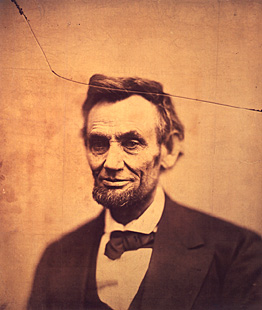
Lincoln and November 19, 1863… 1864… and 1865

Heather Cox Richardson

Seven score and seven years ago Abraham Lincoln brought forth on this continent a new sentiment, conceived in liberty, and dedicated to the proposition that all men are created equal.
Civil War historians know the Gettysburg Address so well that writing about it seems almost trite. We lecture about it; we teach it in discussion groups; we know it by heart.

It is hardly innovative to note that this famous speech marked a turning point in the meaning of the Civil War. With his masterful invocation of the Declaration of Independence, President Lincoln redefined the conflict. No longer would it be a fight solely to prevent the dismembering of the Union; from 1863 forward, it would be a struggle to guarantee that everyone born in America would have equal access to education, economic opportunity, and the law.
Lincoln’s declaration was truly a rededication of America. This, as much as anything, earned Lincoln a dominant place in the American pantheon. His words spoke directly to the true meaning of modern America.

But this belief in equality in America has never gone uncontested. It seems that Lincoln could have been speaking to the present when he warned at Gettysburg that the living must defend the legacy of the dead: “It is for us the living, rather, to be dedicated here to the unfinished work which they who fought here have thus far so nobly advanced. It is rather for us to be here dedicated to the great task remaining before us—that from these honored dead we take increased devotion to that cause for which they gave the last full measure of devotion—that we here highly resolve that these dead shall not have died in vain—that this nation, under God, shall have a new birth of freedom—and that government of the people, by the people, for the people, shall not perish from the earth.”

A year to the day after delivering the Gettysburg Address, on November 19, 1864, President Lincoln offered another epigram about America.

Among the blizzard of correspondence that crossed his desk that day was a brief note the President jotted to General William S. Rosecrans. In it, Lincoln stayed the execution of Confederate Major Enoch O. Wolf, convicted of murdering Major James Wilson and six members of the cavalry of the 3rd Missouri State Militia.

The President freely admitted he did not know anything of the circumstances of the case, and that the decision about Wolf’s future was in Rosecrans’s hands. He had suspended the sentence because he wanted to make sure Rosecrans understood that the general’s own inclinations were unimportant, and that he must do only what was best for the nation. “I wish you to do nothing merely for revenge,” Lincoln wrote, “but that what you may do, shall be solely done with reference to the security of the future.”

After 1863, Lincoln turned his masterful political skills solely toward securing equality for all Americans. As he counseled Rosecrans to do, he lost himself in his vision for the nation. Lincoln took hit after political hit, deflected opponents’ wrath with wry stories, and tried to find middle ground with his enemies. As he indicated to Rosecrans, he had only one goal: to make the American dream accessible to all Americans.

In the end, Lincoln was unable to blunt the hatred of the men who saw his defense of equality as an assault on civilization. By November 19, 1865, the President was dead. But he left behind him a new vision of America, and a charge to those born after the night that he, too, died for it: “that from these honored dead we take increased devotion to that cause for which they gave the last full measure of devotion.”