Spokane Valley, 1857

So I was fooling around at the National Archives website the other day and found this:


Isn't it lovely? This watercolor was painted around 1857 near Plante's Ferry across the Spokane River, and is surely the earliest depiction of Spokane Valley. If you click through to the original record you can zoom in and explore this very detailed painting. Can you find the two men in a canoe? The wagon road?

The image reveals a lot about the environment at that time. I tweeted the image and the helpful @doigSt identified the mountains: "Signal Point, Blossom Mountain & the 2 Mica Peaks." He also asked why there are so few trees in the image. The almost complete lack of trees in the valley would have been due to native burning. Plateau Indians typically set periodic fires to many areas to shape the land to their needs. Regular burning created a purposeful mosaic of prairies and forest that created environments rich in game animals and popular plant foodstuffs.

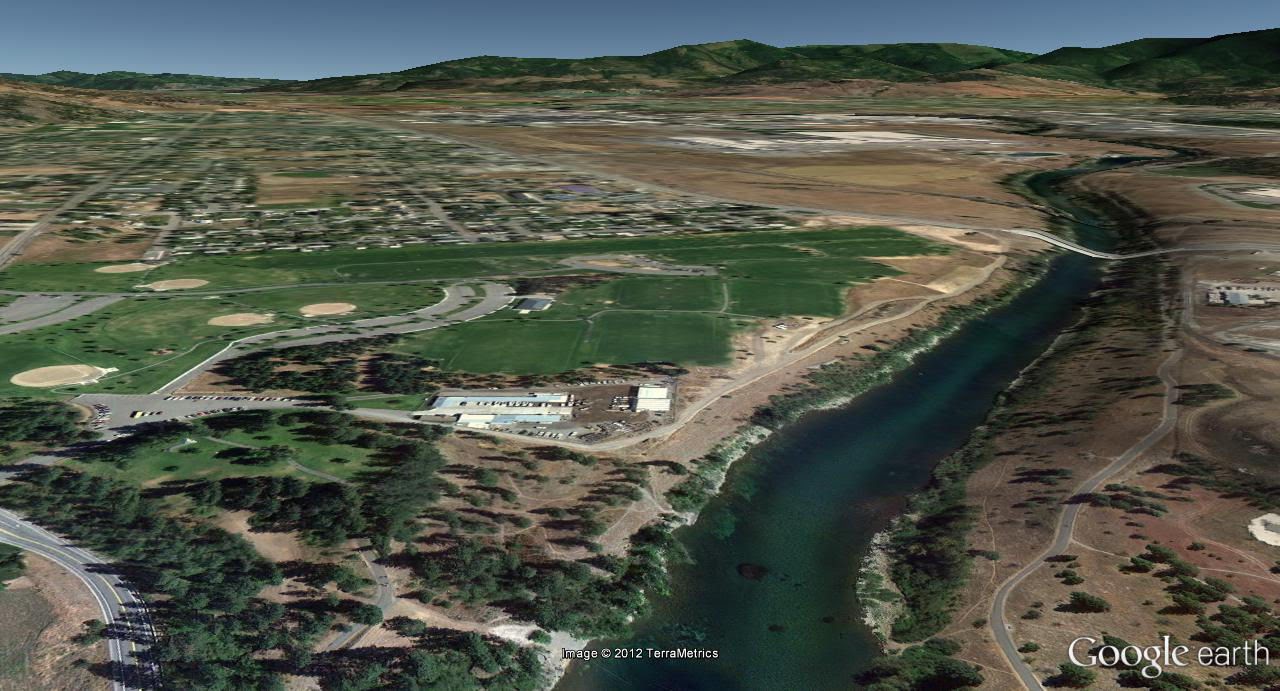
I believe the painter must have been part way up the same bluff where Spokane inventor Royal Riblet built his mansion. Riblet is a great local character, the inventor of the chair lift and many other, often less practical, inventions. Perhaps I will head out with my camera and see if I can rephotograph the same area from the same location. In the meantime, here is the approximate same view in Google Earth:


The Kansas Gold Rush

Dan Allosso

Map of Kansas and Nebraska Territories, 1854
Kansas! For most East and West-coasters, it’s one of those flyover states.  Even for Midwesterners like me, it’s most frequently remembered as a long flat stretch of driving, on the way to someplace else.  With apologies to Kansans, for many other Americans Kansas is either a band from the 70s (“Point of Know Return,” remember? “Dust in the Wind”?), the gray place Dorothy lived before being swept into Technicolor Oz, or the scene of an early, bloody civil war that helped push the nation over the brink between the 1854 Kansas-Nebraska Act and statehood in 1861.

So I was surprised today, when I discovered in a January, 1859 Ranney Letter that “more than two hundred persons in this county” in southern Michigan were planning to go to Kansas in search of gold the following summer.  It hadn’t occurred to me–maybe because I’m familiar with the flat, drive-through Kansas you can see on current maps–that the Nebraska and Kansas Territories extended to the Rocky Mountains and contained quite a bit of what is now Colorado and Wyoming, as well as a big section of the northern foothills (including the Black Hills) that in 1861 would become the Dakota Territory.

In other words, Gold Country.  Between 1854 and 1861, Kansas and Nebraska were part of The West in a way they no longer are.  Fort Laramie, the site of the 1868 Treaty between the U.S. and the Lakota, Dakota, and Arapaho nations, was originally in the Nebraska Territory.  Pikes Peak, now 100 miles south of Denver and 30 miles west of Colorado Springs, was in Kansas.

“How did I miss this?” I thought, with some alarm.  But when I flipped through the pages of books from the “Western” part of my library, such as Patricia Nelson Limerick's The Legacy of Conquest, I find a Kansas and Nebraska embroiled in Stephen Douglas’s expansionism.  Similarly, on my “Impending Crisis” shelf, David Potter’s book of that name devotes many pages to the 1854 Act and to the Lecompton Constitution.  But Lecompton is in the northeastern corner of present-day Kansas, and Stephen Douglas was from Illinois.  The free-state revolutionaries of Topeka and the Bleeding Kansas border war with Missouri were likewise situated on the eastern borders of the present state.

Published by Oliver Ditson, Boston, 1856
On the pages of the Kansas Historical Society’s website, I learned that the people of Kansas were apparently divided in 1859 over whether their state should be a “Big Kansas” including the western gold region, or a “Little Kansas” without it.  Kansas entered the Union in January, 1861, during the (extremely) lame-duck session between Abraham Lincoln’s election and his inauguration, with a population of 107,206.  William Seward had introduced a bill in the Senate in February, 1860, to admit “Little Kansas” under its free-state Wyandotte Constitution, which fixed the border at 102 degrees west longitude, excluding the Rockies.  The bill was defeated by Democrats who opposed Kansas as a free state; but they also objected to the “Little Kansas” borders, saying the Wyandotte convention had exceeded its authority in changing the territorial boundaries.  Were they afraid that the country around Pikes Peak would soon have sufficient population (the target was 93,000) to become yet another free state?

It just goes to show, I guess, how much complex and interesting detail lies just under the surface of the broad brushstrokes we use to integrate local and regional histories into American History.  The Kansas State Historical Society’s site includes a reprint of a 1967 article from their journal written by Calvin A. Gower of St. Cloud (MN) State University, titled “‘Big Kansas’ or ‘Little Kansas,’” which describes the Pikes Peak gold rush and the controversy over Kansas’ borders.  We’re lucky to have more and more of these resources online at our fingertips.  Does their availability obligate us to rethink the relationship between the broad strokes and the details–at least for the regions where we live, write, and teach?

Know Your Archives: The Center for Popular Music

Randall Stephens

It takes a certain temperament to be a historian.  For example, you have to, at least on some level, enjoy rummaging through dusty manuscripts and spending hour upon hour hunting down sources, reading, rereading, and conducting keyword searches until your fingers become arthritic claws.

I don't enjoy that last one, but I do enjoy visiting archives.  Some more than others.  I've been to a variety of amazing collections over the years.  Maybe only one of those, the Reading Room of the Library of Congress, matched shear beauty with the amazing scope of materials.  (Getting tired of reading through that bound volume of brittle 19th-century newspapers?  Have a stretch and look up at the beautiful dome.) For the most part, historians don't visit archives for the lovely vistas. Quite a few archives are situated in cold basements with little sunlight and flickering, humming florescent lights.  An ideal setting for a troglodyte, but not a vitamin-D-deprived historian.

Downtown Nashville, summer 2012
This past summer I went on the road to do some initial research for my next book project, currently titled The Devil's Music: Rock and Christianity from Elvis to Larry Norman.  It was a great experience.  All the archivists and assistants I encountered proved terrifically helpful.  I visited some really stunning collections.  Wheaton College's Billy Graham Center may lay claim to being the best place to study all things related to 20th-century Protestantism, and evangelicalism in particular.  (Don't let their hopelessly outdated 1990s website make you think any less of the place.)  To the south of Wheaton I trekked to the Southern Baptist Historical Library. The staff their gave me numerous tips and helped me track down obscure pamphlets, documents, and letters that I could never have imagined even existed.  As a bonus, the Southern Baptist Historical Library is in Nashville.  Music nuts can take a break by boot-scooting over to the Country Music Hall of Fame or dropping some greenbacks at the Ernest Tubb Record Shop, founded in 1947.

My favorite collection that I visited on this cross-country trip was the Center for Popular Music at Middle Tennessee State University in Murfreesboro, TN. Seldom has research been more fun.  I perused dozens and dozens of books on rock history, gospel, and pop music.  (It was hard not to fall down an rabbit hole.) I listened to a rare, 1956 acetate interview with Elvis Presley from a Texas radio station.  Girls screamed in the background as a flustered Elvis answered with his typical "yessir." I thumbed through anti-rock diatribes from the Carter years.  Through it all I got a better handle on my topic. 

The Center holds acres of records, tapes, magazines, books, manuscripts, and much more. (Search there extensive collection here.)  And the staff at this place, the gem in its crown, could not have been more helpful.  With their aid I found enough research material to keep me working away for months. 

In the Know Your Archives interview embedded above, I speak with Dale Cockrell, Director, and Martin Fisher, Curator of Recorded Media Collections.  They describe the materials the Center collects, the kinds of research being done there, and pretty much explain why anyone doing anything on music history should make the trip to MTSU. 

What Is History? Letting the Market Decide

Randall Stephens

How do we determine what is worth our attention when it comes to the past?  What events, people, and movements matter most?  What should we pay attention to?
"Caesar Crossing the Rubicon," attributed to Jean Fouquet, ca. 1475

When it comes to questions like these I always think back to E. H. Carr's classic What Is History?. It's a slim book, ideal for an intro to historical methods.  It's Carr's G. M. Trevelyan lectures from 1961 at Cambridge University.  At the outset he quotes C. P. Scott (1846-1932) the famous British journalist, publisher, and politician.  "Facts are sacred, opinion is free," said Scott.  Yet, writes Carr, despite Scott's confident motto:

every journalist knows today that the most effective way to influence opinion is by the selection and arrangement of the appropriate facts. It used to be said that facts speak for themselves. This is, of course, untrue. The facts speak only when the historian calls on them: it is he who decides to which facts to give the floor, and in what order or context. It was, I think, one of Pirandello's characters who said that a fact is like a sack—it won't stand up till you've put something in it. The only reason why we are interested to know that the battle was fought at Hastings in 1066 is that historians regard it as a major historical event. It is the historian who has decided for his own reasons that Caesar's crossing of that petty stream, the Rubicon, is a fact of history, whereas the crossing of the Rubicon by millions of other people before or since interests nobody at all (9).

Not surprisingly, Carr also pitched his tent with Benedetto Croce (1866-1952). He quotes Croce approvingly: "All history is contemporary history." (Of course, not everyone agrees with this kind of relativism.*)  

From an undated letter written by George Washington
Here's one crass answer to the question of what matters: let the market decide.  What do people treasure most?  What history books tend to fly off the shelves?  What kinds of history programs do people watch?  (A: Anything about Hitler or ancient aliens.  Or, preferably, a combination of the two.)  

The Washington Post reports on the "auction of over 300 historical documents [that] includes rare letters written by Vincent van Gogh, George Washington, John Lennon and other iconic figures."  By the dictates of the market, these documents matter a great deal. "Other luminaries whose papers will be sold include Lou Gehrig, Louis Pasteur, Sigmund Freud, Charles Darwin, Marie Curie, Giuseppe Verdi, Peter Tchaikovsky, Cole Porter, King Henry II and Napoleon I."  Call it the Antiques Roadshow principle.  Letters from George Washington and Vincent van Gogh are expected to fetch a whopping $200,000 to $300,000.

A high-dollar answer to the question of "What is History."

________

* For a counter view, see G. R. Elton's The Practice of History (1967), a serious defense of history as a quest for objective truth. For a third view, see Richard Evans, In Defense of History (2000): "Nothing has outdated the views not only of Elton, but even of Carr, more than the arrival in the 1980s of postmodernist theory, which has called into question many, if not most of the arguments put forward by both of them" (3).  See also, Donald Yerxa's 2003 interview with Evans in Historically Speaking.

"The king's name is a tower of strength": Richard III's (Possible) Bones, Roundup

Detail from a late 16th century painting
of Richard III, artist unknown.
.
"Richard III dig: Results expected in January," BBC, November 19, 2012

The remains were found underneath a Leicester car park on the former site of the Greyfriars church in September.

Prof Lynn Foxhall, from the University of Leicester, said the team has got to be sure of its facts before it confirmed whether it was the monarch.
>>>

Anthony Faiola, "Unverified remains dig up the twisted legacy of England’s Richard III," Washington Post, November 24, 2012

Underneath a drab parking lot 90 miles northwest of London, archaeologists have unearthed what may become one of this nation’s finds of the century — half-a-millennium-old bones thought to be the remains of the long-lost monarch. But if the discovery has touched off a feverish round of DNA tests against his closest living descendants, it has also lurched to the surface a series of burning questions in a country where even arcane points of history are disputed with the gusto of modern-day politics.>>>

"History could be rewritten if remains of Richard III have been discovered, say Leicester historians," University of Leicester News and Events, November 9, 2012

For Professor Norman Housley and Dr Andrew Hopper of our School of Historical Studies, if the remains found by the University of Leicester are Richard III's, it would rewrite history by bringing closure to the fate of the mysterious king. In addition, by observing that Richard's deformity may have been a result of scoliosis, the idea of him being a 'hunchback' will fade away.>>>

Martin Hickes, "Should Richard III - the last Yorkist king - be reburied in Yorkshire?" Guardian, September 18, 2012

Two major organisations which have exhaustively researched and promoted the 'true' name and history of Richard, which they assert is at odds with the traditional Shakespearean 'evil hunchback' depiction, are expecting much debate at their forthcoming conferences.
>>>