Showing posts with label Historiography. Show all posts

What Is History? Letting the Market Decide

Randall Stephens

How do we determine what is worth our attention when it comes to the past?  What events, people, and movements matter most?  What should we pay attention to?
"Caesar Crossing the Rubicon," attributed to Jean Fouquet, ca. 1475

When it comes to questions like these I always think back to E. H. Carr's classic What Is History?. It's a slim book, ideal for an intro to historical methods.  It's Carr's G. M. Trevelyan lectures from 1961 at Cambridge University.  At the outset he quotes C. P. Scott (1846-1932) the famous British journalist, publisher, and politician.  "Facts are sacred, opinion is free," said Scott.  Yet, writes Carr, despite Scott's confident motto:

every journalist knows today that the most effective way to influence opinion is by the selection and arrangement of the appropriate facts. It used to be said that facts speak for themselves. This is, of course, untrue. The facts speak only when the historian calls on them: it is he who decides to which facts to give the floor, and in what order or context. It was, I think, one of Pirandello's characters who said that a fact is like a sack—it won't stand up till you've put something in it. The only reason why we are interested to know that the battle was fought at Hastings in 1066 is that historians regard it as a major historical event. It is the historian who has decided for his own reasons that Caesar's crossing of that petty stream, the Rubicon, is a fact of history, whereas the crossing of the Rubicon by millions of other people before or since interests nobody at all (9).

Not surprisingly, Carr also pitched his tent with Benedetto Croce (1866-1952). He quotes Croce approvingly: "All history is contemporary history." (Of course, not everyone agrees with this kind of relativism.*)  

From an undated letter written by George Washington
Here's one crass answer to the question of what matters: let the market decide.  What do people treasure most?  What history books tend to fly off the shelves?  What kinds of history programs do people watch?  (A: Anything about Hitler or ancient aliens.  Or, preferably, a combination of the two.)  

The Washington Post reports on the "auction of over 300 historical documents [that] includes rare letters written by Vincent van Gogh, George Washington, John Lennon and other iconic figures."  By the dictates of the market, these documents matter a great deal. "Other luminaries whose papers will be sold include Lou Gehrig, Louis Pasteur, Sigmund Freud, Charles Darwin, Marie Curie, Giuseppe Verdi, Peter Tchaikovsky, Cole Porter, King Henry II and Napoleon I."  Call it the Antiques Roadshow principle.  Letters from George Washington and Vincent van Gogh are expected to fetch a whopping $200,000 to $300,000.

A high-dollar answer to the question of "What is History."

________

* For a counter view, see G. R. Elton's The Practice of History (1967), a serious defense of history as a quest for objective truth. For a third view, see Richard Evans, In Defense of History (2000): "Nothing has outdated the views not only of Elton, but even of Carr, more than the arrival in the 1980s of postmodernist theory, which has called into question many, if not most of the arguments put forward by both of them" (3).  See also, Donald Yerxa's 2003 interview with Evans in Historically Speaking.

Red Meat

I was thinking about writing a short post about all the academic history I’ve been finding at the bottom of some pretty popular books recently.  Alfred Crosby’s ideas about the Colombian exchange in Charles Mann’s 1491, for example.  Or Vaclav Smil’s story of the Haber-Bosch process for fixing atmospheric nitrogen, from his Enriching the Earth, in Simon Fairlie’s 2010 book, Meat: A Benign Extravagance.  Maybe it’s no coincidence that these are both canonical environmental history texts (they were both on my field list, thanks to my EH advisor, Ted Melillo).  Perhaps because their interest is on the edge of science, readers of popular books on environmental issues are more open to the fairly dense technical arguments.  Maybe it’s easier to move ideas from academic books to popular.  But I’m not so sure.  Science writers often have a lot of skill taking excruciatingly complicated stuff and making it comprehensible to the rest of us.  Michio Kaku, Brian Greene, Matt Ridley, and Colin Tudge are just a few of the names that jump to mind.  Richard Dawkins was Oxford’s “Professor for Public Understanding of Science” until 2008.  We could probably learn a thing or two from these authors.

And Simon Fairlie’s book is part of this tradition.  Fairlie is a British farmer and writer, and a former editor of the British environmental journal The Ecologist.  His book about meat’s place in the food chain draws heavily on Vaclav Smil’s work on nitrogen fixation, and digs a little more deeply into the downside of the green revolution Smil describes.  But the thing that really jumped out at me as I read Meat was Fairlie’s response to the famous food-mile study that stunned us all a few years ago. 

You may recall the article “Food Miles and the RelativeClimate Impacts of Food Choices in the United States,” written by Christopher L. Weber and H. Scott Matthews of Carnegie Mellon for Environmental Science & Technology in 2008.  It made headlines outside of the science community because they concluded that “eating local” was not a very good way to reduce greenhouse gases.  Eliminating red meat from your diet one day a week, they said, would reduce your carbon footprint more than going 100% local.  This came as a shock to many people who had embraced local farms and markets as a way of living more sustainably.  I was TA-ing an Environmental History course when the article became a news item, so I had my students read it and discuss.

There are a number of possible responses to a claim like this, and the students were able to see many of them.  They pointed out the social benefits of farmers’ markets and local food, the fact that most Americans get their meat from feedlot-style animal husbandry*, and they concluded that they might get even better results if they did bothrather than choose to be local or to be part-time vegetarians.  Fairlie touches on each of these points, and then he drops his bomb.  What the study doesn’t deal with – what we overwhelmingly urban Americans routinely fail to see when we look at the local question – is on the back end.  The issue isn’t raising food and getting it to market.  The issue is, getting the waste back to the farm. 

Throughout history, there has been a rough symmetry between the input and output sides of agriculture and life.  Food came out of the earth; crop residues, manure, and even human waste went back in.  Then came the era of flush toilets, food miles, and landfills.  Industrial fertilizers now fill in for the nutrients that came from all that missing waste, but they cost a lot, they run off into our water, and they don’t keep the ground from compacting and eroding the way organic material does.  And assuming for a moment that either soaring global demand or peak oil is going to push the price of energy way up in the future, it’s easy to see that the days of cheap nitrogen may be numbered.  So Fairlie’s point is an important one: if we don’t account for getting waste back to the farm, we’re ignoring a big factor in the true cost equation.

Economists have a word for this.  The things we ignore in our models and analyses are called “externalities.”  At first, they’re left out because they’re either difficult to price (like airport noise in the 1950s) or because they’re ubiquitous and “free” (like rivers and the ocean used as sewers in the 19th century).  Later, they’re ignored because they raise difficult questions about private ownership and public responsibility that free-market ideology would rather bypass.  And sometimes it takes someone like Fairlie, who lives on a farm, to remind the city-folk that just because you flushed your toilet or dragged your trash to the curb, the story isn’t over.  I personally suspect that all our problems arise from ignoring externalities.  Sounds like another book project . . .

But maybe you have to be 2/3 of the way through Fairlie’s book and already buying into his vision, for this to be a powerful “Aha!” moment.  I may not have done justice to it here.  Read the book as an example of how cutting-edge Environmental History can be turned into a best-seller, and you’ll also discover Fairlie’s answer to Garrett Hardin’s “Tragedy of theCommons.”  

_____________

* I asked the authors about grass-fed beef and other sources of “red” meat, and Weber responded to my email, saying that “other red meats than corn fed beef do have the same high emissions” because of the methane-producing effect of digesting grass and the typically longer lifetimes of sheep and goats.  So in the view of these scientists it’s not just a feedlot issue.

Bertram Wyatt-Brown, 1932-2012


Randall Stephens

Like so many others, I was sad to hear that Bert Wyatt-Brown passed away over the weekend in Baltimore.  His wife Anne relayed the news on Sunday. 

Bert is best known as an accomplished writer, historian, mentor, and leader of the historical profession.

Bert on the Maine coast, 2006
He served as President of the Society for Historians of the Early American Republic (1994), St. George Tucker Society (1998-99), and Southern Historical Association (2000-2001).  He was a longtime supporter of the Historical Society and regularly wrote for Historically Speaking.  (See my interview with him here on this blog.)

He was the author over 100 scholarly articles and essays and wrote a variety of acclaimed books.  His Southern Honor: Ethics and Behavior in the Old South was a finalist for the Pulitzer Prize.  Novelist Walker Percy called the book "A remarkable achievement--a re-creation of the living reality of the antebellum South from thousands of bits and pieces of the dead past."  "Unlike so many historians who have been interested in handing down judgments, favorable or unfavorable, on the Old South," wrote Harvard historian David Herbert Donald, "Wyatt-Brown has studied Southerners much as an anthropologist would an aboriginal tribe. An important, original book which challenges so many widely held beliefs about the Old South."

True to form, Bert just completed his last book not long before his passing.  I saw him and Anne in September and he was thrilled to have completed the project.  We were emailing back and forth last week about the images to accompany the text.  Titled A Warring Nation: Honor, Race, and Humiliation at Home and Abroad, it will soon be rolled out by the University of Virginia Press.

Maybe most importantly, Bert taught and mentored numerous students at the University of Florida, Colorado State University, the University of Colorado, the University of Wisconsin, and Case Western Reserve University.

As one of his many grad students, I can attest to his generous, wonderful spirit.  With funds from the Milbauer chair he filled at the University of Florida, Bert would help students attend conferences like the Southern Historical Association, the Saint George Tucker Society, the American Historical Association, and others.  He provided research money to students as well.  Many a dissertation was sped along by his help and keen interest.  Bert was a great prose stylist, more than happy to help his charges eliminate passive voice, dangling particles, unidentified antecedents, you name it.  He was tireless in his big-picture, content edits to dissertations, conference, papers, and articles.  (I can't imagine that my first book would have ever seen the light of day without his heroic reading of so many of my bad drafts.) Even after Bert retired he continued to meet with new graduate students at Johns Hopkins and elsewhere.

Those who studied with him, knew him as a colleague, or friend will deeply miss his sense of humor, his joy for living, dinners and visits with him and Anne, and so much more.

He is survived by his wife Anne, a daughter, a son-in-law, and two grandchildren.

From the Pages of Historically Speaking: An Interview with James M. Banner, Jr. on Being a Historian


"On Being a Historian: An Interview with James M. Banner, Jr."
Conducted by Donald A. Yerxa
Historically Speaking (September 2012)

Historian James Banner's new book Being a Historian: An Introduction to the Professional World of History (Cambridge University Press, 2012) is an insightful and often provocative overview of the current state of the discipline of history. Drawing on more than fifty years experience both within and outside academic walls, Banner argues that while there is much to celebrate, the discipline needs to acknowledge and confront a number of serious challenges. Banner, the author of many books and essays on history, education, and public affairs, is currently working on a book about revisionist history. Senior editor Donald A. Yerxa interviewed Banner in July 2012.

Donald A. Yerxa: For the benefit of our readers, would you briefly summarize your central argument in Being a Historian?

James M. Banner, Jr.:
The basic one, from which the book descends, is that history is a discipline—a distinct domain of knowledge— pursued in many professions. That is, there's no "history profession," as we colloquially call it, as such. That argument's corollary is that academic history, while still the center of gravity of the discipline, does not embody all of historians' knowledge, institutions, or practices. Of course, we know this, but our terminology and the way we relate the history of the discipline haven't caught up with the facts—much to the cost of reputation, reward, self-respect, and, most importantly, the training of historians. I thus also argue that, while the preparation of historians has substantially improved in recent decades, it remains deficient. That argument, that we have farther to go in preparing historians, is like an organ point in a passage of music, the rumbling contention of the entire book. Finally, I argue that historians (like, I must say, sociologists and biologists, attorneys and engineers) must seek more guidance, not from the idols of the tribe—academic professors—or from within the conventional template of graduate student preparation—how principally to become an academic scholar-teacher—but from within themselves, from their particular dispositions, gratifications, aims, and gifts.
Yerxa: What prompted you to write it? And for whom is it written?

Banner:
Part of the spur was purely personal as is—isn't it?—all writing. I wanted to try to draw together my reflections, frustrations, and concerns about the entire discipline of history formed over more than a half-century of being a historian. I wanted also to challenge my colleagues to go further in altering the way historians prepare young historians for their professional worlds. And there was a part of me that wished to do what I wish the senior historical organization in the U.S. and the largest and most influential body of historians in the world—the American Historical Association—would periodically do: assess the state of the discipline. And so the book is a kind of evaluation of the condition of the discipline today. But it's also a book with two very specific audiences in mind: first of all aspiring historians, for whom I want to provide a kind of honest, optimistic, yet disenthralled introduction to the discipline they're entering; and second, my more experienced colleagues who ought to be training historians to interact with the larger world as well as with scholars and students and who, I hope, are learning to reach out to that world themselves.

Yerxa: You argue with conviction that it is a mistake to confuse the discipline of history with the profession of history. Why is it such an important distinction to make?


Banner: Simply put, because of the facts. The academic profession is but one of the professions—although, surely, the central one still—in which historians practice their many crafts and apply their great variety of knowledge. Historians also practice history in law and medical schools, in government at all levels, as reporters, in museums and historical societies, and as schoolteachers. These historians, when employed as historians, are all professional historians acting professionally, taking part in the worldwide community of historical discourse and applying historical knowledge in some manner to some purpose. It’s the discipline that binds us, not our places of work, the kinds of work we pursue, the forms our work takes, or the audiences to which we direct that work. Those differ widely. The conventional terminology—“the” history profession—gives pride of place to those who coined the term and have long employed it: academic historians around whom, in the first century of the discipline’s emergence, the world of history gathered. After all, they were the people (mostly men) who created the departments, the standards, the training protocols, the products (mostly books), and the tenure system in which, until the 1960s, most historians were organized. But while historians must still be prepared by academic historians in research universities to master bodies of knowledge and to undertake and produce research scholarship, their employment has long escaped academic walls. In fact, there’s reason to believe that at least half of those now receiving history doctoral degrees, either by choice or necessity (we lack information about that critical matter), do not enter academic work. Consequently, in recent decades we’ve gotten used to distinguishing academic from public historians. That’s fine as far as it goes. But, as I also argue in the book, it’s a weak distinction. Increasingly, historians are hybrids—I’m one of them—who move back and forth between the classroom and other occupations, who write, film, and curate history while holding faculty positions and who teach while working in government or nonacademic institutions. An increasing number of historians are both academic and public historians. So why can’t we just term ourselves historians— colleagues all—and put aside the distinction, perhaps useful but increasingly outmoded, between public and academic historians?  read on >>>

George McGovern: Historian

Jonathan Rees

In the day since former Senator George McGovern died, I have read wonderful tributes to his campaign for the presidency in 1972.  Thankfully, President Obama mentioned McGovern’s heroism during World War II in his statement marking opposition to the Vietnam War and his ill-fated but noble the Senator’s death.  However, the only mentions that I’ve read of McGovern’s career as a professional historian seem somewhat surprised that he was ever a college professor. 

Of course, this confusion is understandable, and if I didn’t teach in Colorado I would probably share it right now even though I have been a huge George McGovern fan for a very long time.  McGovern ran for President when I was six years old, and I distinctly remember rooting for him both because my parents supported him and because I have always liked going against the crowd.  When I was in Middle School, I did a book report on his campaign biography.  I must have learned about his professional life before he entered politics then, but with no inkling of what my own profession would eventually be I’m sure I forgot.

In 1988, I was a volunteer at the Democratic National Convention in Atlanta.  At that time, I had a particular skill for recognizing politicians, but I really didn’t want to bother any of them.  I made an exception for George McGovern.  I walked up to him outside the hall, and said, “I’m really glad to meet you,” as I shook his hand.  He replied, “I’m really glad to meet you too,” and then he got swarmed by a throng of admirers.  I thought I’d never get a chance to meet him again.  I was completely wrong.


George McGovern earned his Ph.D. at Northwestern University studying under the well-known Woodrow Wilson scholar Arthur S. Link in 1953 while simultaneously teaching at Dakota Wesleyan University.  His topic was what has come to be called the Great Colorado Coalfield War of 1913-14 (largely thanks to him).  As McGovern was just starting to run for President, Houghton Mifflin offered to publish his dissertation.  McGovern hired a writer named Leonard Guttridge to help smooth out the academese, and to do a little extra research.  The resulting book, The Great Coalfield War, was the first major publication to examine the infamous Ludlow Massacre of 1914, one of the bloodiest events in American Labor History.  The book remains in print today.

It is interesting to compare the book and the dissertation that preceded it.  The book offers more perspective, going back to about 1903.  However, Guttridge also prepared the publication for the scrutiny of a political campaign.  All of the barely concealed anger and the pro-union language of the original dissertation disappeared.  Still, the book was a pathbreaker, setting the tone for later works like Scott Martelle’s Blood Passion and Thomas Andrews’ Bancroft Prize-winning Killing for Coal.  However, the dissertation is much more fun to read.  George McGovern didn’t really need a co-author.  He was an excellent historian and author in his own right.

I know this because I teach in southern Colorado, near where the strike occurred.  For the last ten years or so I’ve helped organize commemorations of the Ludlow Massacre here at Colorado State University—Pueblo.  In 2004, my department, along with the Bessemer Historical Society—the people who are working to save the archives of the Colorado Fuel and Iron Company, the largest firm that employed those strikers—invited McGovern to campus for a fundraiser.  He not only accepted, he cut his usual speaking fee by two thirds.

Me and a colleague from the Political Science department picked McGovern up at the airport.  Then we drove him to Peterson Air Force Base so that he could pick up his granddaughter.  Then he took us all to lunch at the Broadmoor Hotel in Colorado Springs (famous, among other reasons, for being the place where George W. Bush decided to give up drinking).  That remains the only time that I have ever eaten at the Broadmoor.  Then we dropped off his granddaughter back at the base and drove to Pueblo.

We all chatted almost the entire time.  Of course, the same way that Elton John will have to sing “Crocodile Rock” well past his dotage, McGovern talked about the 1972 election.  His lines were interesting. (They included, “I would rather be me right now than Richard Nixon.” and “Nixon was incredibly intelligent, but completely amoral.”)  I could tell these lines were also very well rehearsed.

When the conversation turned to history, however, McGovern’s eyes lit up.  He began to talk about Arthur Link, and how he had suggested the Colorado topic because, “There’s this huge strike that happened and nobody’s covered it before.”  He talked about doing research in Colorado during the early 1950s, and how he went to the movies in Denver once and the entire audience (but him) booed a newsreel when they saw Mother Jones.  We talked about Consensus History and the New Social History.  I think he liked talking about Colorado History with me and at our fundraiser because nobody asked him to do so very often.

It would be a shame if the historical profession makes the same mistake in the wake of his passing.  After all, George McGovern was a historian before he was ever a politician.

Jonathan Rees is Professor of History at Colorado State University—Pueblo.  Occasionally, he writes about something besides MOOCs in this space and over at his blog, More or Less Bunk.

A Moral Man: A Eulogy for Eugene Genovese*

David Moltke-Hansen

The doorbell rang at the South Carolina Historical Society in the spring of 1987.  When I opened it, the couple standing there asked if David Moltke-Hansen were in.  Then Gene and Betsey introduced themselves and said they had just stopped by to say how much they admired something I had written and to meet me.  That night I told my wife to shoot me; it would never get better than that.

Fifteen or so years later, I was visiting with Gene and Betsey in Atlanta.  Gene was distraught, almost frantic.  It was Betsey’s birthday, and the flowers he had ordered had not come.  Betsey reassured him that she knew he was always thinking of her—except, of course, during baseball games and when he was reading and writing.  That, I thought to myself, doesn’t leave much time except in dreams, at meals, and in the car, with Betsey driving, because Gene never learned how to drive.

Until the last couple of years, when his health deteriorated even further, Gene worked incessantly.  Witness the three books he saw through the press after his beloved Betsey’s death five years and nine months ago.  In addition, he worked on the five volumes of Betsey’s selected, uncollected writings, read manuscripts, and went through four newspapers a day.  He worked like that for nearly sixty years.

That abiding drive hints at another that animated those years.  Gene always was a moralist, whether as a Marxist or as a Catholic.  He recognized the evil men and women do through the acquisition and abuse of power, and he wanted to understand and combat that evil.  At one point scientific socialism seemed the way, but then Communism failed and failed him, even as Marxism continued to influence what and how he wrote.  Last year, rereading old political pieces of his from the ‘60s and ‘70s, he noted wryly: my reasoning was impeccable, just not my premises. 

Uncompromising in his moral judgments, Gene thought it unforgivable weakness to quail from necessary action because of possible collateral damage.  And he was entirely ready to see me become such damage.  Once he told me (after just having handed me a new book that he had dedicated to me) that I should and would die at the revolution.  Which revolution, I asked?  Any worth its salt, he said.  Liberals, social democrats, and other, mealy-mouthed, intellectually flaccid temporizers, the implication was, need to be eliminated.  Or at least have power wrested or kept from them.  He was not fond of libertarians either, thinking radical individualism radically wrong in the face of the collective challenges posed by power’s corruption. 

Now, when I become President, now when I become Pope, Gene would say—suggesting he should be both—things will be different.  The sad difference is that we no longer can hear him say that.  We shall remember, however, more than his humor and passion and moral drive.  We can still celebrate a brilliant interpreter of American slavery and the planter class, a tough colleague, and a generous friend.
________

*Moltke-Hansen gave this eulogy at Eugene Genovese's funeral mass on October 2nd in Atlanta, GA.

Our Pro or Anti-Slavery Constitution?

Steven Cromack

On January 27, 1843, during the Eleventh Annual Meeting of the American Anti-Slavery Society, the abolitionist William Lloyd Garrison submitted a resolution to the Society for approval:  “Resolved, that the compact which exists between the North and the South is a covenant with death and an agreement with hell—involving both parties in atrocious criminality—and should be immediately annulled.”  As time wore on, his rhetoric and actions intensified.  On July 4, 1844, he publicly burned a copy of the Constitution.[1] Garrison believed that the Constitution was inherently evil because it supported slavery. That founding document was an affront to God.   

Is the Constitution pro-slavery?   

For the past four weeks, I have had the pleasure of attending the James Madison Foundation’s Summer Institute on the Constitution at Georgetown University.  The Madison Foundation awards fellowships to social studies teachers and aspiring teachers each year, usually one per state.  As such, I am surrounded by some of the best and brightest secondary social studies teachers from across the nation. These fellow teachers care deeply about their field and their career, and are just as passionate about the material they teach.  On Monday, in a morning discussion section, the topic of conversation was whether the Constitution was pro-slavery, a compromise, or something else. 

For a good portion of the time, the fellows discussed elements of compromise found in the Constitution.  Then Will Lorigan, from Indiana, argued that the Constitution was in fact an anti-slavery document because while it conceded certain concessions to the Southern states, it also gave the national government the power and means to abolish the institution after 1808.  Another, Christopher Carl from Florida, added that the Northerners knew that by offering the Southern states serious concessions—proportional representation, the fugitive slave clause, and a ban on further legislation on the slave trade until 1808—they knew they would triumph in the long run.  Such assertions prompted significant and fascinating discussion.

It is a very intriguing argument.  Indeed, it seems that the Academy has been grappling with the issue of slavery and its role in the founding since the era of the Civil Rights movement. And the debate rages on.  In her 2006 book American Taxation, American Slavery, Robin Einhorn writes:

We can all agree that some of these masters had admirable qualities, that Thomas Jefferson was charming and eloquent, that James Madison was a talented political theorist, that George Washington was a brilliant general . . . .  Nevertheless, these men all owned human beings and, as politicians, defended the ownership of human beings— even when they believed that society would be better off if it acknowledged that “all men are created equal” . . . and so on.[2]

Throughout her book, Einhorn argues that slavery determined the economic system of the early United States, all the while undermining the spirit of a new American nation.

The historian Gordon Wood, however, lambasts those historians who considered the continuation of slavery as a failure of the revolution.  In a scathing review of Einhorn’s book, Wood writes:

It was inevitable that our recent accounts of the Revolution and the founding of the nation would reflect our increased understanding of the importance of slavery to the history of America. . . . to help satisfy the seemingly insatiable desire of many historians today to place slavery at the heart of America’s origins. . . . Robin L. Einhorn has no problem reading the present back into the past or, for that matter, reading the past forward into the present.[3]

Wood’s words essentially indict Einhorn for bringing the present perspective of hindsight into the past.

Was the Constitution pro-slavery or anti-slavery?  Was it a compromise or something else?  Such debates reveal the contested nature of history.  These men— Washington, Jefferson, and Madison—have long been dead.  Their writings live on.  Historians will never be able to fully know the inner worlds of these figures.  Scholars can never know their true intentions, or comprehend fully what they really meant.  The founders’ words offer clues, and perhaps if one gets enough pieces of the puzzle, an incomplete portrait emerges.  But if historians cannot agree on the shape of the piece, not even a partial picture emerges.

Another fellow, James Moran from Idaho, put it another way when he said, “the Constitution is what it is, nothing more.”
__________________

[1] “William Lloyd Garrison,” in American Political Thought, 6th Edition, ed. Dolbeare & Cummings (Washington: CQ Press, 2009), 203.

[2] Robin Einhorn, American Taxation, American Slavery (Chicago: University of Illinois Press, 2006), 14.

[3]  Gordon Wood, “Reading the Minds of the Founders,” New York Review of Books, 28 June 2007.

An Interview with Historian of Religion Paul Harvey

Randall Stephens

From the new issue of Historically Speaking . . .

Paul Harvey is professor of history at the University of Colorado at Colorado Springs. Harvey is a historian of American religion and has written broadly on race, the South, and the U.S. in the 19th and 20th centuries. He’s the author of Redeeming the South: Religious Cultures and Racial Identities Among Southern Baptists, 1865-1925 (University of North Carolina Press, 1997); and Freedom’s Coming: Religious Culture and the Shaping of the South from the Civil War through the Civil Rights Era (University of North Carolina Press, 2005). With Edward J. Blum he has written the forthcoming Jesus in Red, White, and Black (University of North Carolina Press).

Historically Speaking editor Randall Stephens recently caught up with Harvey to speak with him about the field of African-American religious history, teaching, and his new book Through the Storm, Through the Night: A History of African American Christianity (Rowman and Littlefield, 2011).

Randall J. Stephens: Could you say something about how historians wrote about African-American Christianity fifty years ago and how they write about it now?

Paul Harvey: Historians, at least white historians, mostly didn’t write about African-American Christianity fifty years ago. Black scholars did, of course, and fifty years ago the works of sociologists like E. Franklin Frazier dominated the field. Those scholars tended to be highly critical of what they called “the black church,” a term that was invented by 20th- century sociologists. They often saw “the black church” as either hopelessly other- worldly, peddling enthusiasm and a desperate eschatology rather than substantive improvements in the lives of their congregants, or (in the case of more well-established urban churches) too concerned with protecting bourgeois comforts to address the real issues facing most African Americans. Fifty years, ago, liberation theology and “black theology” were just beginning to take root in works such as Howard Thurman’s Jesus of the Dispossessed, a classic of 20th-century American theology. And of course Martin Luther King’s writings were just starting to enter the public realm, culminating with “Letter from a Birmingham Jail” in 1963. But in terms of scholarly works, the broader historical community basically knew nothing about African-American religious history.

Obviously we’ve come a long way since then; the same revolution in social history that affected all other fields of history in the 1960s and 1970s shaped the writing of African-American history as well. The 1970s were the real years of landmark achievements, especially with the publication of Albert Raboteau’s Slave Religion (very well known at the time) and Mechal Sobel’s Trabelin’ On (less well known then and now, but a brilliant if sometimes rather eccentric book). Over the next decade or two, studies of religion during and after slavery poured forth, and in my own early work I tried to contribute to that by pushing forward studies of African-American religion in time, focusing on the years after the Civil War. Most recently, scholars such as Curtis Evans (The Burden of Black Religion) and Barbara Savage (Their Spirits Walk Among Us) have challenged us to question the very terms that have defined the field, including “the black church,” which are intellectual constructs of a very particular period rather than historical realities themselves. This kind of challenge really hit the public realm when Eddie Glaude published a short piece called “The Black Church is Dead” for the Huffington Post. Glaude’s piece suggested that contemporary black churches had lost their prophetic voice, and that black parishioners were gravitating toward gospel-of-prosperity preachers that celebrate American capitalism in a way that would shock a figure such as Martin Luther King. That piece generated such a controversy that it hit the New York Times. I begin my book by talking about the piece and the arguments that ensued from it.

Stephens: How do you think historians will be treating black religion fifty years from now?

Harvey: In the epilogue to my book I suggest a couple of themes that relate here: diversification and re-Africanization of African-American religion. The same trends of immigration and pluralism that have affected all of American religion apply to African-American religion as well. Churches with African immigrant congregants and pastors are becoming increasingly prominent in New York and other urban areas, and they will eventually spread to smaller cities and to the South. Many of these feature the kinds of spirit possessions, exorcisms, and supernatural theology that African- American church leaders in the 19th century tried to drive out of their church life; they saw them as too primitive. Catholicism is also an increasingly important part of black religious life, in part because of Afro-Carribean Catholic immigrants (most obviously Haitians, but black Brazilians and others as well). Then, too, Islam continues to exert a major influence, and draws a substantial number of black American converts, as well as African immigrants who come from Islamic traditions. In fifty years historians will be discussing how a once overwhelmingly Protestant group of black churchgoers became much more diverse. This is “back to the future” territory, because that is the kind of religious diversity with which Africans began their enforced sojourn in the Americas.

Stephens: Did your teaching of African-American history influence you as you wrote the book?

Harvey: My teaching always influences my books, and vice versa, so the short answer is yes. Perhaps even more so for this book, which is meant for classroom use. I had in mind while writing it, “What exactly should my students, or any students in a typical class, know about the particular subject I’m writing about here?” I tried to focus on those essentials and avoid some of the more arcane or esoteric points and debates that my other books have spent much more time on. I also tried hard to write a pretty traditional historical narrative, showing some of the basic stuff historians want to show— change over time, diversity, complexity, etc.

Stephens: What was it like to write for a more general audience? >>> Read on at Project Muse

History Reviews Roundup

.
David Hill, "Book Review: Good Living Street," New Zealand Herald, Sep 19, 2011

A family history. Also a social and intellectual history, and a different take on the Australian Dream. Historian and environmental lawyer Tim Bonyhady follows three generations of Austrian Jews from the scintillating salons of late 19th century Vienna through World War I, Nazi occupation and growing persecution, to a made-for-television escape to Sydney, and a realisation that the struggle wasn't over.>>>

Michael Taylor, "BOOK REVIEW: A bloody season for black Americans," Richmond Times-Dispatch, September 18, 2011

The year 1919 was a terrifying time for many African-Americans. From April to November, a wave of anti-black riots and lynchings swept across the United States. By the time the violence subsided, hundreds of people, most of them black, were dead, thousands had been injured or forced to flee and damage to homes and businesses was estimated to be in the millions.>>>

Chris Hale, "American History Now: An Apt Book for the Times from Temple University Press," Perspectives on History, September 2011

Published by Temple University Press for the American Historical Association, American History Now is a thought-provoking follow up to The New American History, originally published in 1990 (with a revised edition in 1997). Like its predecessor, American History Now thoroughly examines the current states of American historiography, editing out certain areas or specializations that have lost favor since 1990 (such as social history) and emphasizing new ones at the forefront of current research (such as borderlands and religious history).>>>

Anson Rabinbach, "The untold story of the city," TLS, August 22, 2011

In 1934, Martin Heidegger wrote a famous essay explaining why he had refused an invitation to teach in Berlin. “Why I Still Remain in the Provinces” was an anti-urban philippic, warning that cities exposed thinkers to what he called “destructive error”. But when the wise philosopher listened to the local peasants and to “what the mountains, and the forest and the farmlands were saying”, he was reassured. Heidegger was by no means the only twentieth-century intellectual to subscribe to an inexhaustible liturgy of anxieties about modernity and the perils of city life.>>>

Why Study History? Revisited

Randall Stephens


On this blog we've included quite a few posts on "Why Study History?" beginning with one that Heather wrote back in March 2009. So, with the semester starting, it seems like a good time to revisit that question.


There are so many reasons why we study history. Sure, we might like to think that our encyclopedic knowledge of the Battle of Bull Run will win friends and influence people. It probably won't. Far too many undergrads and men and women on the street tend to believe that the study of history involves pointless rote memorization and war trivia. (History Channel maybe?)


As I get ready to teach my course on Critical Readings in History (a methods and historiography class) it helps me to think about the bigger picture. What large lessons does history teach us? How does it help us think critically about the world in which we live?


We learn about cause and effect from history. It teaches us about continuity and disruption. We also answer big questions and learn how to solve all sorts of problems related to what it means to be human.


Over at the Guardian Simon Jenkins writes about what history is and what it is not ("English History: Why We Need to Understand 1066 and All That," September 1, 2011). He begins with a content question that obsesses observes on this and that side of the Atlantic:


Which "bits" of English history do we need to know? Should they be Simon Schama's peasants' revolt, Indian empire and opium wars, or David Starkey's rules of chivalry? Or is the Cambridge professor Richard Evans right to dismiss "rote learning of the national patriotic narrative" out of hand, in favour of studying "other cultures separated from us by time and space"?


The answer is none of them as such. All seem static moments torn out of the context of history to suit a particular outlook on the world. Evans is the most wrong of all. His disparaging use of words such as rote and patriotic implies that facts about one's own country are in some way irrelevant, even shameful. All history must start from the reader's own standpoint in place and time. Otherwise it is just a blur.


To guard against the one-damn-thing-after-another approach, Jenkins warns:


The story of the nation in which we live is not a stage set crowded with isolated tableaux: the Norman conquest followed by Henry VIII, Charles I, the Industrial Revolution and finally leaping to Hitler. Sturdy tales of slavery, gender oppression and the defeat of Germany yield anecdotes that may raise the reader's blood pressure. But they are history neutered of argument, uncreative, essentially dumb. They may make us angry, but not wise. History must be continuous, building from cause to effect and reaching a crescendo in the present day.>>>


History provides us with a context to help us better understand our world today. It also teaches us innumerable lessons about human behavior, the nature of politics, change over time, how to write and tell a good story, and so much more.


But how does one best convince students that all this matters?

Eric Hobsbawm and History in the States and Over the Water

Randall Stephens


I've been reading Tony Judt's collection of essays, Reappraisals: Reflections on the Forgotten Twentieth Century. One chapter in particular, "Eric Hobsbawm and the Romance of Communism," struck me. (That piece originally appeared in the New York Review of Books in 2003.)


Judt covers Hobsbawm's incredibly long, productive career:


At the age of eighty-six, Eric Hobsbawm is the best-known historian in the world. His most recent book, The Age of Extremes, was translated into dozens of languages, from Chinese to Czech. His memoirs, first published last year, were a best seller in New Delhi; in parts of South America—Brazil especially—he is a cultural folk hero. His fame is well deserved. He controls vast continents of information with confident ease—his Cambridge college supervisor, after telling me once that Eric Hobsbawm was the cleverest undergraduate he had ever taught, added: “Of course, you couldn’t say I taught him—he was unteachable. Eric already knew everything.”


It all got me thinking about the influence of historians on the continent, the UK, and this side of the Atlantic. I do recall reading Hobsbawm in graduate school, but, I believe, only in a seminar on Modern Europe. Does that towering historian--born in 1917 and still kicking--still rank as one of the most influential historians in the United States? Does his work on 19th-century history, social banditry, and liberal capitalism still drive historical debates?


Judt's essay also made me wonder about the canon of history books in the US and in Europe. What are the key differences in method, style, and interests in the Old and New Worlds? What have been the most critical 10 works of history published since 1970 in the states and in Europe? Have American historians and their European counterparts reflected on the differences that still shape the field?

After the Historical Revolutions: Or, When the Tree Falls in the Historical Paradigm Forest, Does Anyone Listen?

Paul Harvey

The following cross-post comes from my fellow blogmeister at our Religion in American History blog. Paul is a professor of history at the University of Colorado Colorado Springs. He's the author or editor of a number of acclaimed books on American religious history, including Redeeming the South: Religious Cultures and Racial Identities Among Southern Baptists, 1865-1925 (UNC, 1997); Freedom's Coming: Religious Culture and the Shaping of the South from the Civil War through the Civil Rights Era (UNC, 2007); and the forthcoming Jesus in Red, White, and Black, co-authored with Edward J. Blum.

A review of (and an announcement of) some challenging new works in earlier American History, and the history of the American West, got me thinking about the changing of the historical paradigm guard–or whether those guards get changed at all by scholarly revolutions. These are questions which affect the course of American religious history, but bear with me for a short detour before discussing that further.

My thoughts first came from reading Charles Mann’s review of Daniel K. Richhter’s new book Before the Revolution: America’s Ancient Past (Harvard University Press) in Saturday’s Wall Street Journal (yes, Virginia, I do read the Wall Street Journal! But I'm not sure if the link will let in non-subscribers; if it doesn't and you want to read, I'm happy to send it to you).

I know nothing about this book other than this review, but I am a big fan of Richter’s earlier work Facing East from Indian Country: A Native History of Early America, a favorite of mine to use in class for its wonderful illustrations of how changing one’s angle of vision creates an entirely different historical sense of a period. Richter also engages in some deft analyses of early American documents of religious history from the European-Native encounter, including John Eliot’s bizarre but fascinating Indian Dialogues, of course the Jesuit Relations, Indian conversion narratives, and various ceremonial encounters at treaty negotiations.

In his review of Richter’s new book, Mann writes:

Every few decades, historians develop a new way of looking at the past. I am not talking about ‘revisionism’ but unifying conceptual schemes, the sort of mental framework that Frederick Jackson Turner created in his argument for the importance of the frontier to our history or that Bernard Bailyn established in his studies of the American Revolution’s ideological origins. Historians debated Turner for a long time and continue to debate Mr. Bailyn. I wouldn’t be surprised if they were arguing with Mr. Richter a decade from today.

When I become King of the World I will permanently ban the word "revisionism" and its variant "historical revisionism" (as I have already banned the words "bias" and "politically correct" in my classrooms, since they have become barriers to thought and discussion), since they have been rendered meaningless for precisely the reason Mann explains there.

But the revolution in understanding is not just in the early America of Richter. My longtime friend Anne Hyde, Professor of History at my sister institution Colorado College, is about to publish her magnum opus for the West of the first half of the nineteenth century, Empires, Nations, Families: A History of the North American West, 1800-1860, part of University of Nebraska’s outstanding series History of the American West series. If this this means anything to you, as it will to some of you, the immediate predecessor to Anne’s book is Colin Calloway’s monumental work One Vast Winter Count: The Native American West Before Lewis and Clark.

(As a brief aside, when Anne and I were in graduate school, she always made it to the library at 8:00 a.m. sharp, while I was lucky to drag myself, half hungover and ears still ringing from some too-loud jazz concert the night before, by 10:00 or 11:00 at best, which explains a lot about the great scholarly discipline it took for Anne to finish this huge work, while I was busy watching the Mavs beat the Lakers).

Anne’s work may suggests a paradigm for understanding the history of the West in that era, in a way such as Richter and Colin Calloway have done for earlier American history. Her work also features chapters fully integrating the Mormon West into the larger picture, and too much else of interest besides to even begin to summarize here.

All of this is exciting as an historian. But all of it also makes me wonder how, whether, and when any of this affects public consciousness of earlier American history. Lately historians have been riled by the amateur scholar David Barton, and of course the bookshelves at your Barnes & Noble are full of everything Founding Father related. I understand that, but considering the impact of the works above–great on historians, perhaps little on anyone else–makes me wonder about similar questions for religious history.

The older paradigm of American religious history will be familiar to a few blog readers, and some are familiar with its more recent challengers, summarized in works such as Tweed’s edited volume Retelling U.S. Religious History. . . .

Much of the newer paradigm seems to come from removing religious history from the specific story of the American nation-state, and using categories that engage religious experience at its own level rather than as some proxy for political parties or current day culture wars. We've blogged at Religion in American History extensively about some recent classics that move American religious history/studies well down this path. Entries on Leigh Schmidt, Robert Orsi, Kathryn Lofton, and numerous others come to mind.

Again, however, for religious history as for the studies of earlier American history mentioned above, one wonders whether and how this affects any sort of public consciousness or discussion, and whether it’s the job of religious historians to evangelize for these perspectives that challenge or disrupt how we perceive the American religious past (and present). Or maybe scholars should just do their work, let popularizers who are good at popularizing disseminate this stuff to the general public (like what happens in science all the time–neuroscientists do their thing, and then someone like Oliver Sacks explains a little bit of it to us), and trust that over a generation or two it will find its way into the more general understandings. That's a comforting and easy role to take, but it leaves not much excuse for complaining about why some pseudo-historians advise presidential candidates while the rest of us get to advise freshmen how to raise their grade from a D to a C.

As usual, I have no answers, only questions.

Historians as Public Intellectuals

Randall Stephens

Our first session of the Second Annual Conference on Public Intellectuals (James Hall, Harvard) dealt with a theme that would interest readers of this blog. Thanks are due to all those who took part. Historian Larry Friedman (Harvard's Mind/Brain/Behavior Interfaculty Initiative) deserves special thanks for making this and last year's conference so productive.

9:00 - 12:00pm: Panel 1: HISTORIANS AS PUBLIC INTELLECTUALS
James Hall 1305

Chair: Jill Lepore (Harvard University)


Bertram Wyatt-Brown (Johns Hopkins University), “C. Vann Woodward and W.J. Cash: Similarities and
Contrasts”

Joyce Antler (Brandeis University), “Gerda Lerner, Citizen-Scholar: ‘Why What We Do with History
Matters’”

Ray Arsenault (University of South Florida), “The Freedom Writer: John Hope Franklin as a Public Intellectual”

The three presenters spanned the career's of historians who wrote and spoke to a large public. All had a very interesting, complex relationship with the American past, and, even had a moralist tone to some of their work. Jill Lepore (Harvard) offered comments before our general discussion. Lepore wondered about how the public reacted to each historian and how they encountered opposition. All of these figures spoke to a large audience and, at times, faced opponents. Gerda Lener, said Antler, encountered Nazi and anti-communist hostility in Europe and America. Wyatt-Brown mentioned that W. J. Cash, not long before his suicide, had a deep sense of persecution, largely imagined, which had spun off into delusion. Arsenault pointed out that there was less persecution in Franklin's case. Though Franklin long resented the exclusion and discrimination he faced in his early years. Bill Clinton eulogized Franklin at his funeral, said Arsenault, as: "a genius in being a passionate rationalist, an angry happy man, a happy angry man."

Like John Hope Franklin, Lerner, Woodward, and Cash all struggled with the burdens of the past and understood history in light of present divisive political and identity struggles. How does a public intellectual historian relate the past to the present?

Hence, there was a brief discussion after the presentations about how each of these dealt with a usable past. Most know, for instance, that Woodward, Franklin, and Lerner had an enormous influence on the field and well beyond it. C. Vann Woodward's Strange Career of Jim Crow (as I mentioned on this blog not long ago) powerfully affected Martin Luther King and other civil rights leaders. Gerda Lerner established the first Women's Studies program in the country and served as a role model for thousands of scholars in history and the humanities. And John Hope Franklin turned the public's attention to some of the most desperate moments in American history. Does advocacy history differ from the history written by the deeply committed historicist? The audience and participants considered the work of Howard Zinn and other historian-activists in light of that question.

Like the other panels at this small conference (really like the best kind of grad seminar in its freewheeling discussions) wonderfully illuminated the role of the public intellectual. Later panels on race, religion, the cosmopolitan generation, and a discussion with Robert Jay Lifton further plumbed the areas where scholars interact with a larger public. (Keep an eye out for Lifton's memoir, which he spoke about, due out in June. It will be well worth reading!)

"They say in the novel . . .": What Students Think about History Books and the Authors Who Write Them

Randall Stephens

Every semester I encounter, to paraphrase Oliver Sacks, the student who mistook his history book for a novel. A novel is a work of fiction. How many times do history professors have to explain the difference?

What is a Novel?

Why would a student think that a history book, say Eric Foner's A Short History of Reconstruction, qualifies as a "novel"? (Hint: It has nothing to do with postmodernism or new historicism.) Students don't mistake cricket for baseball or a minivan for a sports car. They are familiar with those, though. Maybe the average undergraduate thinks that if a book has a title and an author--and if it's not a phonebook, cookbook, or a dictionary--then it must be a novel. Perhaps he or she has read The Grapes of Wrath or Don Quixote or Island of the Blue Dolphins. The memory of reading those novels--with so many pages, and with an author's name on the cover--forms how the student thinks of a "book." A history book looks like a novel, smells like a novel, ergo it must be a novel.

What is an Author?

Another common misunderstanding: Students struggle with the idea of history being anything other than a natural force or a collection of unmediated facts. In my experience, quite a few students in history surveys have a very hard time thinking about how works of history--not textbooks--are produced by individuals who have a particular point of view and who develop an argument. I've often found that when students write a review of a book, they will not seem to grasp that there is an author and a thesis behind all that text on the pages they have read. So, summaries will make no reference to the author, as if the facts of history fell from the sky like meteors. Maybe this is why students have pronoun problems: "It says in the book . . ." "They say on page 25 . . ." Do students imagine that all books are like textbooks, written by anonymous committees? "They" sit around a table and figure out how to tell it as it actually happened. Or, "it" bubbles up from the deep and creates history. That might be reading too much into it.

As if Historians Wrote History Books in a Particular Context

Perhaps the average, or below average, student in a history class should be encouraged to think more about how historians or journalists write their books. It might seem like a kindergarten exercise, but . . . A history professor could describe how a historian like Nancy Cott came to write The Bonds of Womanhood: "Woman's Sphere" in New England, 1780-1835 in 1977. She could then explore with the students the social context of the 1960s and 1970s, the rise of the new social history, and then look at how the field of women's history and gender studies in later years added to what Cott wrote about. (Heather's post on historiography ably gets into these issues.)

I'm still trying to figure out how to deal with these matters. True, I might have to push this boulder up a hill, myth of sisyphus-style, for as long as I am in the classroom. But, if I can change how a few students conceive of the world, it might be worth it.

Historians and Their Memoirs

Randall Stephens

What can we learn about the craft of history by reading the autobiographies of historians? A great deal, I think. We get a picture of the context and era that shaped research and writing interests. We see how a historian grew into his or her work. We get an idea of how he or she was trained and mentored . . .

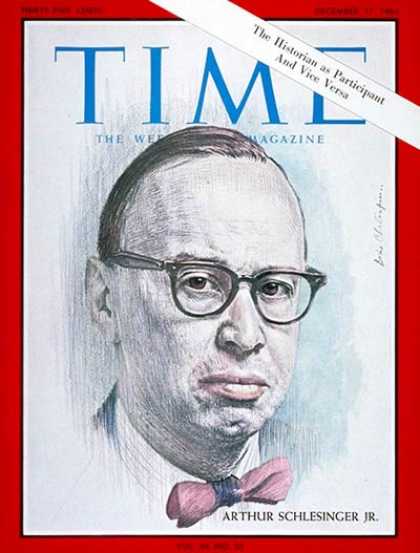
In my Critical Readings in History course I've paired selections from John Hope Franklin's memoir with selections from Arthur Schlesinger, Jr.'s autobiography. Both went to Harvard in the 1930s. Students can see pretty clearly the basic differences in their backgrounds. One grew up in a well-to-do white family with ties to America's intellectual aristocracy. The other came of age in Oklahoma, struggling with poverty and race prejudice. It's not difficult to move from that reading to a discussion of how historians pick the topics they study and how historians are formed by their setting. From there students can reflect on their own interests and how history is, at least in some sense, autobiographical.

I recently dusted off and started rereading C. Vann Woodward's Thinking Back: The Perils of Writing History (Baton Rouge: LSU Press, 1987). Years before he became the tweedy, pipe-smoking Johns Hopkins and then Yale sage of southern history, Woodward was an aspiring historian, not quite sure what the next stage in his life would hold for him. Still, he was ahead of the game. He already had what would be a major book underway while he was still a grad student at UNC in the 1930s:

With a fresh if empty mind and an exciting book of my own underway, I reasoned that perhaps I would now see this unexplored field take on a new glamor and I would rise to the challenge. Much better minds had done so. After all, I was nearly four years older since my first brush with the subject and far riper in wisdom—or so I thought. The first thing to do, I was told, was to master the standard "sets"—the old American Nation series, the Yale Chronicles, and others guaranteed to bring one up to date. Noting with some puzzlement that most of the many volumes were already a generation old, I nevertheless plunged in. That first plunge was chilling. Plodding through volume after volume, I began to wonder if I had ever encountered prose so pedestrian, pages so dull, chapters so devoid of ideas, whole volumes so wrongheaded or so lacking in point. Was there anything memorable about what one was expected to remember? Was this the best my newly chosen profession could do? Was it what I would be expected to do? A career, a lifetime dedicated to inflicting such reading on innocent youth? Or accepting it as a model for myself? Fleeing the stacks repeatedly, I spent much of that first year pacing Franklin Street by night debating whether I might fare better as a fruit-peddler, panhandler, or hack writer. . . . (21-22)

No Southern youth of any sensitivity could help being excited by the explosion of creativity taking place during the early 1930s—in fiction, in poetry, in drama. Nor could I help seeing that the novelists, poets, and playwrights were in the main writing about the same South historians were writing about and making the whole world of letters at home and abroad read what they wrote and ring with their praise. With this awareness and the expectations it aroused, I arrived as a young apprentice at the doors of the history guild for training—and what a striking contrast, what a letdown, what a falling off! No renaissance here, no surge of innovation and creativity, no rebirth of energy, no compelling new vision. This was a craft devoted primarily at the time, or so it seemed to me, to summing up, confirming, illustrating, and consolidating the received wisdom, the regional consensus that prevailed uniquely in the South of the 1930s and
—though I could not then have known it—was to continue through the 1940s. That consensus proclaimed the enduring and fundamentally unbroken unity, solidarity, and continuity of Southern history. (23)

The business about continuity sums up much of Woodward's work as a historian. Indeed, at the beginning of The Strange Career of Jim Crow (1955) he wrote "The people of the South should be the last Americans to expect continuity of their institutions and social arrangements" (3). The book—which Martin Luther King, Jr., called the historical bible of the civil rights movement— argued forcefully that the South's segregationist turn in the 1890s was something new. Woodward's memoir abounds with similar insights into his life and career.

There are many other memoirs by historians that I'd still like to explore. I include here a handful of those I've read and a great many more that I haven't.

Max Beloff, An Historian in the Twentieth Century: Chapters in Intellectual Autobiography (New Haven: Yale University Press, 1992)

Thomas Dionysius Clark, My Century in History: Memoirs (Lexington: University of Kentucky Press, 2006)

Arthur Schlesinger, Jr., A Life in the Twentieth Century: Innocent Beginnings, 1917-1950 (New York: Houghton Mifflin Harcourt, 2000)

Gerda Lerner, Fireweed: A Political Autobiography (Philadelphia: Temple University Press, 2003)

Forrest McDonald, Recovering the Past: A Historian's Memoir (Lawrence: University Press of Kansas, 2004)

John Hope Franklin, Mirror to America: The Autobiography of John Hope Franklin (New York: FSG, 2005)

Margaret Atwood Judson, Breaking the Barrier: A Professional Autobiography by a Woman Educator and Historian before the Women's Movement (New Brunswick: Rutgers, 1984)

George F. Kennan, Memoirs, 1925-1950 (New York: Pantheon, 1983)

William Hardy McNeill, The Pursuit of Truth: A Historian's Memoir (Lexington: University Press of Kentucky, 2005)

Henry Adams, The Education of Henry Adams: An Autobiography (Boston: Houghton Mifflin, 1918)

Maria LĂșcia G. Pallares-Burke, The New History: Confessions and Conversations (Malden, Mass.: Blackwell, 2002)

James M. Banner Jr. Jr. and John R. Gillis, eds., Becoming Historians (Chicago: University of Chicago Press, 2009)

John Lukacs, Confessions of an Original Sinner (New York: Ticknor and Fields, 1990)

John B. Boles, ed., Autobiographical Reflections on Southern Religious History (Athens: University of Georgia Press, 2001)

John B. Boles, ed., Shapers of Southern History: Autobiographical Reflections (Athens: University of Georgia Press, 2004)

Guy Stanton Ford, ed., (New York: Henry Holt and Company, 1910) Essays in American history, Dedicated to Frederick Jackson Turner. Read Carl Becker on Kansas!