Showing posts with label China. Show all posts

Chinese History Roundup

.
Roberta Smith, "History Unfolding on a Hand Scroll," New York Times, January 26, 2012

The painter Fu Baoshi was born in China in 1904, seven years before the Chinese Revolution brought 2,100 years of dynastic rule to an end. He died in 1965, months before China’s Communist regime unleashed the Cultural Revolution, which aggressively persecuted the country’s writers, artists and other intelligentsia, sometimes unto death.>>>

"A nation of city slickers.
A first in Chinese history: city-dwellers outnumber the rural population,"
The Economist, January 21, 2012

FOR a nation whose culture and society have been shaped over millennia by its rice-, millet- and wheat-farming traditions, and whose ruling Communist Party rose to power in 1949 by mobilising a put-upon peasantry and encircling the cities, China has just passed a remarkable milestone. By the end of 2011, according to the National Bureau of Statistics, more than half of China’s 1.35 billion people were living in cities.>>>

Sergey Radchenko, "China's iron grip on past impairs future on world stage," Sydney Morning Herald, January 4, 2012

With China stumping assertively on the world stage, one might think Beijing would be open, even gracious, about the country's past. To the contrary, history remains a sensitive subject, drawing relentless attention from authorities anxious to keep all skeletons safely in closets.>>>

Bethan Jinkinson, "The story behind Chinese war epic The Flowers of War," BBC, January 24, 2012

The film, directed by Zhang Yimou and starring English actor Christian Bale, opened in China on 16 December.

Since then it has been shown on thousands of screens across the country, taking $93m (£60m) gross in its first five weeks, according to entertainment research group EntGroup Consulting.

It was also the highest-grossing Chinese film of 2011.>>>

Chinese History Roundup

.
Rana Mitter, "The Opium War by Julia Lovell – review," Guardian, September 2, 2011

The newly refurbished National Museum of China opened in March 2011 in Tiananmen Square, adorned with groundbreaking technology and architecture. But the story it tells is far less innovative than the design. In the museum's narrative, China's modern period of history opens with the opium war, the original sin of western imperialism in East Asia that forced China to open itself to a century of humiliation, conquest and exploitation until Chairman Mao came to sweep all that away. It's titled "The Road to Rejuvenation", but it could just as easily be called "1842 and all that". This version of the past says more about contemporary Chinese politics, still drawing on China's history as a victim of western imperialism, than it does about the reality of the clash between the 19th century's greatest land and naval empires. Even in a 21st-century museum, the stain of a history more than 150 years old is central.>>>

Daniel J. Watkin, "Historical Opera Is Canceled in Beijing," NYT blog, September 26, 2011

An opera about Sun Yat-sen, China’s first president and Nationalist leader, has been canceled shortly before its scheduled opening at the National Center for the Performing Arts in Beijing because of official objections to the music, according to the composer’s representatives. The work, “Dr. Sun Yat-sen” by Huang Ruo and a production of Opera Hong Kong, was to have opened on Friday, roughly coinciding celebrations of the 100th anniversary of the Chinese revolution. Mr. Ruo’s management, Karsten Witt Music Management in Berlin, said a government official had gone to rehearsals and decided that the music was inappropriate.>>>

John DeFore, "Detective Dee and the Mystery of the Phantom Flame (Di Renjie)," Washington Post, September 23, 2011

Filmmaker Tsui Hark, who helped define Hong Kong cinema in the '80s and '90s, brings supernatural sleuthing to the Tang Dynasty in "Detective Dee and the Mystery of the Phantom Flame," a lightweight but enjoyable yarn set in the days before the official rise to power of China's only empress regnant.>>>

Karen Wada, "Huntington Library sets shows on American history, Chinese mirrors," LA Times, September 1, 2011

Two American history shows -- one looking at the sweeping changes spawned by the transcontinental railroad and the other at how Civil War photographs influenced the ways the nation grieved -- will highlight the 2012 exhibition season at the Huntington Library, Art Collections, and Botanical Gardens. . . . The Huntington also is announcing Thursday an addition to its 2011 calendar: the first public display of a group of Chinese bronze mirrors spanning 3,000 years. "Ancient Chinese Bronze Mirrors from the Lloyd Cotsen Collection," which will run Nov. 12 to May 14, will feature about 80 intricately decorated items from the Qijia Culture (c. 2100 to 1700 B.C.) to the Jin Dynasty (1115-1234).>>>

David Whiting, "‘New’ China asks for understanding," OC Register, September 23, 2011

. . . . Echoing many I met, Hong Lei, a deputy director-general at the Ministry of Foreign Affairs, suggested that instead of looking at China from an American perspective, try looking at China though a Chinese perspective.

For Lei and others, that means getting to know a little Chinese history. Why history?

Stuff happens and laws get made, often for a reason.

Consider our First and Second Amendments. Without British oppression, they might not exist.

In a small-world twist, British oppression also helped form modern China.>>>

An Interview with Hilary Spurling on Pearl Buck

Randall Stephens

The January issue of Historically Speaking will soon be up on the Project Muse site. In the meantime, here's a selection from my interview with Hilary Spurling, which appears in the issue.

In 1932 Pearl S. Buck, daughter of American missionaries in China, won the Pulitzer Prize for her novel The Good Earth (John Day, 1931). Set in rural China, the book chronicles the struggles of a peasant and his slave-wife. In 1937 the novel was adapted into a Hollywood film. One year later Buck was awarded the Nobel Prize for Literature.

The British biographer Hilary Spurling—Ivy: The Life of I. Compton-Burnett (Knopf, 1984); The Girl from the Fiction Department: A Portrait of Sonia Orwell (Counterpoint, 2004); Matisse the Master: A Life of Henri Matisse: The Conquest of Colour, 1909-1954 (Knopf, 2007), winner of the Whitbread Book of the Year Award and the Los Angeles Times Biography prize—takes up Buck’s story in Pearl Buck in China: Journey to The Good Earth (Simon & Schuster, 2010). Focusing on Buck’s first four decades, Spurling stresses the American author’s intimate familiarity with China. Historically Speaking editor Randall Stephens recently spoke to Spurling about her study of Buck.


Randall Stephens: Why has Pearl Buck’s reputation suffered in recent years?

Hilary Spurling: She had many critics in her own day, too. Her success was so sudden and so enormous, and she was a complete outsider. She was a nobody. She had no contacts, no backup and no track record. When The Good Earth was published at the beginning of the 1930s by a publisher about to go bankrupt, it immediately became not just an American best seller but a global best seller. She won a Pulitzer Prize right away, and a few years later she won the Nobel Prize. Literary critics said, what is The Good Earth? An agricultural history of China? They couldn’t make heads or tails of it.

She had lived in China all her life. Buck never felt at home in America, in the 1930s or afterward. Brought up in China, she spoke Chinese fluently and her childhood friends were Chinese. When she was young, she didn’t know any other Westerners. She imagined she would spend her whole life in China.

When she lived in the United States, Buck was alienated by American politics. She knew and loved China so well that she became in a certain sense an apologist for China, trying to explain China to the West. As America moved sharply to the right in the 1950s, Buck was branded as a communist sympathizer. In communist China, however, she was a public enemy, and her books were forbidden. People were punished and humiliated if they’d even heard of her, let alone met her. She got flack from all sides throughout the second half of her life.

I wrote the biography partly because I wanted to write about China. I wanted to explore China and how it reached the state it is in now. In addition, I think that Pearl Buck is one of the great Americans of the 20th century, and I hope that Americans might look at her again and recognize her achievements as quite extraordinary.

Stephens: How would you sum up her relevance today?

Spurling: Think of how Western attitudes toward China have changed in the last four or five years. When I wrote the proposal for this book four years ago, publishers both in American and in England weren’t very interested. They saw no trace of the shock and awe I think we all feel now on both sides of the Atlantic about China. We understand now that China is a very large part of the future for all of us. And I think it no exaggeration to say that Buck was initially responsible for the West’s change in outlook. Nobody since Marco Polo in the 13th century has opened up the East to the West as much as Buck did. We can see the seeds of our attitudes toward China now in what she wrote so long ago. She was the first to foresee China’s future as a superpower. She was a young woman then. It’s extraordinary to see that as early as 1925 she understood that China would become the leader of Asia and that America needed to cultivate its relationship with China.

Stephens: Has she been reassessed in China today?

Spurling: Yes, she is being reassessed again on quite a large scale. In my lifetime she was officially regarded as a public enemy of the whole Chinese nation. Schoolchildren were told to denounce her. One of them was the Chinese novelist Anchee Min, who told me that as a student she was chosen to denounce Pearl Buck. She asked her teachers if she could read The Good Earth because she said it would give her more grounds. They said no Chinese citizen could read it because it was too toxic.

I finished my book last November, and that very month Buck was named on Chinese state radio—which of course is an official voice of the Chinese state—as one of the top ten international friends of China. I see that as a measure of the rate at which China and China’s opinions are changing. People now want to read Buck. The Good Earth was her farewell to China, the last thing she wrote before she left that country for good. No one else in the West was in a position to write such a book, and no Chinese person either. The Chinese writers who were Pearl’s contemporaries—young intellectuals, many of whom she knew and whose battles she fought—shaped and trained her far more than any American writers would. But the last thing such Chinese writers wanted to do was write about the village life they had struggled so hard to escape from. Roughly 85% of Chinese people were illiterate peasants. Chinese intellectuals at the time yearned to go to Beijing or Shanghai and to write about Eugene O’Neill.

Chinese History: Roundup

.
Ken Johnson, "To See a Universe in the Tiny Details of Chinese Artifacts, Boxes to Birds," New York Times, December 31, 2010

Organized by Denise Leidy and Joyce Denney, curators in the Met’s Asian art department, the show presents about 160 mostly desktop-scale works from the museum’s collections, including ornate boxes; carvings in wood, jade, amber, ivory and other semi-precious materials; ceramic vases; and lavishly embroidered silk kimonos used in royal theatrical performances. To pore over these objects is to be repeatedly astounded by the level of design and technical achievement.>>>

Pankaj Mishra, "Staying Power: Mao and the Maoists," New Yorker, December 20, 2010

This persistence of Mao in official discourse and popular imagination may seem an instance of ideological pathology—the same kind that makes some Russian nationalists get misty-eyed about Stalin. Indeed, the Communist state’s vast propaganda apparatus first exalted Mao to divine status. But then a non-ideological view of Mao has rarely been available in the West, even as he has gone from being a largely benign revolutionary and Third Worldist icon to, more recently, sadistic monster. This is largely due to China’s ever shifting place in the Western imagination.>>>

Perry Link, "China: From Famine to Oslo," New York Review of Books, January 13, 2011
The main reason why the Great Famine continues to haunt China fifty years after it happened is that people are obliged—forcibly, if necessary—to continue to accord the famine’s primary perpetrator, Mao Zedong, a position of honor. Mao’s portrait still hangs at the center of Tiananmen, where it overlooks his embalmed body, which lies supine in his mausoleum within the giant square. And Mao remains the spiritual godfather of today’s regime.>>>

Laura Allsop, "The hidden history of China in photos," CNN, December 23, 2010

Daguerreotypes and photographs from the period between 1840 and 1911, which up till recently have not been widely collected or displayed, show a country undergoing vast change, caught between its ancient traditions and modernization. But they are not only historical documents of a changing land: the delicate, sepia-toned images that exist are now being assessed for their art historical value as well and show Chinese photographers of the time interpreting the medium according to centuries-old artistic traditions.>>>

Roger Ebert, Review of Last Train Home, October 13, 2010

The film opens like a big-picture documentary, showing us a huge crowd being directed by police as it grinds its way forward. We are informed that these are some of the 130 million Chinese citizens who make an annual train journey from urban centers to their provincial villages — “the largest human migration in the world.” . . .

There is so much to say about this great film. You sense the dedication of Lixin Fan and his team. (He did much of the
cinematography and editing himself.) You see once again the alchemy by which a constantly present camera eventually becomes almost unnoticed, as people live their lives before it. You know the generations almost better than they know themselves, because the camera can be in two places and they are usually in one or the other.>>>

Lehman Brothers . . . and History in Art

Heather Cox Richardson

On Wednesday, September 29, Christie’s auctioned off about twelve million dollars worth of artwork from the wreckage of Lehman Brothers. (Auction catalog.) While the pieces that made the news were Ethiopian artist Julie Mehretu’s “Untitled 1,” which went for slightly more than $1 million, and Chinese artist Liu Ye’s “The Long Way Home,” which sold for slightly less than $1 million, historians can learn from the collection as a whole. It shows the history of the Lehman Brothers enterprise from its origins in the antebellum South through the collapse of 2008.

In a Wikipedia nutshell, the history of Lehman brothers runs like this:

What would become Lehman Brothers started in 1844 when Bavarian immigrant Henry Lehman opened a dry goods store in Montgomery, Alabama. Soon Henry’s brothers, Mayer and Emanuel Lehman, arrived in America, and the three became cotton traders, organized as Lehman Brothers. The company opened a branch office in Manhattan in 1858, and moved headquarters there after the Civil War. By the 1880s, the surviving Lehman brothers (Henry had died of the dreaded yellow fever before the war) were heavily involved in the worlds of trade and finance.

So far, so good—at least as far as I know. But while Wikipedia goes on to list the company’s involvement with stocks and financial instruments, the artwork Christie’s sold tells a different story.

Notable, if you look through the collection, is the large number of Chinese art and artifacts. This suggests that Lehman Brothers was deeply involved in the late nineteenth-century Pacific trade, which took off after the 1868 Burlingame Treaty opened China to US business, and which brought enormous wealth to America before WWI. A number of paintings sold on Wednesday were of ships, both merchant ships and navy ships (and one excursion steamer painted by Gideon Yates*). The Lehman brothers clearly recognized the importance of ships both to carry and to protect their business ventures. They were—if you can trust their art—almost certainly involved in China.

The rest of the collection sold Wednesday tells another story. The many early eighteenth-century British paintings and prints were undoubtedly a way for rising immigrant businessmen to nail some status to their walls. And the recent years of world-wide investment banking not surprisingly added the sophistication of modern art to the collection.

The earlier and later art Lehman Brother gathered seems to me about what you would expect from a longstanding business’s art collection. But the Chinese pieces and the maritime art was a surprise. I had never thought that the Lehman Brothers that collapsed so spectacularly in 2008 might have been a player in America’s nineteenth-century ocean trade.

__________

*No, guys, I’m not kidding. It sold for $3,748.

History through the Eyes of . . . Xuanzang: Indian Life, 7th Century AD

Randall Stephens

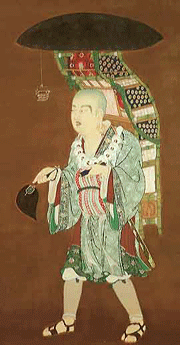
From 629 to 645 AD the Chinese pilgrim Xuanzang wandered through Central Asia and India. His observations provide some insight into the customs, religious beliefs, and life in general in that land. He sailed down the Ganges, hobnobbed with Indian royalty, and traveled extensively on the subcontinent.

He developed a considerable reputation as a scholar in India. Much of his time there he spent studying at the Nalanda monastery, a well-known religious scholarly community. He would translate the sacred texts of Buddhism from Sanskrit into Chinese.

In the passages excerpted here, Xuanzang observes the towns, streets, customs, and behaviors of some of the sites he visited in India.

Si-Yu-Ki: Buddhist Records of the Western World, Vol 1, Samuel Beal, trans. (London, 1906), 73-74, 83, 85.

Towns and Buildings

The towns and villages have inner gates; the walls are wide and high; the streets and lanes are tortuous, and the roads winding. The thorough fares are dirty and the stalls arranged on both sides of the road with appropriate signs. Butchers, fishers, dancers, executioners, and scavengers, and so on, have their abodes without the city. In coming and going these persons are bound to keep on the left side of the road till they arrive at their homes. Their houses are surrounded by low walls, and form the suburbs. The earth being soft and muddy, the walls of the towns are mostly built of brick or tiles. The towers on the walls are constructed of wood or bamboo; the houses have balconies and belvederes, which are made of wood, with a coating of lime or mortar, and covered with tiles. The different buildings have the same form as those in China: rushes, or dry branches, or tiles, or boards are used for covering them. The walls are covered with lime and mud, mixed with cow's dung for purity. At different seasons they scatter flowers about. Such are some of their different customs. . . .

Manners, Administration of Law, Ordeals

With respect to the ordinary people, although they are naturally light-minded, yet theyare upright and honourable. In money matters they are without craft, and in administering justice they are considerate. They dread the retribution of another state of existence, and make light of the things of the present world. They are not deceitful or treacherous in their conduct, and are faithful to their oaths and promises. In their rules of government there is remarkable rectitude, whilst in their behaviour there is much gentleness and sweetness. . . .

Forms of Politeness

There are nine methods of showing outward respect— (1) by selecting words of a soothing character in making requests; (2) by bowing the head to show respect; (3) by raising the hands and bowing; (4) by joining the hands and bowing low; (5) by bending the knee; (6) by a prostration;29 (7) by a prostration on hands and knees; (8) by touching the ground with the five circles; (9) by stretching the five parts of the body on the ground.

Of these nine methods the most respectful is to make one prostration on the ground and then to kneel and laud the virtues of the one addressed. When at a distance it is usual to bow low; when near, then it is customary to kiss the feet and rub the ankles (of the person addressed).

See also, Richard Bernstein, Ultimate Journey: Retracing the Path of an Ancient Buddhist Monk Who Crossed Asia in Search of Enlightenment (Alfred A. Knopf, 2001); Sally Hovey Wriggins Xuanzang: A Buddhist Pilgrim on the Silk Road (Boulder: Westview Press, 1996); and D. Devahuti, ed, The Unknown Hsuan-Tsang (Oxford University Press, 2001).

Roundup: Asian History, Ancient and Modern

History News, Reviews, and the Like from around the World

"N. Korean-Japanese Team Finds Koguryo Tomb in Pyongyang," The Chosun Ilbo, Aug 15, 2010‎.

Academics from North Korea and Japan have unearthed a large tumulus from the Koguryo period in Pyongyang, providing valuable material for studying the history of ancient East Asia, Japan's Kyodo news agency said Saturday. About 4.5 km away from the downtown Pyongyang, the tomb was discovered during construction work in Tongsan-dong, the Lelang District of the Koguryo era and is presumed to have been created around the 5th century. >>>

Jim Eagles, "Silk Road: Tracing the path of ancient footsteps," New Zealand Herald, August 11, 2010.

Jim Eagles travels a well worn path through a historic landscape and finds plenty of remnants from its fascinating past still in place. The old caravanserai stands beside a section of the Silk Road as it has done for over a thousand years. On the other side of the road is an equally ancient cistern built to to provide water for camel caravans plying the hot, dry, dusty path between the timeless cities of Samarkand and Bukhara. >>>

Edward Wong, "China Seizes on a Dark Chapter for Tibet," New York Times, August 9, 2010.

GYANTSE, Tibet — The white fortress loomed above the fields, a crumbling but still imposing redoubt perched on a rock mound above a plain of golden rapeseed shimmering in the morning light. A battle here in 1904 changed the course of Tibetan history. A British expedition led by Sir Francis E. Younghusband, the imperial adventurer, seized the fort and marched to Lhasa, the capital, becoming the first Western force to pry open Tibet and wrest commercial concessions from its senior lamas. >>>

Razib Khan, "Empires of the Word & anti-Babel," Discovery Magazine blog, August 16, 2010.

European nationalism in the 19th and 20th centuries was in large part rooted in the idea that language defined the boundaries of a nation. During the Reformation era some German-speaking Roman Catholic priests declaimed the value of the bond of language against that of religion, praising those non-Germans who adhered to the Catholic cause against German speaking heretics (in the specific case the priest was defending Spanish tercios brought in by the Holy Roman Emperor to put down the rebellion of Protestant German princes). . . . Newer lingua francas, French and later English, lack the deep unifying power of Latin in part because they are also living vernaculars. They may resemble Latin in some particulars of function, but eliding the differences removes far too much from the equation to be of any use. Linguistic diversity is a fact of our universe, but how it plays out matters a great deal, and has mattered a great deal, over the arc of history. >>>

"Pearl Buck in China by Hilary Spurling," New Yorker, August 16, 2010.

Emphasizing the imagination’s power to “make bearable things too ugly to confront directly,” Spurling sensitively traces the biographical background of Buck’s writing. Buck, the daughter of missionaries, spent nearly all of the first forty-two years of her life in China, and her childhood was marked both by grand upheavals such as the Boxer Rebellion and by the stark asperities of everyday poverty. >>>

[I'll be interviewing Spurling about her biography for an upcoming issue of Historically Speaking]