Showing posts with label India. Show all posts

March 2011 Issue of the Journal of the Historical Society

Randall Stephens

The new issue of the Journal of the Historical Society has been arriving in mailboxes this past week. Articles from it can be downloaded at the Wiley Online Library. The March 2011 issue features:

"Blind Men of Industan"
F. S. Naiden

"Three Weeks in Mississippi: James Meredith, Aubrey Norvell, and the Politics of Bird Shot"
Aram Goudsouzian

"Neither a Secular nor Confessional Age: The Bonn Reunion Conferences of 1874 and 1875"
Thomas Albert Howard

"Tar and Feathers"
Barry Levy

"The Age of Reagan? Three Questions for Future Research"
John Ehrman

Here is a little from Howard's "Neither a Secular nor Confessional Age: The Bonn Reunion Conferences of 1874 and 1875":

Europe's "revolutionary century," the nineteenth, has experienced its own historiographical revolution in recent decades. Not too long ago its direction reflected the academy's penchant to think in terms of "secularization"; the title of Owen Chadwick's The Secularization of the European Mind in the Nineteenth Century (1975) might serve as an illustration of an earlier status quo. Encouraged by the advent of the so-called "new cultural history" in the 1990s and building momentum ever since, religious topics have emerged as a significant focus of scholarship. One German scholar, Olaf Blaschke, has influentially proposed that, far from a "secular age," we might do better to think of the nineteenth century as a "second confessional era," in light of the persistence of Catholic and Protestant "milieus" throughout Western Europe and lingering confessional animosities and prejudices. Blaschke's words have received much deserved attention. read more >>>
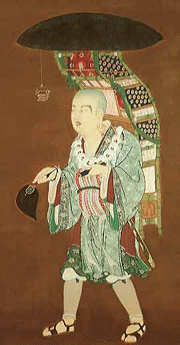
History through the Eyes of . . . Xuanzang: Indian Life, 7th Century AD

Randall Stephens

From 629 to 645 AD the Chinese pilgrim Xuanzang wandered through Central Asia and India. His observations provide some insight into the customs, religious beliefs, and life in general in that land. He sailed down the Ganges, hobnobbed with Indian royalty, and traveled extensively on the subcontinent.

He developed a considerable reputation as a scholar in India. Much of his time there he spent studying at the Nalanda monastery, a well-known religious scholarly community. He would translate the sacred texts of Buddhism from Sanskrit into Chinese.

In the passages excerpted here, Xuanzang observes the towns, streets, customs, and behaviors of some of the sites he visited in India.

Si-Yu-Ki: Buddhist Records of the Western World, Vol 1, Samuel Beal, trans. (London, 1906), 73-74, 83, 85.

Towns and Buildings

The towns and villages have inner gates; the walls are wide and high; the streets and lanes are tortuous, and the roads winding. The thorough fares are dirty and the stalls arranged on both sides of the road with appropriate signs. Butchers, fishers, dancers, executioners, and scavengers, and so on, have their abodes without the city. In coming and going these persons are bound to keep on the left side of the road till they arrive at their homes. Their houses are surrounded by low walls, and form the suburbs. The earth being soft and muddy, the walls of the towns are mostly built of brick or tiles. The towers on the walls are constructed of wood or bamboo; the houses have balconies and belvederes, which are made of wood, with a coating of lime or mortar, and covered with tiles. The different buildings have the same form as those in China: rushes, or dry branches, or tiles, or boards are used for covering them. The walls are covered with lime and mud, mixed with cow's dung for purity. At different seasons they scatter flowers about. Such are some of their different customs. . . .

Manners, Administration of Law, Ordeals

With respect to the ordinary people, although they are naturally light-minded, yet theyare upright and honourable. In money matters they are without craft, and in administering justice they are considerate. They dread the retribution of another state of existence, and make light of the things of the present world. They are not deceitful or treacherous in their conduct, and are faithful to their oaths and promises. In their rules of government there is remarkable rectitude, whilst in their behaviour there is much gentleness and sweetness. . . .

Forms of Politeness

There are nine methods of showing outward respect— (1) by selecting words of a soothing character in making requests; (2) by bowing the head to show respect; (3) by raising the hands and bowing; (4) by joining the hands and bowing low; (5) by bending the knee; (6) by a prostration;29 (7) by a prostration on hands and knees; (8) by touching the ground with the five circles; (9) by stretching the five parts of the body on the ground.

Of these nine methods the most respectful is to make one prostration on the ground and then to kneel and laud the virtues of the one addressed. When at a distance it is usual to bow low; when near, then it is customary to kiss the feet and rub the ankles (of the person addressed).

See also, Richard Bernstein, Ultimate Journey: Retracing the Path of an Ancient Buddhist Monk Who Crossed Asia in Search of Enlightenment (Alfred A. Knopf, 2001); Sally Hovey Wriggins Xuanzang: A Buddhist Pilgrim on the Silk Road (Boulder: Westview Press, 1996); and D. Devahuti, ed, The Unknown Hsuan-Tsang (Oxford University Press, 2001).