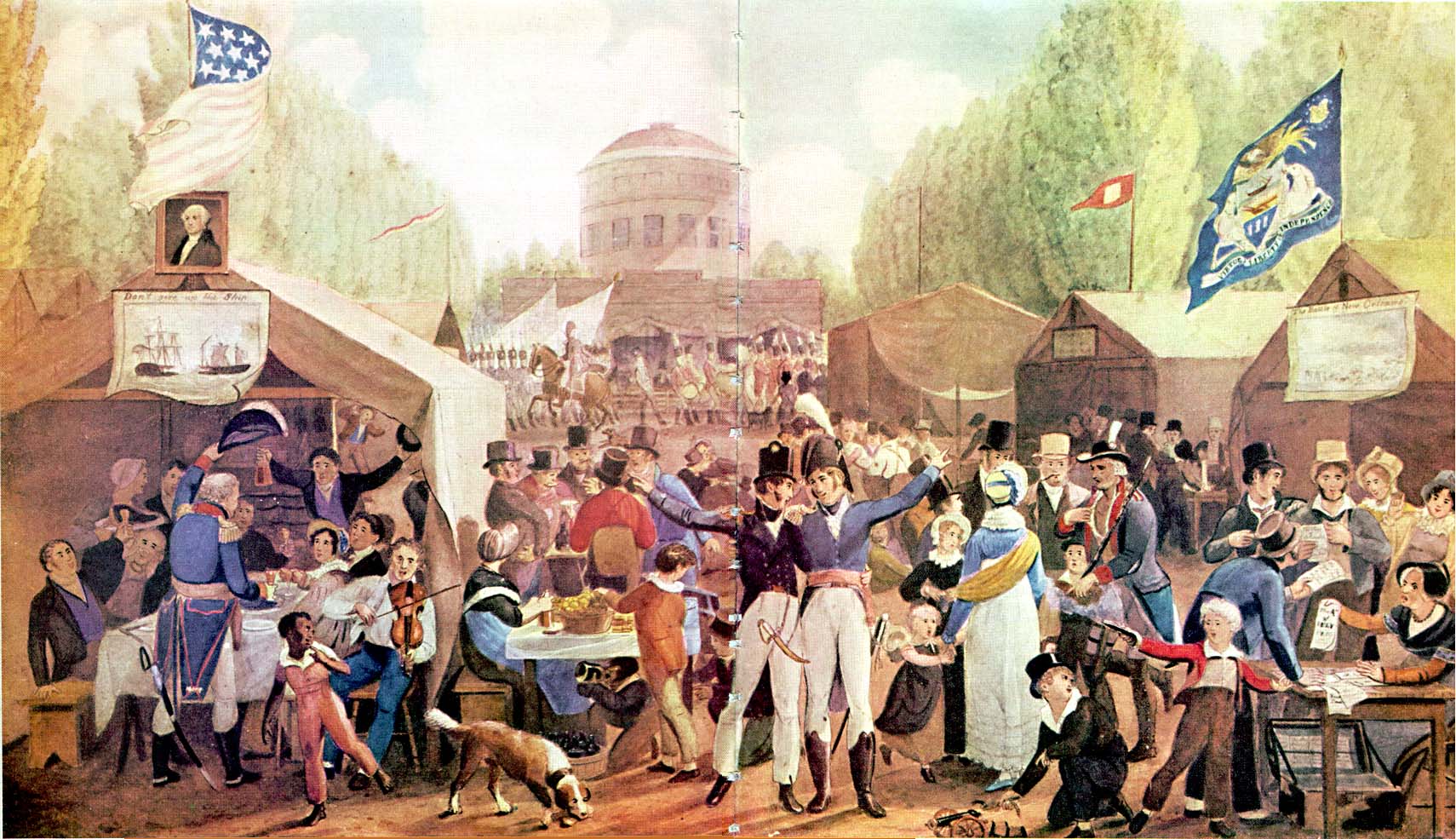
Showing posts with label Fourth of July. Show all posts

4th of July Roundup

.
Jim Cullen, "The Declaration of Independence and the American Dream," HNN, June 29, 2011

"America is a young country," people sometimes say. What they really seem to mean is: "the United States is a young nation." Such a statement makes some sense if one thinks of a political entity that came into existence circa July 4, 1776. It makes less sense when one considers that the Constitution that followed about a dozen years later is the oldest written functioning one in the world. Compared with a traditional nation-state like France or Spain, sure—the United States is a young nation, even if France has had a few republics since then.>>>

"American civil war re-enactment in South Yorkshire - in pictures," Guardian, July 4, 2011

Enthusiasts from all walks of life took part in re-enacting scenes from the American Civil War and in 'living history' events in the grounds of Cusworth Hall, near Doncaster, which are as authentic as possible.>>>

Peter Rothberg, "What Is Patriotism," Nation, July 1, 2011

The first sentence of The Nation's prospectus, dated July 6, 1865, promised "the maintenance and diffusion of true democratic principles in society and government," surely a patriotic sentiment, as was the magazine's name.

Since that time The Nation has attempted to represent and give voice to the best of American values and culture and has steadfastly resisted all efforts through the years to brand dissent as unpatriotic.>>>

Amy Bingham, "Almost a Fourth of Americans Do Not Know When the U.S. Declared Independence," ABC News, July 4, 2011

American Fourth of July traditions are tightly woven into the fabric of U.S. society, but the history of the country’s independence seems to have slipped through the seams.

A Marist poll released Friday shows that only 58 percent of Americans know when the country declared independence. Nearly a fourth of respondents said they were unsure and sixteen percent said a date other than 1776, when the Declaration of Independence was signed.>>>

Brian Handwerk, "Fourth of July: Nine Myths Debunked," National Geographic, July 4, 2011

Many time-honored patriotic tales turn out to be more fiction than fact. On the Fourth of July—today marked by a continent-spanning Google doodle—here's a look at some memorable myths from the birth of the United States.>>>

"Fourth of July, Bah Humbug!" Says Frederick Marryat

Randall Stephens

Many a European traveler crisscrossed the United States in the 1830s and 1840s, writing down their observations, scoffing and laughing when and where appropriate, or cheering on the bumptious new country. Tocqueville is the most famous. Charles Dickens and Frances Trollope also come to mind. But there are scores of others, too. (I've been trying to track down any travel record written by a Norwegian in the 19th century. Any help?) Reading their accounts is fascinating and illuminates what English, French, and German men and women of letters made of this loud, proud, rowdy new nation.

Naval officer and British novelist Frederick Marryat (born , July 10, 1792, London—died Aug. 9, 1848, Langham, Norfolk, Eng.) was not pleased with the rough-and-tumble barbarities of the Americans and their seeming disinterests in real education and real cultivation. He thought it especially irksome that the egalitarian handshake was the universal greeting in the land. Was everybody here of the same station? How awful.

So, to shed light on what some non-Americans thought about our national holiday and what it said about the country, I quote a passage here from Marryat's A Diary in America: With Remarks on Its Institutions (New York, 1839). Note the judgments about education and the mobocratic tendencies of the young country.

"Lesson 62. "Story about the 4th of July. "6. "I must tell you what the people of New York did. In a certain spot in that city there stood a large statue, or representation of King George III. It was made of lead. In one hand he held a sceptre, a kind of sword, and on his head he wore a crown.

7. "When the news of the Declaration of Independence reached the city, a great multitude were seen running to the statue.

8. "The cry was heard, 'Down with it—down with it P and soon a rope was placed about its neek, and the leaden King George came tumbling down.

9. "This might fairly be interpreted as a striking prediction of the downfall of the monarchial form of government in these United States.

10. "If we look into history, we shall frequently find great events proceeding from as trifling causes as the fall of the leaden statue, which not unaptly represents the character of a despotic prince.

11. "I shall only add, that when the statue was fairly down, it was cut to pieces, and converted into musket-balls to kill the soldiers whom his majesty had sent over to fight the Americans."

This is quite sufficient for a specimen. I have no doubt that it will be argued by the Americans: "We are justified in bringing up our youth to love our institutions" I admit it; but you bring them up to hate other people, before they have sufficient intellect to understand the merits of the case.

The author of "A Voice from America," observes— "Such, to a great extent is the unavoidable effect of that political education which, is indispensable to all classes of a self-governed people. They must be trained to it from their cradle; it must go into all schools; it must thoroughly leaven the national literature; it must be line upon line, and precept upon precept, here a little and there a little; it must be sung, discoursed, and thought upon everywhere and by everybody."

And so it is; and as if this scholastic drilling were not sufficient, every year brings round the 4th of July, on which is read in every portion of the states the act of independence, in itself sufficiently vituperative, but invariably followed up by one speech (if not more) from some great personage of the village, hamlet, town, or city, as it may be, in which the more violent he is against monarchy and the English, and the more he flatters his own countrymen, the more is his speech applauded.

Every year is this drilled into the ears of the American boy, until he leaves school, when he takes a political part himself, connecting himself with young men's society, where he spouts about tyrants, crowned heads, shades of his forefathers, blood flowing Like water, independence, and glory. . . .

I think, after what I have brought forward, the reader will agree with me, that the education of the youth in the United States is immoral, and the evidence that it is so, is in the demoralization which has taken place in the United States since the era of the Declaration of Independence, and which fact is freely admitted by so many American writer. . . .

I shall by and by show some of the effects produced by this injudicious system of education; of which, if it is necessary to uphold their democratical institutions, I can only say, with Dr. Franklin, that the Americans "pay much too dear for their whistle." . . .

I will now just give the difference of the acquirements demanded in the new and old country to qualify a young man as an M. D.:—

English Physician and American Physician:

1. A regular classical education at college 1. Not required.

2. Apprenticeship of not less than five years 2. One year's apprenticeship,

3. Preliminary examination in the classics, &c. 3. Not required.

4. Sixteen months' attendance at lectures in 2J 4. Eight months in two years, years.

5. Twelvemonths' hospital practice. 5. Not required,

6. Lectures on botany, natural philosophy, &c. 6. Not required.

Tell us what you really think, Marryat!

And now I'm off to an early Fourth of July picnic/frolic, where there will be loud, inarticulate toasts, booming music of the vulgar sort, long-winded orations, explosions, and democratic-style sport. We will shake hands when we meet each other on a level field.

July 4, 1826

Randall Stephens

It was fifty years to the day after the 13 colonies declared independence from Great Britain.

President John Quincy Adams wrote in his diary about the festivities in Washington. "The volunteer companies assembled on the square," he observed, "fronting the house and paid the passing salute by marching through the yard."

Arriving at the door of the Capitol, I was there met by Mr. Anderson, the Comptroller, with whom we entered the hall of the House of Representatives. The Reverend Mr. Ryland made an introductory prayer.

Joseph Anderson, the Comptroller, read the Declaration of Independence; Walter Jones delivered an oration commemorative of the fiftieth anniversary; the Reverend Mr. Post, Chaplain of H. R. U. S., made a concluding prayer.


After which, Governor Barbour delivered an address to the citizens assembled, soliciting subscriptions for the relief of Mr. Jefferson. . .

News traveled slowly over bad roads. Members of congress knew of Jefferson's troubles, but the severity of his situation was unclear. Few could have guessed that Jefferson's one-time rival and on-again/off-again friend John Adams was also in his last throes. Thomas Jefferson and John Adams died on that hot July day.

Four days later John Quincy received a batch of letters. One brought bad news. A missive "from my brother, written on the morning of the 4th, announcing that, in the opinion of those who surrounded my father's couch, he was rapidly sinking; that they were sending an express for my son in Boston, who might perhaps arrive in time to receive his last breath. The third was from my brother's wife to her daughter Elizabeth to the same purport, and written in much distress." On his way north to Boston, while in Waterloo, MD, he heard that his father had died. It was July 9th. He was stricken with grief. "My father had nearly closed the ninety-first year of his life," he confided to his diary, "a life illustrious in the annals of his country and of the world."

He had served to great and useful purpose his nation, his age, and his God. He is gone, and may the blessing of Almighty Grace have attended him to his account! I say not, May my last end be like his!—it were presumptuous. The time, the manner, the coincidence with the decease of Jefferson, are visible and palpable marks of Divine favor, for which I would humble myself in grateful and silent adoration before the Ruler of the Universe. For myself, all that I dare to ask is, that I may live the remnant of my days in a manner worthy of him from whom I came, and, at the appointed hour of my Maker, die as my father has died, in peace with God and man, sped to the regions of futurity with the blessings of my fellow-men.

Plenty of Americans in 1826 had something to say about the death of two lions of the Revolution. Prone to view the world through the eyes of faith, and to read signs in the sky and on the ground, newspaper editors, clergy, and laypeople were astounded. On July 11 the Massachusetts Salem Gazette lamented "We know not in what language to express ourselves in announcing . . . another event which has transpired to render the late glorious anniversary, the national jubilee, in some respects the most memorable day in the history of our country." That was no hollow encomium. It rang true across the young nation. The New York Commercial Advertiser rhapsodized: "it seems as though Divine Providence had determined that the spirits of these great men, which were kindled at the same altar, and glowed with the same patriotic fervor . . . should be united in death, and travel into the unknown regions of eternity together!"

Some years back Margaret P. Battin wrote in Historically Speaking about the strange coincidence of Jefferson's and Adam's deaths on the same day. "Although the fact that Adams and Jefferson died the same day is taught to practically every schoolchild, asking why is not," Battin noted. "What could explain this? There are at least six principal avenues to explore, but all of them raise further issues." She then offered some of the explanations given over the ages for their demise on that same anniversary.

It makes me wonder about the comparison and contrast between our age and the beginning of the Jacksonian era. Do Americans now have similar ideas linking nation, patriotism, and providence? Do Americans esteem their leaders and the political giants of our day in any way like they did 184 years ago? How have citizens understood God and country from one era to the next?