Showing posts with label Economic History. Show all posts

Economics in the Age of Fracture

Dan Allosso

I’ve started re-reading Daniel T. Rodgers’ Age of Fracture.  I glanced at it in the final run-up to my PhD comps, but it didn’t make much of an impression.  Then Jane Kamensky mentioned it during her closing talk at the Historical Society’s recent conference, and I thought I ought to pick it up again.

This closer reading led me to a couple of thoughts.  First, that there’s probably a whole lot more in many of those books we powered through in grad school; it’s probably worth revisiting some of them and digesting them slowly.  Second, what doesn’t seem relevant when you’re under the gun and trying to absorb the historiography of a field may be really useful when you’re thinking about teaching or writing – especially for the public.

I’ve only scratched the surface of Age of Fracture so far, but it strikes me as a very interesting attempt to argue a complicated point for a more-or-less general audience.  This fascinates me, since I think historians really need to help us all understand how we got to where we are today.  I hope to pick up some ideas about how to do this, especially about where the boundary is between assertion and explication: how much of an argument you can carry with an authoritative voice and how much you need to demonstrate with evidence and analysis.  At one point, for example, Rodgers says, “What precipitates breaks and interruptions in social argument are not raw changes in social experience, which never translate automatically into mind. What matters are the processes by which the flux and tensions of experience are shaped into mental frames and pictures that, in the end, come to seem themselves natural and inevitable: ingrained in the very logic of things” (Kindle Locations 125-127).  This is an interesting claim; very close to the idea I just found in Giambattista Vico’s New Science (another book I picked up as a result of the conference), “Every epoch,” Vico wrote, “is dominated by a ‘spirit’, a genius, of its own. Novelty, like beauty, recommends certain faults which, after fashion changes, become glaringly apparent. Writers, wishing to reap a profit from their studies, follow the trend of their time” (quoted in Anthony Grafton’s Introduction).  It’s a provocative idea, and it obviously has a lineage – but is it true?  And can it be used to explain social change over time?
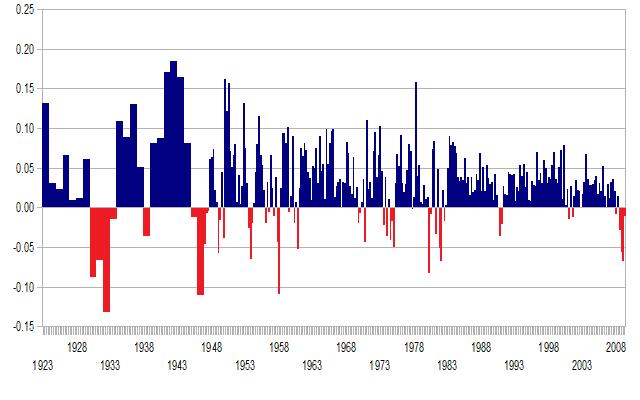
GDP Growth, 1923-2008, (Source: wikimedia).
Another thing Rodgers does, in the early pages of Age of Fracture, is to provide a schematic for a “historiography” of the field of Economics.  Beginning with Alfred Marshall (Principles of Economics, 1890), Rodgers traces the development of economic thinking (and college economic teaching) through Paul Samuelson (Economics, 1948), and then into the variety of competing interpretations resulting from the failure of macro-economic prediction in the 1970s and 80s.  Along the way, Rodgers mentions many of the relevant texts in this development: popular texts such as Milton Friedman’s Capitalism and Freedom and F. A. Hayek’s Road to Serfdom as well as academic titles like Ronald Coase’s “The Problem of Social Cost” and Richard Posner’s Economic Analysis of Law.  It would be interesting to organize a syllabus around these titles, and read them one after another.  In addition to tracing the development of economic theory, the themes of such a class might be to examine whether theory or contingency really moved society, and more importantly to test the point made above by Rodgers and Vico: to see if the explanations offered by economists in their historical moments contain “faults which, after fashion changes, become glaringly apparent.”

Capitalism and Colonialism

Dan Allosso

When I was reading for my US History oral exams, one of the historiographical arguments that really got my attention was the long-running debate over the market transition. The question of when America made the turn from being an agrarian, egalitarian society to becoming a commercial, class society fascinated me; and so did the heated disagreements of eminent historians. As I read more, I realized that a lot of the argument really had to do with the definition and grouping of these terms (as Michael Merrill brilliantly pointed out in a 1995 article called “Putting Capitalism in its Place”). Were Joyce Appleby and Christopher Clark (not to mention Allan Kulikoff or Winifred Rothenberg!) even talking about the same thing when they used the words capitalism, market, commerce, and agrarian? Did “agrarian” naturally line up against “commerce,” and did either side really own the moral high ground?

Now I’m teaching Honors US History to undergrads. Clearly it wouldn’t be appropriate to expose them to the full glare of this debate. It would not only take too long to do, but it would be drilling too deep in even an Honors general education class for non-history majors. But I don’t want to cruise through this moment in history without mentioning it – I’m trying to challenge these students to think critically, so it’s my job to bring up the complex issues the textbook buries.

I had them read a couple of chapters of Matthew Parker’s 2011 book The Sugar Barons. Parker writes about Barbados in the early decades of its sugar revolution, the 1630s and 40s. He includes a detailed description of the introduction of slaves into the British sugar economy, through an interesting series of highly conflicted excerpts from the memoirs of English observers. A really valuable addition, from my perspective, was Parker’s extensive use of letters between several Barbados planters and merchants and John Winthrop, Governor of the City on the Hill.

The direct connection between Boston and the West Indies is useful, I think. Unlike Virginia or the New Netherlands or the Spanish colonies, which are usually presented to students as business ventures, the New England colonies are often portrayed as the seat of . . . something different. Something exceptional. The early link between Boston and Barbados, the Winthrop family’s business interests in the Caribbean, and the close connection that developed during the English Civil War, when Barbados became a principal market for New England produce, are all important challenges to the idea that there was ever a clean separation between commerce and colonies.

This is not to say that the type of agrarian anti-capitalism described by historians like Kulikoff never existed. But perhaps it suggests that when such sentiments developed, they were reactions to a colonial system built on a very problematic type of commerce rather than attempts to claim that a naïve, pre-commercial yeomanry had ever existed in America. From this perspective, even the earliest “agrarian” documents like Jefferson’s Notes on the State of Virginia seem to share something with writings of back-to-the-land idealists of the 19th, 20th, and 21st centuries.

Board Games, Capitalism, and Piracy

Heather Cox Richardson

It’s fairly widely known that the game Monopoly was developed in America in the late nineteenth century to illustrate the evils of land monopoly. Rising prices, especially in the cities, in the 1870s and 1880s brought fortunes to a lucky few and misery to many. Ideas for negotiating this rough transition to a modern economy sprouted from all sorts of fertile minds, but few held the popularity accorded to Henry George’s Single Tax plan. George had lived both in California and New York during land booms and argued that land values rose through public development, rather than through individual enterprise. To restore equality, he argued, the government should take this unearned wealth back from the pockets into which it fell by taxing the value of the land.

This seemed a remarkably easy way to address the problem of growing inequality. Henry George clubs sprang up across the U.S. and even spread to Europe. George came close to winning the mayoralty of New York City in 1886 (he won more votes than newcomer Theodore Roosevelt). And Elizabeth Magie invented The Landlord’s Game, Monopoly’s forerunner, to explain the principles of land monopoly to potential Single Tax acolytes.

As anyone who has endured a rainy afternoon as a child knows, playing Monopoly was also a brutal lesson in the harshest form of capitalism. Invariably, one player emerged early as the canniest trader, or was lucky enough to capture Boardwalk and Park Place. S/he would slowly bleed the rest of the players dry over the long, painful course of hours. The only real option for a losing player was to rob the bank (something that, sadly, I didn’t figure out until I watched my children play the game). As someone said to me today, a young loser did not figure out the game was rigged, but rather assumed s/he was just bad at the game.

The structure of “land monopoly” and the internalization of failure, of course, were what Henry George’s followers were trying to highlight.

In contrast to the long, slow death of Monopoly stands the original Pirateer, a game that took the toy world by storm in 1994. It was produced independently, very briefly, by the Mendocino Game Company. In 1996, it won the Mensa Select Award for board games. In Pirateer, four gangs of pirates compete to collect a treasure from the island at the center of the board. They must then get it back to their own harbor before their ships are sunk by the other pirates, tacking according to wind patterns and the roll of dice. It is a rollicking game, essentially a free-for-all, but one that is bounded by natural laws (the wind), limited elements of luck—the roll of dice—and by a player’s strategic skill.

Crucially, anyone can win Pirateer right up to the very last play of the game. A clever four-year-old seeing the patterns of the board differently than his opponents can beat a seasoned player. No one can have a lucky break that determines the entire cast of the game. Everyone stays enthusiastic. No one gets an early advantage that means success four painful hours later. And the resentments at the end of Pirateer are correspondingly minor compared with those after Monopoly.

The contrast between these games hit me today when someone suggested that the true secret to the success of capital accumulation was protecting goods from piracy. The discussion was of the 1400s and the importance of walled cities, but it seems to me to hold true for colonial settlements in America, and even for modern-day attempts to regulate the internet.

Monopoly and Pirateer. Worth thinking about.

Chinese History Roundup

.
Roberta Smith, "History Unfolding on a Hand Scroll," New York Times, January 26, 2012

The painter Fu Baoshi was born in China in 1904, seven years before the Chinese Revolution brought 2,100 years of dynastic rule to an end. He died in 1965, months before China’s Communist regime unleashed the Cultural Revolution, which aggressively persecuted the country’s writers, artists and other intelligentsia, sometimes unto death.>>>

"A nation of city slickers.
A first in Chinese history: city-dwellers outnumber the rural population,"
The Economist, January 21, 2012

FOR a nation whose culture and society have been shaped over millennia by its rice-, millet- and wheat-farming traditions, and whose ruling Communist Party rose to power in 1949 by mobilising a put-upon peasantry and encircling the cities, China has just passed a remarkable milestone. By the end of 2011, according to the National Bureau of Statistics, more than half of China’s 1.35 billion people were living in cities.>>>

Sergey Radchenko, "China's iron grip on past impairs future on world stage," Sydney Morning Herald, January 4, 2012

With China stumping assertively on the world stage, one might think Beijing would be open, even gracious, about the country's past. To the contrary, history remains a sensitive subject, drawing relentless attention from authorities anxious to keep all skeletons safely in closets.>>>

Bethan Jinkinson, "The story behind Chinese war epic The Flowers of War," BBC, January 24, 2012

The film, directed by Zhang Yimou and starring English actor Christian Bale, opened in China on 16 December.

Since then it has been shown on thousands of screens across the country, taking $93m (£60m) gross in its first five weeks, according to entertainment research group EntGroup Consulting.

It was also the highest-grossing Chinese film of 2011.>>>

November issue of Historically Speaking

Randall Stephens

In not too long, the November issue of Historically Speaking will be shipping out. And, as usual, it will soon be posted on Project Muse. This issue features a forum with Joyce Appleby on the emergence of capitalism; Peter Coclanis and Stanley L. Engerman's discussion of the influence of Eugene and Elizabeth Fox Genovese; essays on the Christian America debate; and more. Here's the run down:

Historically Speaking (November 2011)

Taking Historical Fundamentalism Seriously
Johann N. Neem

Historians Meet Thanksgiving: What Would George Do?
Sam Wineburg and Eli Gottlieb

The Early Modern Origins of Capitalism: A Roundtable

The Cultural Roots of Capitalism
Joyce Appleby

What’s Left for Economics? A Comment on Appleby
Hans L. Eicholz

Comment on Appleby
Hendrik Hartog

Response
Joyce Appleby

Athens and Sparta and the War of Rank in Ancient Greece: An Interview with J.E. Lendon Conducted by Donald A. Yerxa

Labor Day: The Lessons of the Past
Robert H. Zieger

The Intellectual World of Southern Slaveholders: Two Assessments of the Recent Work of Eugene D. Genovese and Elizabeth Fox-Genovese

Sic et Non
Peter A. Coclanis

The Richness of Intellectual Life in the Antebellum South
Stanley L. Engerman

Teaching and Writing about the History of African-American Christianity: An Interview with Paul Harvey
Conducted by Randall J. Stephens

Then, and Then Again
Joseph A. Amato

Bloodlands: Europe between Hitler and Stalin: An Interview with Timothy Snyder
Conducted by Donald A. Yerxa

The Brixton Pound and Localism

Philip White

In recent years, there has been a resurgence in localism in the foodie and environmentalist communities in the US, with farmers markets and specialty grocers the beneficiaries of those looking for locally-grown produce sold outside of Wal-Mart and its ilk, which typically favor the cheapest possible foreign fare. The trend makes sense for health reasons – not a shock that peaches from an orchard five miles away are more nutrient-dense and typically less pesticide-afflicted than those shipped from Central America – and for the local economy. Traders such as independent book stores and one-off coffee shops have also benefited from those who’d prefer to patron small businesses with whom they can build long-term relationships, rather than store #7680 of a huge multinational.

However, there is no doubt that “Main Street” as it’s often called here and “The High Street” in the UK has failed to halt the overall decline in number of stores and business volume that arguably began since the advent of the big box stores that accompanied the expansion of suburbia in the 1950s and 1960s.

To help turn the tide, some towns are introducing local currencies that encourage residents and merchants to spend their money with neighboring small businesses. In the US, these and other forms of financial exchange media that became known as “scrip” – including Larkin Merchandise Bonds and Caslow Recovery Certificates – were introduced during the Great Depression to alleviate the challenges caused by lack of cash flow. As many as 5,000 were in circulation by the mid-1930s. More recently, local currencies such as San Francisco’s Bernal Bucks, Great Barrington (Mass.)’s Berkshares and the Ithaca (NY) HOUR (also a payment system for labor there) have promoted local trading. These are typically introduced by groups of business owners and/or private citizens, and are not backed by city, state or federal government.

The latest area-specific currency in the UK is the Brixton Pound (B£) re-launched earlier this month after a more limited first issue in 2009. Several rural English towns, including Lewes, Stroud and Totnes have run similar schemes with mixed results, but Brixton, located in south London, is the first urban area to try it. Rather than replacing the pound, the B£ is a complementary currency, which is supported by the local council but not backed by the government. Companies or individuals can exchange pounds for the local notes in person or by electronically transferring money into the B£ Community Interest Company account, which they can only spend in independent stores within Brixton. For a limited time, those who do so will get a 10 percent bonus. To help publicize the initiative, Brixton notes are embossed with images of local celebrities, such as NBA star Luol Deng, WWII secret agent Violette Szabo and, most notably, David Bowie in his memorable Aladdin Sane album pose.

So what effect will the Brixton Pound have on the local economy and, beyond that, on the lives of those who live there? It’s worth noting that the area has been a hotspot for racial tension in the past 30 years, with riots in 1981, 1985, 1995, and, most recently, this past August. Brixton is blighted by high unemployment, crime and poor relations between the police and residents. So, in one sense, any proactive policy that involves residents in a scheme that boosts pride in their area and engages them with local businesses has to be positive. And organizers are adamant that widespread use will reduce Brixton’s environmental impact. But whether such a plan can truly reinvigorate independent merchants or is merely postponing their demise remains to be seen. What else can local communities do to restore profitability to their ‘Ma and Pa’ shops? How do such schemes fit in with broad-stroke localism/direct democracy plans that would enhance local government while limiting centralized control?

Running on Empty: Back to the Seventies

Randall Stephens

At least since Bruce Schulman published his The Seventies: The Great Shift In American Culture, Society, and Politics in 2002, historians have been reflecting on that pivotal decade and how it altered the course of recent American history. Maybe it's a sign of the historiographical times that Jefferson R. Cowie's Stayin' Alive: The 1970s and the Last Days of the Working Class won the prestigious Parkman Prize in 2011.

Historians like Daniel T. Rodgers (Age of Fracture) and Judith Stein (Pivotal Decade: How the United States Traded Factories for Finance in the Seventies) also weighed in on the era in 2011. And new explorations of religion and politics in the postwar years are changing what we think about the "recent" rise of the Religious Right (see Dan Williams' God's Own Party: The Making of the Christian Right and Darren Dochuk's From Bible Belt to Sunbelt: Plain-Folk Religion, Grassroots Politics, and the Rise of Evangelical Conservatism).

Is this the scholarly analogue of what The Onion hilariously described back in 1997?: "U.S. Dept. Of Retro Warns: 'We May Be Running Out Of Past'". Unlikely. But, still, the past keeps catching up with us. The seventies--with all it's tragic pathos, decline, hirsute decadence, and acres of polyester--just pulls us in. The decade is certainly a draw for those observes who like to emphasize the heartbreaking, grim side of life. Maybe in these desperate economic times we also see ourselves reflected back in that bleak era.

Josh Rothman makes that point in the Boston Globe this Sunday. He also cites out very own Journal of the Historical Society.

When we talk about today's economic crisis, we tend to think about the 1930s and the Great Depression. Increasingly, though, economic historians are focusing on another decade -- the 1970s. It was during the seventies, conventionally dismissed as an aesthetically challenged interegnum between the revolutionary sixties and the Reaganite eighties, that the seeds of our current crisis were planted. The argument was advanced last year, primarily in Pivotal Decade: How the United States Traded Factories for Finance in the Seventies, by Judith Stein, a historian at CUNY. Now it's gaining momentum, with a roundtable of historians and economists responding to the book in this month's issue of The Journal of the Historical Society. As the historian Daniel Rodgers puts it, "In the economic history of the first half of the twentieth century, the crucial decade was the 1930s. For the second half of the twentieth century," there is a "growing consensus" that "the pivotal decade was the 1970s."

I couldn't agree more. In a modern US course several years ago my students and I explored the cultural and political dimensions of the seventies hangover by reading
Andreas Killen's captivating, yet underappreciated 1973 Nervous Breakdown: Watergate, Warhol, and the Birth of Post-Sixties America. (I take special pride in being born in such an awful year.)

John Lennon, not long before his death at the hands of a deranged man, told an interviewer: "Wasn't the 70s a drag, you know? Here we are. Well, let's try and make the 80s good, you know?" Yet the Me Decade would linger on and on. So writes Killen in his intro paragraph:

Will the seventies never end? The question asked recently by a pundit in the New York Times is a valid one. The sevenries are, indeed, the decade that refuses to end--despite the fact that, for a long time, they barely counred as a decade, so completely were they obscured by the long shadows cast by both the sixties and the eighties and by the noisy clamor of their respective partisans. While the former were claimed by the Left and the latter by the Right, the seventies remained the foundling of recent American history, claimed by no one. Despite the current wave of seventies nostalgia and revisionism, these years still need to be liberated from the two decades that bracket them. More than simply the aftermath to the one and the prelude to the other, this decade should be considered on its own terms, as a distinct cultural moment, a moment of rupture and discontinuity in American history but also of tremendous creativity.

Alabama Claims, Economic Development, and a Possible Thesis Topic

Heather Cox Richardson

Like most other good, red-blooded Americans, I have spent much time lately thinking about the Alabama Claims.

After the Civil War, the American government demanded that the British government pay damages in reparation for the destruction caused to American shipping by warships built for the Confederacy in England. International arbiters threw their weight behind the American argument, and in 1872 Britain paid America $15.5 million to settle the cases.

A paragraph or two on the Alabama Claims shows up in every textbook on the American Civil War, and scholars always refer to them when discussing the foreign policy issues of those dramatic war years. Sometimes we even mention them when we talk about postwar trading patterns, explaining that the burning anger Northerners developed for England during the war encouraged them to look for new trading partners in the Pacific to enable the nation to sever ties with Europe.

But it came to my attention this summer that I had never seen a discussion of what ultimately happened to that $15.5 million. In the references I’ve seen, it simply stops dead when it goes to the United States.

It turns out that’s not at all the way it played out.

I had a conversation this summer with an elderly woman who mentioned that her prominent family’s financial start had come from the lump sum her seafaring great grandfather had received from the U. S. government because he had been “captured by pirates.” This didn’t quite add up, since I couldn’t figure out why the government would reimburse a sea captain for a pirate attack, and because the dates the man lived didn’t coincide with any major pirate activity on the American East Coast, where he sailed. My friend knew the name of his ship, enabling me to chase down what had happened to it. A quick search of on-line newspapers revealed that the “pirate” who had captured and plundered his ship was Rafael Semmes, captain of the C. S. S. Alabama, and the ship had been taken during the Civil War. Her great grandfather received a cut of the Alabama Claims money, and it was enough to enable him to establish a store, hotel, ice cream parlor, and bowling alley in his New England town. To this day, his heirs remain a leading family in the community.

Was it unusual that her family had received enough cash to establish them as prominent citizens in their New England town? I started to poke around a bit, and at the Yarmouth Historical Society discovered the history of Alfred Thomas Small, the master of the Lafayette. Semmes captured this ship on February 23, 1862, and held the captain and crew in chains for several days before sending them back to Boston in another of his prizes. He then burned the Lafayette to the waterline.

On June 10, 1875, Captain Small received a settlement of $6,712.91 from the Alabama Claims, along with $3,391.51 in interest since the taking of his ship, netting the captain a tidy sum of more than $10,000. It was enough to set him up as a local magnate in a thriving seaport. After thirty-five years at sea, Captain Small settled in Yarmouth, Maine, and managed the Yarmouth Manufacturing Company that generated electricity for the town. He quickly became a leading citizen.

Two stories of wealth brought into New England towns through the Alabama Claims do not a pattern make, but they are suggestive. Has anyone ever traced down what happens to reparations claims in general? How do they affect economic development? In the end, who pockets the cash, and what do they do with it? And what about the Alabama Claims in particular? Since the ships taken by Confederate raiders largely came from New England, did the Alabama Claims have a noticeable effect on postwar development in small New England towns?

Seems to me like a thesis begging to be written. Any takers?

Life and Debt in the US

Randall Stephens

Has the United States ever defaulted on its debt? Yes. It did so in 1790 and in 1933 as well. Both cases are quite different from the current situation in D.C. (More on that below.)

The second of those had to do with the repayment of gold obligations. When "President Roosevelt and the Congress decided that it was a good idea to depreciate the currency in the economic crisis of the time," writes Alex J. Pollock, "they also decided not to honor their unambiguous obligation to pay in gold."

Arthur Schlesinger dealt with the matter in his Coming of the New Deal, 1933-35. The administration, wrote Schlesinger, aimed to break loose from foreign economic entanglements. Here's Schlesinger:

From the viewpoint of classical theory, Roosevelt's decision to abandon the international gold standard was, indeed, a wanton step. When Britain had left gold in 19S1, it had at least done so because the pressure on its gold reserves left it no alternative. But, despite Roosevelt's professed fears about a raid on American gold by Dutch banking interests, United States gold stocks were, in fact, capable of meeting normal foreign demands. The presidential decision seemed therefore to have a more sinister implication. It meant that American monetary policy was no longer to be the quasi-automatic function of an international gold standard; that it was to become instead the instrument of conscious national purpose. More than that, the step involved the repudiation of obligations to pay in gold long written into the "gold clause" of public and private contracts--an act which damaged all creditors who had hoped to make a killing out of the increase in the value of the dollar (203).

Long before, in 1790, the United States defaulted on its international and domestic obligations. The first government of the new nation enacted the Funding Act of 1790, which allowed Alexander Hamilton, secretary of the treasury, to take on the war debts of individual states. It was intended, in part, to create confidence in the new government. Altogether it amounted to $21.5 million dollars of assumed debt. According to John Carney over at CNBC: "Prior to the passage of the Funding Act, much of the debt was expected to default. It traded at deep discounts to face value. Once the act was passed, the value of the debt skyrocketed—because bondholders were sure they would be repaid by the new federal government. In fact, quite a lot of money was made by people who bought the state debt in anticipation of the Funding Act or with early notice that it had passed. Even at the time of the Founding, traders were profiting from informational asymmetries." That positive outcome had to do with the fact that the federal government was not itself in debt, but was only assuming state debt. That's why, says Carney, "the bonds rallied after the passage of the act."

Some weeks ago historian Julian Zelizer reflected on the political troubles that make the current economic crisis different. "There was a time when Congress worked differently," he observes. "During the committee era, which lasted from the 1910s through 1970s, bipartisan dealmakers were the kings of Capitol Hill. Legislating was seen as an art, and producing policy was the objective." Zelizer, writing on July 5th, hoped for a return to the deal making of recent history. That didn't happen, but a deal has been struck, nonetheless. Zelizer fittingly concludes: "But the fact that we have another example of what should be a routine decision turning into high-stakes gamesmanship should be a stark reminder that we need Congress to work better than this."

Avast! Pirates in History

Heather Cox Richardson

One of my favorite graduate students was an expert on pirates. Trying to supervise his research meant that I had an opportunity to learn from him enough about historical piracy to have a working knowledge of it. From Roger, I learned that we actually have very few primary sources directly discussing pirates, and that much of what popular histories say of piracy is fantasy. I also learned that piracy was an economic and political enterprise that was vital to countries in the seventeenth and eighteenth centuries, and that early governments largely accepted it.

Finally, I learned that piracy is every bit as active today as it was in the Golden Age of Piracy, as men at sea make a living by stealing the wealth of others. There are even, my student pointed out, websites for the reporting of pirate attacks, although he explained that the legal tangles such accusations launch means that piracy remains seriously under-reported. There are also companies that promise protection against pirates, selling technology that makes the days when sailors rounding Cape Horn scattered carpet tacks on their decks to thwart robbers seem quaint indeed.

It is in honor of this student that I carry my keys on a fob of pirate flags.

Roger also inspired me to start reading about pirates on my own. Some of the scholarly books out there, notably Robert C. Ritchie’s Captain Kidd and the War Against the Pirates, are smart and worth reading.

But Roger’s tutorial taught me enough to know that the best book on pirates I’ve come across is William Gilkerson’s Pirate’s Passage. It purports to be a children’s story, although the themes it addresses are relevant to everyone. It is the story of the relationship between a young boy in Nova Scotia in the 1950s and an old sailor who brings a 35-foot yawl into the family dock on a treacherously stormy winter night. While the actual age and status of the old sailor is deliberately obscure, there is little doubt that he is—or was—a pirate.

As the weeks pass, the boy endures bullying from the local rich family that is trying to get control of his mother’s valuable real estate and develop it. In the evenings, the mariner tells the boy stories of pirates. Eventually, the child’s quest to defend himself from the local thugs and save his mother’s property becomes a personal exploration of wealth, ownership, and piracy, in the past and the present, forcing the boy to make decisions about what is truly just.

Pirate’s Passage is an engaging romp that tells good history. The author clearly knows his primary sources on piracy, and he often includes passages from them as the elderly man reads to the boy. Gilkerson situates Sir Francis Drake, Mainwaring, Morgan, the buccaneers, and all their peers in their proper times and places; he also brings to life what it meant to be a sailor tied to the pirate life: hunting pigs on Hispaniola, raiding passing vessels, and getting a share of the take—a rough life, to be sure, but one that compared favorably to life on a Royal Navy ship, where lice, scabies, whipping, injuries, and endless work were the norm.

But Gilkerson does more than provide a good account of historical pirates. His book is a profound reflection on the meaning of history. The mariner refuses to let his young friend imagine the pirates as fun swashbucklers. They are human beings, trying to negotiate the shifting spheres of politics and power in order to survive and, whenever possible, make their fortunes. The first conversation the old man has with the boy about pirates begins with an observation that speaks directly to what historians do: “Rules are a given,” he says. “What could be more important than seeing who makes ‘em, and who breaks ‘em, and who makes their own, and how it’s worked through time?”

As the old man tells his stories and advises the young man’s exploits, he insists the boy look deeply into cause, effect, and, critically, responsibility. When his young friend dismisses Drake as a criminal, the mariner asks him to reconsider. Was it Drake who was the criminal, he asks, or Queen Elizabeth, who encouraged the famous pirate to go strike a blow for England? Who, exactly, is a pirate, when governments as well as individuals engaged in piracy? What justification for theft of property is acceptable? Are the rules the same for the rich as for the poor? These questions are not just academic in Pirate’s Passage, either. The local family persecuting the boy’s mother represents the local government, forcing the boy to cross a number of legal lines (in extraordinarily interesting ways) in order to protect her property. He becomes, the mariner tells him, a member of the Brotherhood.

In the end, the boy must sift through not only the past but also the present for his understanding of justice. He does so with the guidance of a wily old mariner, who refuses to let him accept easy answers.

It turns out the old salt is not just a pirate, he is a historian.

Key Questions for a World Civ Seminar

Bill McCoy

Today's guest post comes from my Eastern Nazarene College history department colleague Bill McCoy. Bill is a PhD candidate in African history at Boston University, where he is completing his dissertation: "To Heal the Leper: The Mbuluzi Leprosy Hospital in Swaziland, 1948 to 1982." Along with teaching non-western history, McCoy has taught courses on Europe since the middle ages, world political geography, and a Swaziland travel course on the
history of missions. Here, McCoy considers something that quite a few of us probably think about: how to frame our courses with key questions in mind.

This coming Fall, I have a chance to teach a course at Eastern Nazarene College titled "Contemporary Questions." It's a seminar for first-year honors students, which will (because I am teaching it) replace their general education history requirement (in our context, a survey called The West in the World Since 1500). In the past, the course has been a replacement for the general education philosophy requirement, and in the future, it might replace a literature requirement or something else, depending on the specialty of the faculty member teaching the course.

So the class is a history class, but instead of the traditional chronological survey approach, I am building the course around significant question for our contemporary world and then trying to help students work through the ways that history helps us answer those questions, even if the questions will not have definitive answers. In the past few weeks, I've been brainstorming the questions that will shape the course syllabus, but I'd love some input from others about this. What questions matter most in the world today? What reading material might students enjoy/get the most out of in a course such as this. To get things started, I'll offer a few examples of questions I've considered; I would love to get reactions to these and, especially, suggestions about other questions to add to the list:

* What is the role of geography and the environment in history?
* Why is there such massive economic inequality in the world?
* What are the causes of horrors like genocide?
* Why do we live in nation-states?
* Is patriotism a virtue?
* Why do so many people live in cities?
* Who makes history? Who matters in history?
* How have humans expressed themselves in the arts?

Notes from Grad School: The Coming College Crisis

Dan Allosso

The two wide spots in the 2010 US “Population Pyramid” reflect college-age Americans and their parents. For yearssince I was an undergrad, reallyI’ve suspected that when a graph of the annual cost of college crossed the annual income of average Americans, there would be a problem. It recently occurred to menow that I’m a parent of two high-schoolersthat the real issue is slightly more complicated.

I’m not a statistician, but I suspect that if you were to look at the numbers, you’d see some interesting things. First, the average US family size (2000 census) was 3.14, with an average of .90 children per family. But wait! 52% of US households had no children at all. The average number of children, in families that have children, is 1.86for convenience let’s call that 2. This means there are really two groups of people in America: half of us have kids and the other half don't. We probably have different perspectives on education as a social good.

So, in a family with children, the average is two children. They tend to be close in age, which means they tend to get to college age at roughly the same time. So, going back to that population pyramid, on average those college-age Americans in that first wide spot have a college-age sibling. About 60% of American kids go to college, and they’re more likely to go if a sibling also goes. So, in those college-oriented families, the parents in that wide spot that centers on age 45-49, on average have two kids in college.

Add to this the conclusions of studies like the one done by the St. Louis Fed, and the picture becomes even clearer. Their “wealth curve” shows that married couples with children have only half the net worth of married couples without children. And the overwhelming majority of the wealth in America is held by people aged 55 to 75. So what we’re looking at is a big batch of Americans coming to college from families of modest means.

Annual average tuition, fees, room and board (TFRB) at four-year private institutions has grown from $18,312 in 1986, to $30,367. Average TFRB at four-year public institutions has risen from $7,528 to $12,796 over the same period. So if you’re the average family described above, you're looking at over $240,000 to send your two kids to private schools, or $100,000 for public. And the bills come over a six or seven year period.

When I was an undergrad, there was no FAFSA. Parents were not automatically expected to pony up the funds. I saved, took out a small student loan, and worked. That’s not even an option for my kids. But beyond the personal implications, what do these changes mean for the American economy? What are the long-term implications of scooping all the savings, home equity, and retirement nest-eggs of middle class Americans, into this one bucket? Or of this group of Americans taking on huge additional debt? And what will happen to an American higher education industry that has become accustomed to these revenues, when people can no longer afford them, when credit dries up, or when the population pyramid shifts again in ten years, and the narrower bands of parents and children reach college-age?

Forward to the Past: Debt and Debtor's Prisons

Randall Stephens

How will historians understand the rise in unemployment and the increase in bankruptcy when they look back on our era? (See the graph here from www.uscourts.gov.) What are the historical and cultural ramifications of the economic downturn? Cycles of recession and depression mark major turning points in American history. The panics of 1837 and 1857 upset family life, toppled businesses, and can be charted through the rise in suicide rates and bankruptcies. The depressions of the 1890s and the 1930s shook the world.

In ages past one way to deal with all those folks who could not pay up was to throw them into the clink. If you gambled away your money and lived a profligate life in the 18th century, there was no safety net to catch you.

An entry in Mitchel P. Roth's, ed., Prisons and Prison Systems: A Global Encyclopedia (Greenwood Press, 2006) sheds light on London's famous debtor's prison:

FLEET PRISON. Built in the twelfth century, Fleet Prison became London's most famous debtors' prison and was the first building in London constructed for the specific purpose of being a gaol (jail). 11 was rebuilt numerous times and by the fourteenth century was holding; debtors, individuals convicted in the Court of Star Chamber, and those charged with contempt of the Royal Courts. Among its most distinguished prisoners was the poet John Donne, who spent a stint in Fleet Street in 1601, and later William Penn. It was demolished by the Great Fire of 1666 and then rebuilt. Partly because of its prominence as a jail for debtors and bankrupts, it was burned down once more during the 1780 Gordon Riots.

The Fleet Prison had a well-earned reputation for cruelty and corruption. The office of warden, or keeper, was considered a hereditary position. The position of keeper was a highly lucrative position with opportunities to earn fees for providing prisoners with food, lodging, and even short-term release. In the eighteenth century an individual purchased the office of the Keeper of the Fleet for 5,000 pounds. When he stepped down, he then sold the position to the deputy warden for the same price. During its heyday prisoners of both sexes mingled freely, leading one observer to describe it as the "largest brothel in England." Here women could improve their conditions by selling their bodies. The prison was usually overcrowded. In 1774 it held 243 debtors along with 475 members of their families who had nowhere else to go. The prison was finally closed in 1842. (105-106)

How did all fare in the colonies? Peter J. Coleman writes of the state of things in Pennsylvania in his book Debtors and creditors in America: Insolvency, Imprisonment for Debt, and Bankruptcy, 1607-1900 (Beard Books, 1999)

The early treatment of poor and insolvent debtors was not significantly more liberal or humane than in New York, New Jersey, or in some of the New England colonies. To be sure, the Frame of Government of 1682 embodied enlightened principles-that prisons should be workhouse-reformatories rather than mere places of punishment, and that prisoners should not have to support themselves or pay fees-but the legislature modified these concepts almost immediately (1683 and 1684) by requiring debtors to support themselves and by introducing the system of servitude for debt. Nevertheless, it proved exceedingly difficult to formulate acceptable rules governing debtor-creditor relations. The colonists quarreled among themselves and with the proprietor and his governors, and the Crown disallowed many of the early laws, including the act establishing the support and servitude systems and another of 1700 establishing (141)

Reformers began to challenge the system in force in the 19th century. (Click to enlarge the reformist paper to the right.) The following comes from the fabulously useful Gilder Lehrman Institute of American History. This portion is from "Guided Readings: Pre-Civil War Reform":

Imprisonment for debt also came under attack. As late as 1816, an average of 600 residents of New York City were in prison at any one time for failure to pay debts. More than half owed less than $50. New York's debtor prisons provided no food, furniture, or fuel for their inmates, who would have starved without the assistance of relatives or the charity of humane societies. In a Vermont case, state courts imprisoned a man for a debt of just 54 cents, and in Boston a woman was taken from her three children as a result of a $3 debt.

Increasingly, reformers regarded imprisonment for debt as irrational, since imprisoned debtors were unable to work and pay off their debts. Piecemeal reform led to the abolition of debtor prisons, as states eliminated the practice of jailing people for trifling debts, and then forbade the jailing of women and veterans.

Here's a question to ask history students in the classroom. Could something like a debtors' prison come back in the western world? If so, what social or economic forces could lead to that. Is that an impossibility? If so, why?

Banking was Contentious—Why Isn't Its History?

Dan Allosso

Banking has been a contentious issue throughout American History. The pages of our history books allow us brief glimpses of the most familiar stories, like Jefferson’s distrust of Hamilton and the Jacksonian Bank War. The popular press continues to blame banks—especially big, powerful, central ones—for many of our economic ills. It’s interesting that Rolling Stone has been at the forefront of this popular war against the central banks, featuring frequent articles by William Greider in the 1980s and Matt Taibbi in recent months. This ongoing popular distrust of banks and bankers, however, seems not to be shared by many of the economic historians we look to for leadership on these issues, and who often treat historical bankers with respect verging on reverence. As a result, the stories of American banking that find there way into mainstream history often treat the objectives and goals of bankers as economically sound and politically neutral, even when they acknowledge popular dissent.

For example, consider the early 19th-century “Suffolk System,” imposed on New England by the Suffolk Bank and six other Boston banks. It has come down to us as an attempt to insure the value of New England bank notes, at a time when any chartered bank was allowed to print its own money. Students reading about this and living in a world where we have a single, national currency, naturally assume that the Suffolk System provided an urgently needed service for the New England Economy. People who want to justify “small government” on economic terms suggest that bad (country) banknotes were driving good (city) banknotes out of the market through Gresham's Law, and that the system was proof that “private individuals acting outside the bounds of political control have proven entirely capable of providing much the same functions as a central bank, and at a far lower cost.” Even economic historians who admit that the Suffolk System was thoroughly hated by most New England banks, treat the system as a tool for providing a needed benefit to the financial market, and analyze its efficiency in providing this service.

The average discount on country banknotes in Boston by the 1820s was less than one percent, suggesting that most people did not fear to use them as currency. The Suffolk’s objective, economic historians tell us, was to insure the integrity of these various pieces of money; but also, they admit, to reduce the volume of country banknotes circulating in the city. Why might a consortium of city bankers be interested in reducing the circulation of country notes? Perhaps to give their own notes more circulation? Similarly, the Suffolk’s tactics for getting banks to “join” their system involved hoarding large quantities of the target bank’s notes and then bringing them into the bank for redemption all at once. This constituted an artificial “run” on the country banks, and at least one filed suit against the Suffolk for “malicious intent to break the bank without cause.” Historians have praised the Suffolk for forcing rural banks to hold larger reserves. But with mass redemptions comprising often more than half the victim bank’s total assets, it’s questionable whether any of the Suffolk’s associated Boston banks could have withstood similar treatment. So, what was the real objective of these raids?

The effect of the raids, historians agree, was to intimidate banks into joining the system. They were required to deposit $5,000 in the Suffolk Bank, on which they were paid no interest. You could call this a tax, but ransom might be a better word. The Suffolk thus had the use of hundreds of thousands of dollars over a period of four decades, at no cost. When the New England banks finally fought back, and got a state charter for their own clearinghouse, the Suffolk did not choose to compete with them. It went back to its regular business. Economic historians have suggested this change had something to do with the relative efficiency of the “cross-subsidization” of “payments-system networks,” and have analyzed these economic factors in detail. But perhaps in focusing so intently on the numbers, they miss the motivation. What if the goal of the system was never about providing an efficient service? What if it was about improving the competitive position of the Boston bankers by either limiting or taxing the rest of the New England banks?

It seems to me that motivation is the crucial question, in historical questions like this one. Too often, I think, historians take up the documented rationales for acts like the creation of the Suffolk System, as if they came from a disinterested, reliable source. They treat challenges in the popular press, and even in the courts, as understandable but generally misguided opposition to good economic policy. And perhaps they hesitate to dig deeper into the lives and personal archives of the people behind these changes, because that type of research is not part of the traditional “tool-box” of economic history. It’s precisely these personal archives, if they exist, that might provide answers to why people like the Boston bankers joined together to establish organization like the Suffolk System. These answers might shed an altogether different light on the actions of these institutions and the results they ultimately achieved.

Using Primary Sources: Credit Reports

Dan Allosso

Unlike many of the records that I’ve been using so far in my research, credit reports like the R.G. Duns collection at Harvard’s Baker Library are a primary source that seems to stay much more in the background of many research projects. Partly this may be due to the Baker Library’s rules: no photography of the materials, no direct quoting of the reports without prior approval. But a much more reserved, qualified use of these credit reports probably also comes from the mediated form of the information in them.

As Christopher Clark described them in The Roots of Rural Capitalism, reports like those in the R.G. Duns books began to be used after the Panic of 1837, and became much more extensive after the Panic of 1857, to provide a way of evaluating the credit-worthiness of (mostly rural) borrowers for the benefit of (mostly urban) creditors. This geographic distance is key to the value of the reports; since the credit agencies employed local correspondents who reported facts, opinions, and rumors about their subjects that would have been common knowledge in the local business community. But we don’t know much about these reporters: the correspondents identified themselves in the bound volumes by code numbers, so the sources of these judgments are not at all transparent. This anonymity and the use of coded language (which as Clark points out, tends to apply contemporary “moral principles to business”) adds to the appearance of unanimity, authority, and consistency of judgment. But a closer look at the reports, especially those of long duration, casts some doubt on this supposition.

I’ve been to the Baker a couple of times to look at the R.G. Duns books. The librarians are very helpful; they bring the books out to your work table, one at a time, and can get additional volumes quickly, if your research takes an unexpected turn. One of my subjects, in Michigan, for example, did not turn up in the Kalamazoo book when I expected him to be there. Going back to the book for St. Joseph County (south of the city), I found reports of his business activities in his home community long after the “official story” of his life had him moving to the big city. The Duns reporters also wrote about him being involved in businesses that never came up in the other materials I’ve looked at, which gives me a whole new trail to follow in my investigation.

But while they are helpful for pointing to holes in my information, I think the Duns reports are most interesting for the way they describe changing attitudes toward the behavior (or “character”) of businessmen in these rural areas, and the expectations of urban creditors. It’s important to remember, when reading reports like these, that the correspondents were writing from the point of view of their distant clients. Tensions over the relative power of the local and distant parties to these credit relationships, as well as changing standards of personal and business conduct, are a central element of these narratives.

The contrast between the two brothers I’m studying in upstate New York is dramatic. They lived in adjacent towns, but in different counties covered by different Duns correspondents. They had been partners for decades, but later in life they became competitors. The younger of the two became the richest man in his county, and developed a reputation for credit-worthiness and stability that was amply recorded by his local Duns reporter. He set up his son as a banker, guaranteeing the young man’s credit with his own. When the son became an alcoholic and needed to be institutionalized, his father made good all the bank’s investors and depositors, and transferred the business to his younger son and two daughters. All these details are recorded, with very little personal judgment, in the Duns book.

In contrast, this man’s older brother seems to have pioneered the borders of financial respectability, by continually crossing them. The Duns reporter who covered his file for many years stressed the fact that the older brother was “fond of litigation,” tended to pay only after an “execution” by the court, and “cannot be trusted out of sight.” Like his respectable younger brother, this upstate businessman also started a bank, which he used primarily to finance his own business. This business was ultimately successful in a competitive national and international market, in part because its owner was willing to take substantial risks and go much farther out on a financial limb than his Duns correspondent was comfortable with. These conflicts of interest between the businessman’s activities and the standards of the Duns reporter suggest a changing dynamic of rural and urban financial power. As, I think, does the increasingly adversarial tone taken over time in several accounts. After a while, many of my local subjects seem to become less compliant with demands for information by their local Duns correspondents. It may even be a mark of financial success for them that some are able to completely stop cooperating with these reporters. In that case, the negative personal tone of the later entries in some of these credit narratives might be read as evidence of rural financial independence, rather than failure to conform in an increasingly urban credit regime.

Reading Primary Sources: Bank Notes

Dan Allosso

We don’t think much about our money. We may worry about how much of it we need; but we’re not concerned about what it looks like or where it came from. Rarely do we remember that this is a modern phenomenon. Until the Civil War, Americans were very aware of the origin and relative safety of their money.

The best money in early nineteenth-century America was gold, but there was a limit to how much of it you could conveniently carry. And there wasn’t enough of it to go around, especially in towns and villages far from financial centers like New York and Philadelphia. So local people exchanged promissory notes that were basically IOUs stating, for example, that Miller Jones owed Farmer Smith $50 for his wheat harvest, payable sixty days after Smith delivered the bushels of grain to the mill. If Farmer Smith needed to pay someone else sooner than sixty days, he had several options. He could write his own promissory notes (if people trusted him), endorse the Miller Jones’s note to a third party (if people trusted Miller Jones), or take Jones’s note to the bank for cash. The banker would exchange the note for cash, at a “discount” representing interest for the sixty days he would have to hold Jones’s note before he could redeem it. The “cash” the banker would give Farmer Smith could include gold coins if Smith insisted on it, but if the banker had his way it would be—and this is where it gets interesting—bank notes.

Bank notes were initially just like promissory notes, except that they were issued by the bank. They were usually written to a named recipient for a specific amount. But they were much more easy to endorse to a second party, because in most cases everyone knew and trusted the bank. Over time, banks were able not only to write a lot of these types of notes, but to begin writing general notes for smaller denominations, that were immediately payable to anyone “on sight.” Of course the details of how this developed varied from place to place, but these small denomination sight notes became “circulating currency,” or what we think of as money.

When banks gained the ability to issue their own notes, they basically began creating money. In many states, there were laws requiring the bankers to invest in a state insurance fund, or to deposit securities (government bonds or mortgages) with the state comptroller in order to issue notes, but very rarely was there a substantial specie requirement. In other words, the money these state banks printed was usually backed by something other than piles of gold in the vaults of the banks, because there were no piles of gold.

Confidence in the banker issuing a note was crucial to the note’s acceptance. This confidence was naturally greater in states that had a “safety fund” or that required securities to back note issues. Everyone knew that there was never enough gold at the bank to pay all the notes. The expectation was rather that there would be enough to conduct regular business, and pay the notes brought in for redemption on any given day, rather than all the notes outstanding. This differential between everyday redemptions and all the notes outstanding was all-important: this was how the bank literally made money.

The money-making ability of the local bank was not only profitable for the banker, but was essential to the community. Without the money printed by local banks, farmers and millers would have had a much more difficult time doing their business. Especially in remote areas, which was where most of the farm products destined for city dinner tables were grown. Most of the “real money” (that is, gold) was hoarded in the big eastern cities, or after Andrew Jackson’s 1837 Specie Circular was used to buy land at the frontier Land Offices. Very little was available in the settled farmlands that made up the middle of the country. Local banks provided the cash and credit that allowed farmers to plant, tend, and harvest their crops, at a time when 90 percent of Americans were farmers.

All this changed during the Civil War. The Lincoln administration first issued their own notes, called Greenbacks because they were printed with green ink, to help pay for the war. Between 1863 and 1865, Lincoln’s Treasury Secretary, Salmon Chase, led a campaign to centralize control of American banking by creating a system of national banks and by taxing the notes of local banks, to make them too expensive to use relative to the new national notes. Chase and his supporters claimed that local banks were unsafe, and that the extreme variety of notes floating around in the economy (it has been claimed there were over 9,000 different types in circulation in the early 1860s) provided too much opportunity for counterfeiters. While both of these arguments were valid up to a point, Chase’s solution wasn’t the only possible response. Our current system of national currency was not inevitable; by nationalizing the power to make money, Chase added a nearly immeasurable new source of revenue for the central government. This aspect of the change to national notes has gone largely unrecognized, and we now treat our national currency as a completely natural and inevitable part of our national economy--except in a few places like far western Massachusetts, where local people have taken advantage of changes and loopholes in the banking laws, to once again begin making their own money.

Lehman Brothers . . . and History in Art

Heather Cox Richardson

On Wednesday, September 29, Christie’s auctioned off about twelve million dollars worth of artwork from the wreckage of Lehman Brothers. (Auction catalog.) While the pieces that made the news were Ethiopian artist Julie Mehretu’s “Untitled 1,” which went for slightly more than $1 million, and Chinese artist Liu Ye’s “The Long Way Home,” which sold for slightly less than $1 million, historians can learn from the collection as a whole. It shows the history of the Lehman Brothers enterprise from its origins in the antebellum South through the collapse of 2008.

In a Wikipedia nutshell, the history of Lehman brothers runs like this:

What would become Lehman Brothers started in 1844 when Bavarian immigrant Henry Lehman opened a dry goods store in Montgomery, Alabama. Soon Henry’s brothers, Mayer and Emanuel Lehman, arrived in America, and the three became cotton traders, organized as Lehman Brothers. The company opened a branch office in Manhattan in 1858, and moved headquarters there after the Civil War. By the 1880s, the surviving Lehman brothers (Henry had died of the dreaded yellow fever before the war) were heavily involved in the worlds of trade and finance.

So far, so good—at least as far as I know. But while Wikipedia goes on to list the company’s involvement with stocks and financial instruments, the artwork Christie’s sold tells a different story.

Notable, if you look through the collection, is the large number of Chinese art and artifacts. This suggests that Lehman Brothers was deeply involved in the late nineteenth-century Pacific trade, which took off after the 1868 Burlingame Treaty opened China to US business, and which brought enormous wealth to America before WWI. A number of paintings sold on Wednesday were of ships, both merchant ships and navy ships (and one excursion steamer painted by Gideon Yates*). The Lehman brothers clearly recognized the importance of ships both to carry and to protect their business ventures. They were—if you can trust their art—almost certainly involved in China.

The rest of the collection sold Wednesday tells another story. The many early eighteenth-century British paintings and prints were undoubtedly a way for rising immigrant businessmen to nail some status to their walls. And the recent years of world-wide investment banking not surprisingly added the sophistication of modern art to the collection.

The earlier and later art Lehman Brother gathered seems to me about what you would expect from a longstanding business’s art collection. But the Chinese pieces and the maritime art was a surprise. I had never thought that the Lehman Brothers that collapsed so spectacularly in 2008 might have been a player in America’s nineteenth-century ocean trade.

__________

*No, guys, I’m not kidding. It sold for $3,748.

Economic History: State of the Field in Historically Speaking

~
"But with the slow menace of a glacier, depression came on," Frances Perkins lamented in 1934. "No one had any measure of its progress; no one had any plan for stopping it. Everyone tried to get out of its way.
" How did this thing happen and when will it end? Common questions back in the Dirty Thirties.

Today, journalists, historians, policymakers, and so many others are grasping for some handle on the current economic slump. What's the historical context of economic trouble? What went wrong? Could it have been avoided? "Some brilliant scholar has to write a comprehensive history of modern economics," says David Brooks in the NYT, "because the evolution of this field is clearly one of the most consequential things happening in the world today." Brooks' speculates: "One gets the sense, at least from the outside, that the intellectual energy is no longer with the economists who construct abstract and elaborate models. Instead, the field seems to be moving in a humanist direction."*

Others disagree. Over a month ago Diane Coyle penned an essay for the Chronicle on how "Economics Is on the Verge of a Golden Age." "An astonishing explosion of creativity and intellectual progress has been under way for years in a number of areas," observes Coyle. "Consider competition economics (should the Department of Justice challenge the Google Books settlement on antitrust grounds?), the application of game theory or the use of market design (what's the best system for matching newly qualified doctors or Ph.D.'s to jobs?), development economics, the economics of technological change and network markets (what prices should mobile-phone companies charge for access to one another's networks?), and the study of long-term growth."*

The latest issue of Historically Speaking (April 2010) features a forum on "The Neglected Field of Economic History?" Senior editor Donald Yerxa organized the forum with a generous grant from the Earhart Foundation. I paste below Yerxa's intro to the forum and short excerpts from each essay. (Read the full forum and other material from the new issue of HS at Project Muse.)

No graduate student in history in the 1970s could escape economic history. One of the major professional debates of that era—about the cliometrics of Robert Fogel and Stanley Engerman’s Time on the Cross—went well beyond historiographical interpretation to encompass seemingly fundamental differences over the nature of historical methodology. But where does economic history stand now? In this our third in a series of four forums we asked several leading economic historians to assess the state of their field. Robert Whaples gets our conversation started with the forum’s lead essay. Philip Hoffman, Deirdre McCloskey, Joel Mokyr, and Werner Troesken respond, followed by a rejoinder from Whaples.

"Is Economic History a Neglected Field of Study?"
Robert Whaples

In the fall of 2008 and early 2009 it looked to many weary and wary workers, investors, policy makers, and analysts as though the U.S. economy was about to fall off a cliff into an abyss as bottomless as the Great Depression. What on Earth was going on? Everyone wanted to know, and many turned to history—economic history—for answers. The press burgeoned with interviews and insights from economic historians who were called to Washington and New York to offer advice. Indeed, Christina Romer, an economic historian from University of California, Berkeley, whose pioneering early research examined historical trends in economic volatility and who has done influential research on the causes of the Great Depression and the recovery from it, was tapped by President Barack Obama to be chair of the Council of Economic Ad- visors. And Ben Bernanke, a former Princeton University economist and author of Essays on the Great Depression (2000), held—and still holds—the most powerful economic policy making position in the world as chair of the Federal Reserve.

In these turbulent times, it became obvious to almost everyone that understanding economic his- tory is useful, indeed essential, and economic historians are indispensible. And yet many economic historians have the sense that their discipline is a neglected field, a field on the margins, caught in a no man’s land between two disciplines: ignored and underappreciated by economists and misunderstood, feared, and perhaps even despised by historians. Most economic historians sense that the discipline has almost always been on the margins and that this marginalization has increased appreciably since the end of a brief golden age that glimmered during the 1960s and into the 1970s.

To understand this situation, I’ll begin—as economic historians almost always begin—by doing some counting. . . . read on>>>

"Response to Robert Whaples"
Philip T. Hoffman

To make the picture even more depressing, Whaples (being the good economic historian that he is) backs up his assertions with solid evidence. One could easily add to it. To judge by the titles of articles in mainstream history journals (the American Historical Review, the Journal of American History, the Journal of Modern History, Past and Present), interest in economic history is vanishing.1 Dissertations in economic history in history departments are rare.2 And citations suggest that major works of economic history can pass unnoticed by the history profession even when they address issues that once fascinated many non-economic historians.3

My personal experience, if it is worth anything, suggests much the same. Older historians I know who were trained in the 1970s may not write economic history, but they do seem willing to pay attention to it. They also seem open to borrowing from the social sciences and to the possibility of generalization—in other words, to the notion that what they have unearthed in the archives is not necessarily a special case. . . . read on>>>

"One More Step: An Agreeable Reply to Whaples"
Deirdre N. McCloskey

I agree with every word of Robert Whaples’s elegant and well-grounded essay.1 Whaples doesn’t say things until he has the goods—and as he says, we people from the economic side tend to think of the goods as numbers. It’s very true, as he also says, that our numerical habits have repelled the history-historians, especially since they have in turn drifted further into non-quantitative studies of race, class, and gender (it is amusing that the young economic historian Whaples quotes gets the holy trinity slightly wrong, substituting “ethnicity,” a very old historical interest, for “class,” a reasonably new one; it is less amusing that historians believe they can adequately study race, class, and gender without ever using numbers, beyond pages 1, 2, 3).

But it’s also true, as is shown by the fierce and ignorant quotations he reports from other economists and economic historians, that quantitative social scientists don’t get the point of the humanities. “Whenever I read historians,” said a young economic historian to Whaples, “my response is: How can you say that without a number? Do you have a number?” Many social scientists, and especially those trained as economists, believe adamantly that, as Lord Kelvin put it in 1883, “when you cannot express it in numbers, your knowledge is of a meager and unsatisfactory kind; it may be the beginning of knowledge, but you have scarcely in your thoughts advanced to the state of Science.” The young economists nowadays believe this so fervently that rather than deviating ever from their faith they insist on collecting sometimes quite meaningless numbers (such as what is known as “statistical significance,” or what they are pleased to call “calibrations” of a hypothetical model unbelievable on its face). . . . read on>>>

"On the Supposed Decline and Fall of Economic History"
Joel Mokyr

Much like the West, the field of economic history has experienced endless lamentations of its imminent decline and fall. Whaples’s basic argument that economic historians as a group are disrespected by economists and feared and despised by historians is typical of this kind of premature eulogy. The Cliometric Revolution had all been so promising back in the 1970s, and now all we are good for is telling a few stories about past economic crises to entertain our fellow economists or supply them with a telling historical anecdote to decorate the first paragraph of some technical paper. How bad are things, really?

It has never been easy to be an economic historian. Much like Jews in their diaspora, they belong simultaneously in many places and nowhere at all. They are perennial minorities, often persecuted, exiled, accustomed to niche existences, surviving by their wits and by (usually) showing solidarity to one another. They must work harder, and know more. . . . read on>>>

"Toward a Richer, More Diverse Intellectual Marketplace? A Response to Whaples"
Werner Troesken

Mostly I agree with Robert Whaples. Economic history is a neglected field in both economics and history. I have only two concerns. First, Whaples quotes a historian who characterizes cliometrics as generating “trivial” and “unreliable” results. I spent nearly fifteen years in a history department producing work in cliometrics. While I often felt isolated, which is the reason I left, my experience was nothing at all like that implied by the quotation. With a few unimportant exceptions, I always felt that my colleagues in history respected my work. I realize that my experience might not be representative, but I want to offer that qualification up front. Second, I think Whaples overstates the degree to which economists reject historical evidence and the broader enterprise that cliometricians call economic history. Although economic history could be held in higher esteem by economists than it currently is, there is evidence to suggest that economic history still has its place in economics departments.

But, whatever my quibbles, Whaples raises an important question: What is it about the field of economic history that undermines its position among both economists and historians? What follows is a crude and preliminary attempt to answer this question. . . . read on>>>

"Is Economic History a Neglected Field of Study? Final Thoughts"
Robert Whaples

There is considerable good sense in the comments of my four colleagues. I certainly didn’t mean to suggest that economic history is “ready for hospice care” and “doomed to extinction,” or to deliver a “eulogy.” Rather, my fundamental point, which all seem to agree on, is that, despite manifest evidence that economic historians continue to produce a high-quality product that more historians and economists should go out and read, the current amount of output in the economic history industry is below the social optimum. The demand is too low.

I don’t blame economic historians for this. Collectively, we are not as haughty as some of my quotes may suggest. And although we may not have all the breadth, polish, and ability to marshal evidence suggested by my commentators, economic historians are immensely practical. . . . read on>>>