Showing posts with label New England. Show all posts

No Person Shall Bee Any Wise Molested: Religious Freedom, Cultural Conflict, and the Moral Role of the State

.
A conference planned for October 3 - 6, 2013, in Newport and Providence, Rhode Island, organized by the Newport Historical Society, the Pell Center for International Relations and Public Policy, Salve Regina University, the George Washington Institute for Religious Freedom, the John Carter Brown Library, Brown University and the Rhode Island Historical Society to mark the 350th anniversary of the 1663 Rhode Island Charter.

What is religious toleration? What are its functions, effects, and limits in society? How has it
manifested (or not) around the world in human history?

The 1663 Rhode Island Charter stipulated that no person "shall bee any wise molested,
punished, disquieted, or called in question, for any differences in opinione in matters of religion." This charter famously ignited the "lively experiment" that both reflected and shaped religious and political developments in the early modern world and has continued to influence global conversations about the role of toleration and religious freedom. The 350th anniversary of this charter provides a timely point of entry into a thoughtful consideration of a far larger set of questions about religious freedom in particular historical and present day contexts.

Far from exemplifying a simple narrative of "progress," toleration and religious liberty have
been contested, often resisted ideas that have proved surprisingly difficult to implement equitably. This is especially true when one looks outside the traditional boundaries of church- state relations to consider the lived experiences of religious dissenters, ethnic minorities, women, and enslaved and free people of color, including American Indians and indigenous populations around the world. The uneven adoption of such ideas in the early modern world, ongoing intolerance in the United States even after the ratification of the Bill of Rights, and the globalization and contestation of full religious liberty today suggest that a more comprehensive investigation of the meaning of religious liberty and toleration is an issue of particular urgency for the present.

Situated in historic Newport and Providence, Rhode Island, this conference looks at the sources,
 consequences, changing meanings, and lived experiences of religious freedom and intolerance. To that end, the program committee solicits panels and individual paper proposals that represent innovative research on the broad themes of religious liberty, toleration, intolerance, religious conflict, and the role of government in such contexts. Papers that cut across traditional lines of disciplines, geographies, and chronologies are especially welcome, as are papers that look at transnational and comparative contexts, local and international conditions of toleration, and the shifting boundaries between the public and the private. In addition to historians, the committee hopes to engage scholars from other disciplines, including (but not limited to) anthropology, ethics, literature, religious studies, political science, economics, theology, sociology, law, philosophy, and peace, conflict, and coexistence studies.

Possible topics include (but are not restricted to):


* New perspectives on the 1663 Rhode Island charter-its context and consequences

* Shifting meanings of religious freedom in specific historical contexts
* Intersections of religious freedom or prejudice with race, ethnicity, class, gender, or
* sexuality
* Limits of religious freedom and expression
* Economic, cultural, and political consequences of religious tolerance and intolerance
* Conflicts over public space
* Religiously inspired moral coercion
* Nationalism, national identity, and transnational networks
* Historical formations of the religious, the civic, the secular, and the state
Experience of the religiously unaffiliated, freethinkers, and the "nones"
* Attitudes towards religion in secular culture
* The interplay between law, policy, and religious coexistence
* Lived tolerance and intolerance
* Interreligious dialog and ecumenism
* Instruments of religious intolerance in the twenty-first century
* Governments and indigenous peoples
* Literary and artistic boundaries of religious freedom
Please send a 500 word proposal and curriculum vitae for each participant to
spectacleoftoleration@gmail.com
by February 1, 2013. Full panel proposals should be sent
under one cover and should include a panel chair and respondent. Questions should be directed to the email above.

This conference is part of The Spectacle of Toleration: Learning from the Lively Experiment,

a multi-year project that aims to open up an international conversation about toleration and
religious freedom. In addition to the academic conference, The Spectacle of Toleration plans
to provide several years of public programming. For more information, please see:
www.newporthistorical.org/index.php/the-spectacle-of-toleration/

Blueberries

Dan Allosso

When I read old books, I’m always on the lookout for references to other old books, or to topics that were relevant when the book was written, but that may not be well known now.  These sometimes lead in new and surprising directions.  There were several things in Bolton Hall’s Three Acres and Liberty, the book that launched the back-to-the-land movement in 1907, that seemed to deserve more investigation.  The thing that really jumped out at me, though, was a passing remark he made about blueberries.

In spite of being a hardy native plant that the Indians had harvested from time immemorial, Hall says “with our present knowledge of the blueberry, it is doubtful if it can be made a commercially cultivated crop.”  This surprised me, since one of my family’s favorite activities when we lived out East was picking blueberries at a big berry farm in the shadow of Mount Monadnock.  But Bolton Hall was no dummy.  Three Acres and Liberty describes a variety of intensive gardening techniques that are popular today (and that many people think were invented by their current proponents), including the use of manure instead of commercial fertilizers; “super close culture,” where plants are set very close together to use the land and water efficiently and keep down weeds; “companion cropping” and “double cropping,” to extend the growing season; rotation to reduce the impact of pests; soil inoculation using nitrogen-fixing legumes (just recently discovered when he wrote); mulching to save water; raising chickens, ducks and rabbits to use waste and produce food and manure; canning and drying to preserve even small quantities of food; and even disposal of city sewage by using human waste on urban gardens.  So I had to believe he was right about blueberries not being commercially viable in 1907.  And of course, the obvious next question was, when did this change?

Apparently, Hall wrote those words just about as late as he could have.  Commercial blueberry production began in Maine in the last quarter of the nineteenth century, but the source of the berries were native plants that propagated themselves and spread as they had always done.  The only change was that growers removed the surrounding trees to give the blueberries more room and light.  However, in 1911 a New Jersey woman named Elizabeth Coleman White (1871-1954) read a USDA Bulletin about experiments in blueberry propagation.  She invited the bulletin’s author, botanist Frederick Colville, to the New Jersey pine barrens, where blueberries grew wild as they did in Maine.  White and Colville got the locals, who picked the wild berries regularly, to tag the bushes where they found the largest fruits.  They asked the local pickers questions about taste, time of ripening, plant vigor, and disease resistance, and brought the best plants back to the family’s farm in Whitesbog.  By 1916, White and Colville had created the “Tru-Blu-Berry,” America’s first commercial blueberry.  In 1927, White helped organize the New Jersey Blueberry Cooperative Association, which still exists today.

I’ve only scratched the surface of this story – there’s a lot that could be done with a topic like this! – but the thing I like most about it is that White and Colville were smart enough to use the expertise and local wisdom of the poor folk, the “pineys,” who went out into the barrens to pick wild fruit.  The Progressive Era is remembered as a time when top-down, expert-driven solutions became all the rage.  Often these scientific innovations were imposed on rural people without consultation, much less consent.  And often these changes were much less valuable and lasting than the experts promised.  So it’s great to find a story where the innovation came from a cooperative process, and led to a tangible and lasting improvement.  I’ll think of this next summer, when I pick the fruit from the eighteen blueberry plants of half a dozen varieties I planted this fall.
____________

Sources:  

Distinguished Women of Past and Present: http://www.distinguishedwomen.com/biographies/white-ec.html

USDA Technical Bulletin #275, 1932: http://organicroots.nal.usda.gov/download/CAT86200269/PDF (This is really cool! Did you know the USDA has an online National Agricultural Library with an “Organic Roots Digital Collection”?  I didn’t until today.  Here it is: http://organicroots.nal.usda.gov.)

The Ranney Letters Are Going Online

Dan Allosso

As I was doing research toward my dissertation in Ashfield, Massachusetts, last year, I came across a series of family letters written by a set of eight brothers (they had one sister, but she apparently wrote no letters).  The Ranney brothers were all born between 1812 and 1833 in Ashfield, but all of them except the third son Henry went west—some farther than others.  They wrote each other regularly for more than fifty years, and over a hundred of their letters are preserved at the Ashfield Historical Society.  The collection probably includes most of the letters Henry Sears Ranney  received from his brothers (he was apparently a very meticulous record-keeper, and served as Ashfield’s Town Clerk for fifty years!), but not all.  For example, there is no mention of the death at age 25 of younger brother Lyman, who was working for a merchant in Tahlequah and had written several letters home with interesting observations of the South and the Indian Nation.  And unfortunately the collection does not include copies of letters Henry wrote.  That’s unfortunate, but not unexpected.  Although blotter-books were widely used in this period to make copies of handwritten letters, this practice was usually reserved for business correspondence.
   
A collection of a hundred family letters spanning half a century is treasure for a historian interested in the lives of regular people.  Because the writers were all brothers, there is very little time wasted on empty formality—they get right to the point and write about what’s most important to the family.  Reading the letters, we get a rare glimpse at the interests and concerns of a fairly normal American family, as they experienced life in the nineteenth century.    

The Ashfield Historical Society has been great about letting me transcribe and post these letters, which I have begun to do at www.ranneyletters.com.  In the long run, I hope they can become a resource for teachers looking for primary material on the Yankee Migration to the northwest, and for anyone interested in the voices of regular Americans in the nineteenth century.  When I’ve completed the set (something over a hundred letters and several background essays on local history, research, etc.), I’m going to self-publish them into a paperback volume.  As I prepare the material, I’m hoping to get feedback from people on what is useful and interesting; I’ll use this when I prepare the final version for print.  So if you get a chance, please take a look or tell people you think may be interested.  And stay tuned, letters will be posted more or less daily. 

The story begins in May, 1839, with a three-page letter from twenty-four year old Lewis George Ranney to his younger brother Henry.   Lewis begins with the most important news: “our folks are well as usual.” Their parents had moved most of the family to Phelps New York in 1833.  Henry, sixteen at the time, had stayed behind in Ashfield.  In early 1838, George Ranney bought 105 acres in Phelps for $5,000; a year later he bought another hundred acres for $2,800.  Eldest son Alonzo Franklin Ranney had a two acre house lot in town, worth $500, and Lewis was living at home in 1839 when he wrote to Henry—but he had already decided by this time that he was going on to Michigan.  

The contents of the letter reveal the topics that interested Lewis, that he knew his brother would want to hear about.  First, news of both the immediate and extended family.  In response to Henry’s letter, Lewis lists the birth dates of all the siblings.  Their mother, Achsah Sears Ranney, had eleven children in the 21-year period between age 23 and 44, and then lived to age 80.  Nine of the children were alive in 1839.  Lewis goes on to mention a couple of Ashfield acquaintances, and then tells Henry that their father wants him to send money.  Funds will be tight in Phelps until the harvest, several months away, and their father “has had none from Michigan.”  This is a very interesting point, because it shows that the family is not only in contact over half the continent, but is financially connected as well.  Money and information (and, as we’ll see later, merchandise) flows in both directions between family members all over North America.  We’re mistaken if we assume that when people moved west, they cut their ties with family and went on their own.  This web of continuity and connection is one of the most interesting aspects of the collection.

Good Fences

Dan Allosso

Robert Frost famously epitomized New Englanders with the wry phrase, “Good fences make good neighbors.”  But even if your neighbors are far enough away for comfort and you like them, fences have their uses.  I’ve been thinking about these as I continue to work on 19th-century American history while starting up a small farm in the upper Midwest.  It’s interesting, because I suspect I’m living through a moment of historic change, and it’s all about fences.

In addition to influencing the relationships of neighbors, I’m learning fences have a number of other uses on the farm.  Of course, they help keep your animals where you want them.  And hopefully they help keep predators off your animals.  And they may keep wildlife off your vegetables, although hungry deer will jump any fence less than eight feet high.  Less obviously, though, fences define our relationship to the land and the uses we can put it to.

Most everyone is familiar with the story of the colonial split-rail fence.  There’s one on the cover of William Cronon’s Changes in the Land.  The rail fence, roughly cut from the timber settlers needed to clear in order to turn wild eastern forest into farmland, symbolizes European ideas of land use and ownership that settlers brought with them and imposed on the environment and the natives they found there.

This style of fencing was cheap and easy where settlers found trees needing to be cleared.  I took this photo at the Genesee Country Village and Museum in western New York.  This section of the museum represents life around the year 1800, when farming was a family enterprise done with ox, horse, and human power (I spent a 4th of July weekend in that cabin with my family as "The 1800 Farm Family").  An energetic farmer could clear about seven acres of land in a year, and often the family farmstead was split between a small cultivated field, a pasture for grazing animals, and a woodlot for fuel.  As families moved west, however, they discovered plains of prairie grasses that towered over the heads of children like Laura Ingalls.  The wooden fences of the East were impractical in many parts of the Midwest, where lumber came from far away at great expense, and was reserved for building things like houses, barns, churches and saloons.  And without internal combustion and irrigation, much of the land farther west was unfit for cultivation, but ideal for grazing if the animals could just be contained.

Joseph Glidden (1813-1906) was a New Englander who moved to Illinois in 1843.  He patented barbed wire in 1873 and died a millionaire.  Among his holdings were 335,000 acres in Texas: range land that his invention had allowed to be fenced.  The enclosure of the rangelands is one of the mythic moments in the story of the American West.  Through books and movies like The Virginian (1902), Oklahoma (1943), Shane (1953), Heaven’s Gate (1980), and Open Range (2003), it is as central to popular western history as Frederick Jackson Turner’s comments about the closing of the frontier are to the academic West.  Barbed wire fences dramatically expanded our ability to affordably control very large spaces.  Once again, Americans were able to impose our vision on the land (and also, once again, on the Indians).

Fences remain important to farmers, and their use is still a complicated affair.  Cattle and horses can be grazed on pasture enclosed by a few strands of barbed wire.  Sheep, with thick fleeces to protect them, will go through barbed wire.  Goats are even harder to contain – there’s an old saying that if your fence won’t hold water, it won’t hold goats.  And although chickens will usually come back home in the evening, there are a lot of varmints out there that will eat them in the meantime if they aren’t protected by a fence.  Farmers have used woven wire, hardware cloth, rigid panels, and electric wire to contain and protect animals.  Each comes at a price, and it adds up: a decent four-foot high sheep and goat fence will run you over a dollar a foot.  So these fences tended to be expensive and permanent.  Most small farmers use and endlessly reuse a variety of materials based on what they can get cheap, and hoard the bits they aren’t currently using.

As sustainability and soil depletion have come into sharper focus in recent years, innovative farmers have rediscovered what the old-timers knew before the age of chemical fertilizer: pastures will support a larger number of animals if they are grazed in succession.  Sheep and goats prefer to eat different plants than cows, so they can coexist with cattle on a pasture without competing.  And then the poultry can follow, eating bugs out of the droppings; which not only breaks up the fertilizer and spreads it over the fields, but also actually reduces the number of parasites and pathogens.  This is a win-win-win, the animals are better off, the farmer produces a larger quantity and wider variety of protein on a given plot of land, and the land itself is improved in the process.  The only catch is, you have to enclose and protect all these different types of creatures!  

That’s where the story gets interesting.  The cost of fencing has traditionally made it difficult for farmers to fence appropriately for intensive pasturing, and the effort involved in setting and moving fences has made land use inflexible.  But recently, battery-powered low-impedance fence chargers and moveable electric fences have changed the game again for small farms.  Deep-cycle batteries like the ones in your boat or RV can run miles of low-cost electric tape, twine or netting.  They can even be hooked to solar chargers.  And they’re easy to set up and move, allowing farmers to raise temporary paddocks and move animals as quickly or slowly as needed over the land.

This may not seem like such a big deal, but I think it may turn out to be.  The world’s food supply depends heavily on fossil fuels, both for transportation and for the production of synthetic fertilizers like anhydrous ammonia.  It currently takes fifteen calories of energy to put a calorie of food on your table.  If there’s any truth to either climate change or peak oil, multi-thousand acre cornfields and factory-style feedlots may turn out to be as much of a twentieth-century anomaly as McMansions and jet-setting to conferences.  But it has been suggested that the world’s food needs could be met by intensive techniques combining grazing with gardening.  Farmers like Joel Salatin claim that not only would intensive pasturing solve the world food problem, but “in fewer than ten years we would sequester all the atmospheric carbon generated since the beginning of the industrial age” (Folks, This Ain’t Normal, p. 195).  If true, this is a really big deal; and even if Salatin is not quite right about this, intensive pasturing still seems like a really good idea.  And these new fences make it possible.  That could be historic.

The Past Is a Foreign Country

Dan Allosso

So I’m sitting in a Starbucks in Keene New Hampshire, writing a biography of freethinker Charles Knowlton.  I’m doing a chronological first draft; there’s plenty of detail, background, explanation, and interpretation that I’ll need to add to this, but I figured getting down the skeleton of the story is the first step.

Pun not intended, but there it is.  I’m writing about the first time Knowlton goes up to the “medical lectures” in Hanover (they formed the basis of what later became Dartmouth Medical School).  The fourteen-week lectures cost $50, which neither Knowlton nor his traveling companion Herman Partridge could scrape together.  So the two men decided to steal a body, since it was an open secret that Hanover paid $50 for “subjects” they could use in anatomy lectures.

This was probably Knowlton’s idea.  He had already stolen a body and gotten away with it by this time.  He was 22; his companion Partridge was 31.  Ironically, Partridge later became the Coroner of their home-town Templeton, Massachusetts.  They found one body, but it was badly decomposed when they got to it and only yielded a skeleton.  Then they heard of another burial, ten miles in the wrong direction.  Desperate (the lectures had already commenced and they were missing them!), they went out in the night and stole this body too.

Carrying the corpse into Keene, where I now sit writing about it, Partridge was sure they had been discovered.  Their wagon was old and their horse slow.  They had to get out and push when they went up hills.  Certainly there would be no chance of an escape, if they were caught.  Partridge’s panic, however, was premature.  They avoided the town and tavern, staying the night with a farmer who had lived in Templeton.  The eighty-mile trip took them three days, and when they arrived in Hanover, the corpse was unusable and the anatomy professor was not buying.  But he gave them $20 to dispose of the body.

As I write these events, I find myself trying to imagine what Keene looked like in 1822.  What it was like to drive an old wagon over country paths, taking three days to make a trip we can now accomplish in two hours.  And I hope that, since it’s interesting to me, it will be to my readers when I satisfy my own curiosity and fill in these details.

For every sentence of narrative, it seems as if there’s another sentence of explanation and context.  So it’s not just that these things happened in this particular sequence, but that they happened in this alien world where you can’t pass over the meaning of carrying a body through town at a snail’s pace.  The suspense would go on for a much longer time, if people on horseback or even running on foot could catch up to you.  The anxiety that someone was going to smell the foul thing decaying under the covers in the wagon must have built to an extreme level, when hours passed under the hot sun as the old horse trudged on.

But here I sit, in an air-conditioned cafĂ©.  The past really is a foreign country . . .

Self-publishing Histories?

Dan Allosso

I’ve been pondering the idea of self-publishing history, and I think the time has nearly come.

Say self-published to anyone over about 30, and the first thought they’ll probably have is “vanity press.” It has always been possible to have a manuscript printed and bound, and there are plenty of examples of useful histories that have been produced this way. Nearly all the “Centennial” histories on display or for sale at small-town historical societies were written by local people, mostly without formal literary or historical training, and published in small lots by local printers or specialist publishers. There were once many more local printers willing to take on “octavo” printing and bookbinding. Dr. Charles Knowlton, for example, self-published his 500-page tome Elements of Modern Materialism using a small printer in Adams, Massachusetts, in 1828 (he bound the volumes in leather and stamped the spines with gilt ink himself), and his infamous birth control book, The Fruits of Philosophy was also produced at Knowlton’s own expense and sold by Knowlton out of his saddle-bags to his patients, until Abner Kneeland began advertising an expanded second edition in The Boston Investigator in 1833.

There are a number of companies specializing in reprinting out-of-copyright books, and many old town histories are for sale at historical societies in these reprint formats. But there are many more stories at these repositories than made it into those old histories, and there are often local historians who work for years at these societies, digging up material on particular families, or on political and social movements that interest them. The market for their stories may be very specific (as in the case of town or regional history), diffuse (as in the case of genealogy), or may be too small to be economically feasible for a standard publisher. This is where self-publishing can change the game.

I’ve been watching the self-publishing industry for several years, and it has changed dramatically. When I wrote my first novel, companies like iUniverse were just beginning to offer self-publishing packages online. These companies used the newly-developed print on demand technology that companies like Amazon and Ingram were adopting to produce mainstream titles just-in-time, to print their clients’ work. They offered editorial services, marketing packages, and bare-bones “publishing,” if you wanted to do those other things yourself. For a little over a thousand dollars, you could get your book into print.

The objection to vanity publishing has always been that it’s trash. If you couldn’t get a publisher interested in your book, the wisdom held, it did not deserve to see the light of day. There’s some truth to this argument, but I think it was much more valid when the book trade was big, profitable for small publishers, and the business was widely distributed among thousands of firms. Nowadays, a small number of media giants control nearly all of the titles that “move,” as well as most of the backlists that fill the rest of the shelves in bookstores. These companies, studies and anecdotal accounts suggest, are becoming ever more conservative. The costs of launching a commercial title are so high for them that they would much prefer to get a new book from an established author than to take a risk.

But wait a minute. The major publishers, just like iUniverse, Amazon, and Ingram, print on demand. So, where are the costs? Hint: they’re not in the royalties. The real expenses are pre-production costs and distribution, and overwhelmingly, marketing. This is partly because the publishers’ economic model is still based on bookstores, and the need to put thousands (or hundreds of thousands) of physical copies on shelves around the world. But what about those regional, special-interest, niche-market titles?

There are a number of new small publishers catering to niches. Combustion Books for anarchist steam-punk titles and Chelsea Green for sustainable living and farming titles like Harvey Ussery’s brilliant The Small-Scale Poultry Flock, for example. But I chose in 2007 to buy the bare-bones package and self-publish. I lined up my own editing (author Terry Davis, whose workshop I was attending, for story; my Dad, a master teacher of language and literature, for line-editing), sent in my file and my check, and they printed my book. That was just the beginning. I quickly learned that having a title, even on Amazon, does not make the registers ring. Marketing, getting the word out, getting people to look for it, took some real effort. Luckily, the internet offers people in niches an incredible opportunity to find kindred spirits, wherever they may be. I found teen-review websites where I could have my young adult novel read and reviewed by actual teens (they liked it), and I found a contest I could enter my book in (which it won). It’s still selling well, five years later.

But back to history. I had a delightful conversation this week with a woman in Maine who has written a memoir that should be published. It has humor, conflict, suspense, local flavor, and incredible human interest. But how to get it into print? Well, the good news is that, since I tried it in 2007, the self-publishing industry has gone through another generation of change. You can now publish on Amazon, Lulu, and a variety of other platforms, with much more format-flexibility than was available a few years ago and completely free of charge. And they pay much better than they used to back in the early days. Much better on a per-unit basis, in fact, than traditional publishers. If you know what you want to say, if you’re comfortable with the technical end of putting a book together (I like to remind myself that Knowlton and many of the people who published books in the past didn’t have a professional editor, either), and especially if you know who will want the book and how to reach them, self-publishing might be something to consider.

(For Historical Society members going to the conference this Spring, I notice there isn’t a formal session about publishing options. Maybe we can get an informal thing going, or talk about it over lunch if anyone’s interested . . .)

Alabama Claims, Economic Development, and a Possible Thesis Topic

Heather Cox Richardson

Like most other good, red-blooded Americans, I have spent much time lately thinking about the Alabama Claims.

After the Civil War, the American government demanded that the British government pay damages in reparation for the destruction caused to American shipping by warships built for the Confederacy in England. International arbiters threw their weight behind the American argument, and in 1872 Britain paid America $15.5 million to settle the cases.

A paragraph or two on the Alabama Claims shows up in every textbook on the American Civil War, and scholars always refer to them when discussing the foreign policy issues of those dramatic war years. Sometimes we even mention them when we talk about postwar trading patterns, explaining that the burning anger Northerners developed for England during the war encouraged them to look for new trading partners in the Pacific to enable the nation to sever ties with Europe.

But it came to my attention this summer that I had never seen a discussion of what ultimately happened to that $15.5 million. In the references I’ve seen, it simply stops dead when it goes to the United States.

It turns out that’s not at all the way it played out.

I had a conversation this summer with an elderly woman who mentioned that her prominent family’s financial start had come from the lump sum her seafaring great grandfather had received from the U. S. government because he had been “captured by pirates.” This didn’t quite add up, since I couldn’t figure out why the government would reimburse a sea captain for a pirate attack, and because the dates the man lived didn’t coincide with any major pirate activity on the American East Coast, where he sailed. My friend knew the name of his ship, enabling me to chase down what had happened to it. A quick search of on-line newspapers revealed that the “pirate” who had captured and plundered his ship was Rafael Semmes, captain of the C. S. S. Alabama, and the ship had been taken during the Civil War. Her great grandfather received a cut of the Alabama Claims money, and it was enough to enable him to establish a store, hotel, ice cream parlor, and bowling alley in his New England town. To this day, his heirs remain a leading family in the community.

Was it unusual that her family had received enough cash to establish them as prominent citizens in their New England town? I started to poke around a bit, and at the Yarmouth Historical Society discovered the history of Alfred Thomas Small, the master of the Lafayette. Semmes captured this ship on February 23, 1862, and held the captain and crew in chains for several days before sending them back to Boston in another of his prizes. He then burned the Lafayette to the waterline.

On June 10, 1875, Captain Small received a settlement of $6,712.91 from the Alabama Claims, along with $3,391.51 in interest since the taking of his ship, netting the captain a tidy sum of more than $10,000. It was enough to set him up as a local magnate in a thriving seaport. After thirty-five years at sea, Captain Small settled in Yarmouth, Maine, and managed the Yarmouth Manufacturing Company that generated electricity for the town. He quickly became a leading citizen.

Two stories of wealth brought into New England towns through the Alabama Claims do not a pattern make, but they are suggestive. Has anyone ever traced down what happens to reparations claims in general? How do they affect economic development? In the end, who pockets the cash, and what do they do with it? And what about the Alabama Claims in particular? Since the ships taken by Confederate raiders largely came from New England, did the Alabama Claims have a noticeable effect on postwar development in small New England towns?

Seems to me like a thesis begging to be written. Any takers?

New England's "Maruellous" Pine Trees

Heather Cox Richardson

How many people today have heard of the King’s Broad Arrow?

Not many, I’d wager, and yet it was once the key to settling a continent and the spark to a revolution. It’s a simple mark: three quick swings with an ax, one straight up and two in a V at the top, to make an arrow. After 1711, the King’s Mark branded old-growth New England white pines as the property of the King of England.

Those old-growth white pines were key to British interest in settling New England. In 1605, Captain George Weymouth explored the coast of what is now Maine, sailing the Archangel to Monhegan, Camden, and up the Kennebec River. He discovered vast shoals of fish and, as one of his comrades recorded, giant “firre-trees,” “out of which issueth Turpentine in so maruellous plenty, and so sweet, as our Chirurgeon and others affirmed they neuer saw so good in England. We pulled off much Gumme congealed on the outside of the barke, which smelted like Frankincense. This would be a great benefit for making Tarre and Pitch.”

The trees that so impressed Weymouth and his men were White Pines, (Pinus Strobus), still known in England as the Weymouth Pine.

These huge trees dominated the coastline where Weymouth sailed. They were the tallest trees in eastern North America, standing up to 230 feet. Their wood is soft, easy to cut, straight, and generally without knots. Unlike hardwood, it can stand for years without cracking, and it bends, rather than breaks, in a high wind. It was a perfect tree to make masts, and if there was one thing the Royal Navy needed, it was its own source of mast wood. As William R. Carlton put it in his 1939 New England Quarterly article titled “New England Masts and the King’s Navy”: “Masts, in the days of wooden ships, played a far greater part in world affairs than merely that of supporting canvas. They were of vital necessity to the lives of nations. Statesmen plotted to obtain them; ships of the line fought to procure them. . . .” They were vital to the well being of the British Navy . . . and thus to Britain itself.

The Navy had been getting its masts from the Baltic countries and Norway, but the masts they supplied had to be spliced, and the supply was always susceptible to disruption. The discovery of a new source of masts was enough to spur interest in settling New England. By 1623, entrepreneurs in Maine and New Hampshire were milling pine masts for British navy yards, a trade centered out of Portsmouth, New Hampshire’s “Strawberry Bank.”

After a war with the Dutch closed off British access to the Baltic in 1654, England began to rely on the Colonies to supply masts. The resulting boom in mast wood created a frenzy of cutting which threatened to decimate the old-growth trees. By 1691, the Crown had protected almost all white pines more than 24 inches in diameter at 12 inches above the ground. Surveyors marked these potential masts with the King’s Broad Arrow.

Colonists were outraged. Pine wood was valuable—very valuable—not only for masts but also for boards. Men routinely poached the pines, sawing the old-growth trunks into widths no more than 22 inches wide to get around the new laws. They also protested the restrictions, which were a real hardship in a region where wood was imperative for everything from houses to heat. They began to mutter that the Parliament had no right to intrude on their private property.

In 1772, a New Hampshire official tasked with protecting the King’s Trees charged six sawmill owners with milling trunks that had been marked with the King’s Broad Arrow. One of the owners refused to pay the resulting fine. He was arrested and then released with the promise that he would provide bail the next day. Instead, the following morning he and 30 to 40 men, their faces disguised with soot, assaulted the government officials and ran them out of town. While eight of the men were later charged with assault, the local judges who sentenced them let them off so lightly the verdict could easily be seen as support for their actions.

The Pine Tree Riot, as it came to be called, has often been cited as a precursor to the Boston Tea Party. The latter is the more famous occasion when New Englanders challenged royal authority, but it is worth noting that the first flag of the American Revolutionaries bore the image of a White Pine in the upper lefthand corner.

Banking was Contentious—Why Isn't Its History?

Dan Allosso

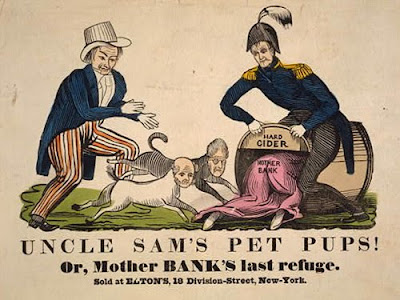
Banking has been a contentious issue throughout American History. The pages of our history books allow us brief glimpses of the most familiar stories, like Jefferson’s distrust of Hamilton and the Jacksonian Bank War. The popular press continues to blame banks—especially big, powerful, central ones—for many of our economic ills. It’s interesting that Rolling Stone has been at the forefront of this popular war against the central banks, featuring frequent articles by William Greider in the 1980s and Matt Taibbi in recent months. This ongoing popular distrust of banks and bankers, however, seems not to be shared by many of the economic historians we look to for leadership on these issues, and who often treat historical bankers with respect verging on reverence. As a result, the stories of American banking that find there way into mainstream history often treat the objectives and goals of bankers as economically sound and politically neutral, even when they acknowledge popular dissent.

For example, consider the early 19th-century “Suffolk System,” imposed on New England by the Suffolk Bank and six other Boston banks. It has come down to us as an attempt to insure the value of New England bank notes, at a time when any chartered bank was allowed to print its own money. Students reading about this and living in a world where we have a single, national currency, naturally assume that the Suffolk System provided an urgently needed service for the New England Economy. People who want to justify “small government” on economic terms suggest that bad (country) banknotes were driving good (city) banknotes out of the market through Gresham's Law, and that the system was proof that “private individuals acting outside the bounds of political control have proven entirely capable of providing much the same functions as a central bank, and at a far lower cost.” Even economic historians who admit that the Suffolk System was thoroughly hated by most New England banks, treat the system as a tool for providing a needed benefit to the financial market, and analyze its efficiency in providing this service.

The average discount on country banknotes in Boston by the 1820s was less than one percent, suggesting that most people did not fear to use them as currency. The Suffolk’s objective, economic historians tell us, was to insure the integrity of these various pieces of money; but also, they admit, to reduce the volume of country banknotes circulating in the city. Why might a consortium of city bankers be interested in reducing the circulation of country notes? Perhaps to give their own notes more circulation? Similarly, the Suffolk’s tactics for getting banks to “join” their system involved hoarding large quantities of the target bank’s notes and then bringing them into the bank for redemption all at once. This constituted an artificial “run” on the country banks, and at least one filed suit against the Suffolk for “malicious intent to break the bank without cause.” Historians have praised the Suffolk for forcing rural banks to hold larger reserves. But with mass redemptions comprising often more than half the victim bank’s total assets, it’s questionable whether any of the Suffolk’s associated Boston banks could have withstood similar treatment. So, what was the real objective of these raids?

The effect of the raids, historians agree, was to intimidate banks into joining the system. They were required to deposit $5,000 in the Suffolk Bank, on which they were paid no interest. You could call this a tax, but ransom might be a better word. The Suffolk thus had the use of hundreds of thousands of dollars over a period of four decades, at no cost. When the New England banks finally fought back, and got a state charter for their own clearinghouse, the Suffolk did not choose to compete with them. It went back to its regular business. Economic historians have suggested this change had something to do with the relative efficiency of the “cross-subsidization” of “payments-system networks,” and have analyzed these economic factors in detail. But perhaps in focusing so intently on the numbers, they miss the motivation. What if the goal of the system was never about providing an efficient service? What if it was about improving the competitive position of the Boston bankers by either limiting or taxing the rest of the New England banks?

It seems to me that motivation is the crucial question, in historical questions like this one. Too often, I think, historians take up the documented rationales for acts like the creation of the Suffolk System, as if they came from a disinterested, reliable source. They treat challenges in the popular press, and even in the courts, as understandable but generally misguided opposition to good economic policy. And perhaps they hesitate to dig deeper into the lives and personal archives of the people behind these changes, because that type of research is not part of the traditional “tool-box” of economic history. It’s precisely these personal archives, if they exist, that might provide answers to why people like the Boston bankers joined together to establish organization like the Suffolk System. These answers might shed an altogether different light on the actions of these institutions and the results they ultimately achieved.