Showing posts with label Forums. Show all posts

Books & Culture Podcast on Historically Speaking

Randall Stephens

Last week over at the Books & Culture site John Wilson and Stan Guthrie did a podcast on Historically Speaking.  They discuss the new issue and highlight some of the contents.  Wilson praises our forum on Brad Gregory's new book The Unintended Reformation: How a Religious Revolution Secularized Society (Belknap Press of Harvard University Press, 2012). (Alexandra Walsham, Bruce Gordon, Carlos Eire, and Euan Cameron offered comments.) Wilson sees the book as "one of the most interesting, provocative, learned works of history that I've read in the last several years and it's good to see that Historically Speaking is devoting attention to it." 

Gregory introduces his lead piece to the forum as follows:

The Unintended Reformation is a work of historical analysis that takes the present as its point of departure. . . . While disclaiming comprehensiveness, the book aims to be as explanatorily powerful as possible while making as few theoretical and methodological assumptions as necessary. Secondarily, the book addresses some major contemporary concerns based on its historical analysis. These remarks will speak mostly to the first ambition and briefly to the second.

I endeavor in The Unintended Reformation to answer a basic but very big question: How did contemporary ideological and institutional realities in North America and Europe come to be as they are? The book intends to characterize these realities matter-of-factly. Ideologically, they include an open-ended range of secular and religious truth claims made by individuals about matters pertaining to human meaning, morality, purpose, and priorities, including some religious truth claims articulated with great intellectual sophistication by theologians and philosophers of religion. Insofar as the present is the product of the past, any adequate history must be able to account for all these claims. The modern liberal institutions variously characteristic of all contemporary Western states permit this ideological heterogeneity through the legal and political protection of individual citizens to believe and live as they please so long as they obey established laws.   


Read more of the forum and the rest of the issue at Project Muse, or subscribe to the print version today.

April Issue of Historically Speaking

Randall Stephens

The April 2012 issue of Historically Speaking should arrive in mail boxes in the next couple of weeks. Readers will find plenty to enjoy in this one. It includes essays on political and religious history, interviews with Jeremy Black and David Hempton (the latter recently named the new dean of Harvard Divinity School), and a forum on American Revolutionary Era history. I'll post excerpts with links when the issue is available on Project Muse.

Not a subscriber? Have a look at this free sample issue from last year.

Historically Speaking (April 2012)

"The Roots of Democratic Self Government"
James Muldoon

"The Church in the Long Eighteenth Century: An Interview with David Hempton"
Conducted by Donald A. Yerxa

Bridging the Gap between the Political and the Cultural Histories of the American Revolution: A Forum

"Rethinking the American Revolution: Politics and the Symbolic Foundations of Reality"
Michal Jan Rozbicki

"An Infatuation with Titles: Hereditary Privilege and Liberty in the Ear of the American Revolution"
Trevor Burnard

"A New History of Liberty"
Peter S. Onuf

"Scraping Rust from the Rebar of Early American History"
Alan Tully

"Conceptual Bridges and Antibodies: A Response"
Michal Jan Rozbicki

"'Responsible to God and Not to Man': Lottie Moon and Southern History"
Regina D. Sullivan

"Kennan’s Boswell? A Review Essay"
William Stueck

"Challenging Historiographical Orthodoxy Many Times Over: An Interview with Jeremy Black"
Conducted by Donald A. Yerxa

"If Not Progress, What?"
Glenn W. Olsen

"Three Muslim Empires"
Stephen Dale

November issue of Historically Speaking

Randall Stephens

In not too long, the November issue of Historically Speaking will be shipping out. And, as usual, it will soon be posted on Project Muse. This issue features a forum with Joyce Appleby on the emergence of capitalism; Peter Coclanis and Stanley L. Engerman's discussion of the influence of Eugene and Elizabeth Fox Genovese; essays on the Christian America debate; and more. Here's the run down:

Historically Speaking (November 2011)

Taking Historical Fundamentalism Seriously
Johann N. Neem

Historians Meet Thanksgiving: What Would George Do?
Sam Wineburg and Eli Gottlieb

The Early Modern Origins of Capitalism: A Roundtable

The Cultural Roots of Capitalism
Joyce Appleby

What’s Left for Economics? A Comment on Appleby
Hans L. Eicholz

Comment on Appleby
Hendrik Hartog

Response
Joyce Appleby

Athens and Sparta and the War of Rank in Ancient Greece: An Interview with J.E. Lendon Conducted by Donald A. Yerxa

Labor Day: The Lessons of the Past
Robert H. Zieger

The Intellectual World of Southern Slaveholders: Two Assessments of the Recent Work of Eugene D. Genovese and Elizabeth Fox-Genovese

Sic et Non
Peter A. Coclanis

The Richness of Intellectual Life in the Antebellum South
Stanley L. Engerman

Teaching and Writing about the History of African-American Christianity: An Interview with Paul Harvey
Conducted by Randall J. Stephens

Then, and Then Again
Joseph A. Amato

Bloodlands: Europe between Hitler and Stalin: An Interview with Timothy Snyder
Conducted by Donald A. Yerxa

Forum on Daniel Rodgers's Age of Fracture in April Issue of Historically Speaking

Randall Stephens

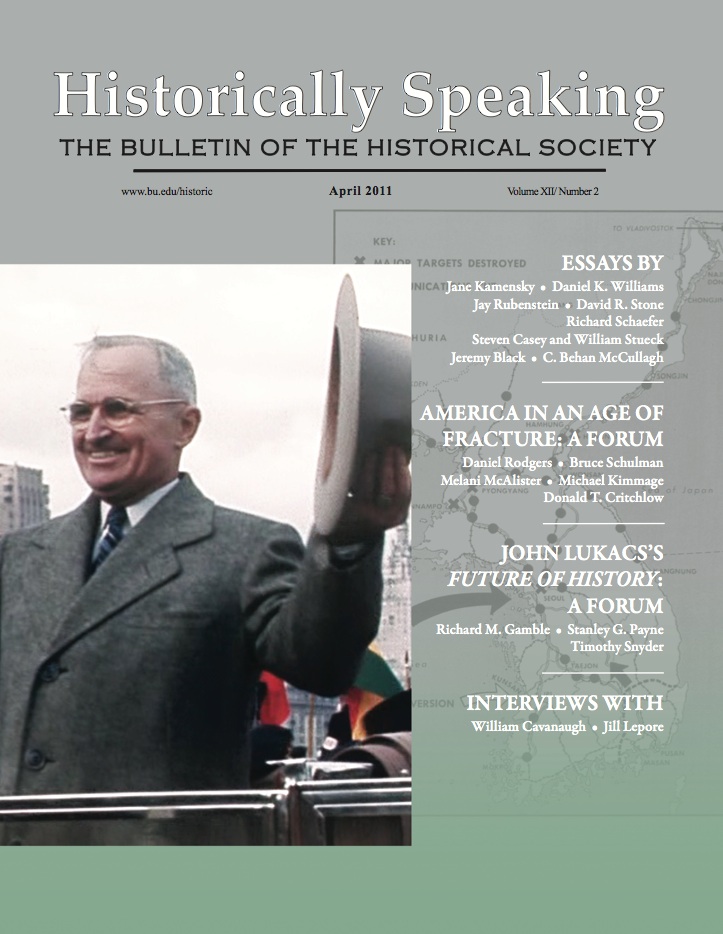
Over at the U.S. Intellectual History blog there's been a lively discussion and debate generated by Daniel Rodgers's new book Age of Fracture. We add a little to that here with a selection from the forum on the book in the new issue of Historically Speaking. (View the full April 2011 issue on Project Muse. Use your college, university, or library connection for full access.)

AMERICA IN AN AGE OF FRACTURE: A FORUM

Historians and other observers of postwar America note the dramatic social and political changes underway since the 1960s. It was, as Daniel Rodgers puts it, an age marked by discontinuity, shifting party allegiances, and social fracture. An intellectual and cultural historian, Daniel Rodgers is Henry Charles Lea Professor of History and director of the Shelby Cullom Davis Center for Historical Studies at Princeton University. He is the author of four books, including: The Work Ethic in Industrial America, 1850-1920 (University of Chicago Press, 1978), winner of the Organization of American Historians’ Frederick Jackson Turner Prize; Contested Truths: Keywords in American Politics (Basic Books, 1987); and Atlantic Crossings: Social Politics in a Progressive Age (Harvard University Press, 1998), which won the American Historical Association’s Beer Prize and the Organization of American Historians’s Hawley Prize. His latest book, The Age of Fracture (The Belknap Press of Harvard University Press, 2011), argues that in the 1970s Americans began to think of the country in terms of choice-making individuals rather than as a society shaped by classes, interests, and norms. Historically Speaking asked Bruce Schulman, Melani McAlister, Michael Kimmage, and Donald Critchlow to comment on Rodgers’s short essay about this shift in American thought. Their comments are followed by Rodgers’s response. (Citations of Rodgers’s book are in parentheses.)

Daniel Rodgers, "Age of Fracture," Historically Speaking (April 2011)

The history of the United States in the last quarter of the 20th century seems to constitute, at first glance, a maze of paradoxes. It was the age of Reagan, conservative partisans said at the time: a moment of deep political reversal. Peggy Noonan, one of the most gifted of Reagan’s speechwriters, joined the White House staff to be present at “the Reagan revolution.”1 Political managers dreamed of a realignment election that would change the very frame of partisan politics, and political scientists pored over election results to see if they could discern that one had occurred. A sense of the world as shifting rapidly beneath one’s feet was widespread, but, for all of Reagan’s symbolic prominence, the notion of a clear political watershed turned out to be an illusion.

Party allegiances shifted dramatically in the last quarter of the century, particularly among white southern voters; a new and highly energized conservative political movement came into being; but the realignment election that would give the Republican Party a permanent majority failed to occur. Closely fought elections, divided governance, and an increasingly divided electorate have marked the last three decades’ politics, not a new consensus. Even Reagan himself, Noonan wistfully admitted, “wasn’t a revolutionary; he wasn’t a missile drawn to the heat of a new idea.”2 The battles over taxes and regulation that Reagan’s election precipitated represented no revolutionary break with history. Even the “culture wars” and their partisan mobilization of religious loyalties replayed long-standing strains in 20th-century American politics.

A stronger argument for discontinuity can be made for the structures of the late 20th-century economy. The global economic crisis of the 1970s with which the era began, buffeted by oil price shocks and inflation, was a prelude to wide-ranging transformations in the domestic and global economies. Squeezed by new cost pressures, compromises between labor and management unraveled. Union membership spiraled precipitously downward. Manufacture went global in search of cheaper labor. Finance capitalism emerged out of the crisis stronger than ever before, fueled by new and more exotic investment instruments and new investor ambitions for corporate restructuring. The derogatory “age of greed” label reflects a simplistic reading of the moral tone of the era, but the phrase had its structural basis, as David Harvey and others have argued, in the collapse of the Fordist economy of the middle years of the century.3

And yet the age of materialism, global markets, ascendant financial capitalism, new political ambitions, and an intensely politicized punditry was also, and in many ways more fundamentally, a period of deep transformations in social thought. It was here, on the terrain in which Noonan thought her hero Reagan to have been least adept, that the discontinuities of the era were most pronounced. A whole vocabulary of concepts that had once seemed the common sense of social thought weakened and new languages took their place. The age of Reagan, the “age of greed,” was simultaneously, and more importantly, an age of transformation in ideas.

“A war of ideas,” conservatives often called it, but it was much less structured by partisan polarities than has often been understood. Ideas flowed quickly into politics through more aggressively partisan think tanks and more aggressively partisan funders of books and university research. But ideas simultaneously slipped across the political blocs, often incongruously and unpredictably. Deregulation was a radical project before it became a conservative one. The first practical school voucher proposals were the work of liberal social scientists. Libertarian ideas infiltrated social thought, leaving a trail across both Left and Right. >>> read on

See also the four comments and Rodgers's response:

Bruce Schulman, "Daniel Rodgers's (New) Consensus History"

Melani McAlister, "Popular Media in an Age of Fracture"

Michael Kimmage, "A Response to Age of Fracture"

Donald T. Critchlow, "On a Darkling Plain"

Daniel Rodgers, "A New Consensus?"