Showing posts with label intellectual history. Show all posts

Ἀρετή: The Greek Way to Define Life

Steven Cromack

Achilles and Patroclus, from a red-figure kylix, ca. 500 BC
While Americans pride themselves on being the first great individualistic nation, the idea of self-actualization is actually distinctly Greek.  The Ancient Greeks called the idea of being “the best you can be” or “reaching your highest potential” areté.[1]   Achieving areté was the Greeks’ reason for living, and a matter of honor (timé).  This sense of life, however, also stemmed from their sense of death.  The Ancient Greeks were a death-centered culture.  Having nothing to die for meant one had nothing for which to live.  When that reason to die became clear—for one’s polis or family, for the honor of one’s leader, or for a friend, life became meaningful and precious.  Achieving areté made life worth living, valuable, and therefore offered a means for the Greeks to meet death head on.   

Nothing captures areté better than the characters in Homer’s Iliad.  Its characters champion “reaching your highest potential.”  The story revolves around Achilleus[2],  the great Achaean warrior who undergoes an internal struggle to find a reason to die.  Everybody is going to die eventually, and each character is aware of this, as is the rest of Greek society.  Because all humans have to die, however, they should earn a noble death.  Society will then remember them with honor.  Those individuals who give their life for what they value become institutions, immortals, and heroes. 

Having withdrawn from the Trojan War, Achilleus allowed his good friend Patroklos to enter battle wearing his personal armor.  During the battle, however, the Trojan prince Hektor killed Patroklos.  The death of his dear friend at the hands of the Trojans drove Achilleus into a rage.  He now had something for which to die.  Achilleus could now fight and die for Patroklos, as Protoklos fought and died for him.  In doing so, Achilleus could now live gloriously—fight with all his might against the Trojans.  He declared, “Now I shall go, to overtake that killer of a dear life, Hektor; then I will accept my own death, at whatever time Zeus wishes to bring it about, and the other immortals.”[3]   When Achilleus arrived on the battlefield, Athene circled his head, from which came a great blaze of fire.  Homer writes, “There he stood, and shouted, and from her place Pallas Athene gave cry, and drove endless terror upon the Trojans.  As loud as comes the voice that is screamed out by a trumpet by murderous attackers who beleaguer a city.”[4]   Achilleus became the best he could be on the battlefield.  He was full of life and glory, something that only came with the death of his best friend.  With that newfound sense of life, Achilleus won the war for the Achaeans.

The Greeks not only loved Homer’s characters, but also internalized timé.  Such was the case during the Greco-Persian Wars.  When Persia invaded Greece, Athens was in grave danger.  If conquered, the Athenian people would fall under the tyranny of Persia.  And so, the Athenian soldiers met their enemy at the shores of Marathon for a final stand.  They were ready to die for their families and their polis.  When the battle began, the Athenian hoplites charged the Persian troops at full speed.  According to Herodotus, “The Persians, therefore, when they saw the Greeks coming on at speed, made ready to receive them, although it seemed to them that the Athenians were bereft of their senses, and bent upon their own destruction.”[5]   The Athenians were indeed “bent upon their own destruction,” since they were ready to die.   That day, the Athenian hoplites “fought in a manner worthy of being recorded.”[6]   The Greeks found their reason for living, the preservation of their city-state.  These hoplites believed that if they were going to die, they might as well do so with a sense of timé.  At Marathon, because the Greeks were willing to die for their families, their polis, and for each other, much like Achilleus did, they were able to push the Persians out of Greece.

Ἀreté, as defined by the characters of Homer’s Iliad, and internalized by the Greek soldiers was what gave many Greeks meaning.  If the Greeks could find those things most precious to them, then they could live (and die) gloriously.

__________________

1. Richard Hooker, "Areté," Washington State University, http://www.wsu.edu/~dee/GLOSSARY/ARETE.HTM

2. I used the Lattimore translation, which uses Achilleus, as opposed to Achilles.  For the evolution of the name, see Herbert Jordan at http://www.iliadtranslation.com/homeric_names.html

3. Homer, The Iliad, trans. Richard Lattimore, (Chicago: University of Chicago Press, 1951), 18.114-116.

4. Ibid., 18.204-220.

5. Herodotus, The Persian Wars, trans. George Rawlinson (New York:, 1942), 6.112.

6. Ibid.

Richard H. King on Why I Became a Historian

Randall Stephens

Why are some youngsters fascinated by the past while others don't have the slightest interest in the subject?  (Indeed, quite a few run to the hills at the mere mention of "history.")  What makes some of us into historians?

While I was at the British Association of American Studies meeting at the University of Manchester I had some time to sit down with the historian Richard H. King.  I asked King the same question I've put to other historians: "Why
did you become a historian?" 

King is a prolific author (now emeritus professor of American intellectual history, University of Nottingham). While in grad school at the University of Florida I read his engaging book A Southern Renaissance: The Cultural Awakening of the American South, 1930-1955 (Oxford University Press, 1980).  Along with that volume he is also the author of a number other influential books, including: The Party of Eros: Radical Thought and the Realm of Freedom (Delta, 1972); Civil Rights and the Idea of Freedom (University of Georgia Press, 1996); Race, Culture and the Intellectuals, 1940-1970 (Johns Hopkins University Press, 2004); and he co-edited Dixie Debates (New York University Press, 1995) with Helen Taylor.

In the interview here, King speaks about his undergraduate experience at the University of North Carolina, Chapel Hill, in the early 1960s.  He also talks about the literary and social forces of the day that led him to study the past.

Conference on Public Intellectuals, Harvard, 2012

.
Third Annual Conference on Public Intellectuals
History of Science Department
Harvard University
April 12-14, 2012

Call for Papers

Since the 1950s, American writers and thinkers such as Irving Howe, Kenneth Clark, Russell Jacoby, Thomas Bender, bell hooks, Richard Posner, Toni Morrison, Thomas Sowell, and Cornel West have debated the meaning and purpose of public intellectuals. Many have openly criticized what they call the increasing corporatization of public intellectual life within the academy. Increasing specialization and narrower disciplines, some argue, has led to a growing paucity of radical ideas and a growing obsession with a mass media-infused culture. Others on the ideological right maintain that leftist public intellectuals do not pay enough attention to market forces and are too protected by and safely ensconced in tenured ivory towers, writing and teaching only to indoctrinate their students.

This conference seeks to bring together scholars and researchers in all disciplines whose work focuses on public intellectuals. We hope to engage these issues while moving beyond past debates into new questions on the role of public intellectual life in the 21st century. Paper topics on all global areas as well as the U.S. are welcome. The conference also seeks to provide a forum for self-reflection by public intellectuals in the past and present. The conference format will include individual presentations organized into workshops of 3-4 presenters and three special roundtable sessions.

Proposals of 300 words or less must include your identifying information including name, title, institution, email, and phone number. Please send two copies to the co-organizers, Larry Friedman (ljfriedm@indiana.edu) and Damon Freeman (dfreeman@sp2.upenn.edu).

Deadline for paper and panel proposals: Wednesday, November 30.

Forum on Daniel Rodgers's Age of Fracture in April Issue of Historically Speaking

Randall Stephens

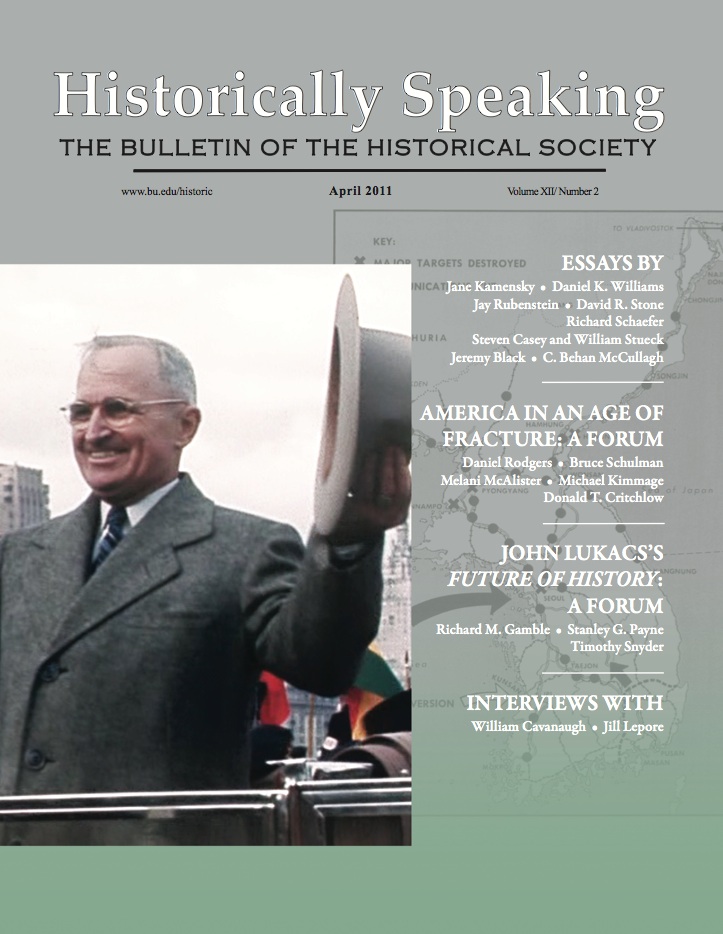
Over at the U.S. Intellectual History blog there's been a lively discussion and debate generated by Daniel Rodgers's new book Age of Fracture. We add a little to that here with a selection from the forum on the book in the new issue of Historically Speaking. (View the full April 2011 issue on Project Muse. Use your college, university, or library connection for full access.)

AMERICA IN AN AGE OF FRACTURE: A FORUM

Historians and other observers of postwar America note the dramatic social and political changes underway since the 1960s. It was, as Daniel Rodgers puts it, an age marked by discontinuity, shifting party allegiances, and social fracture. An intellectual and cultural historian, Daniel Rodgers is Henry Charles Lea Professor of History and director of the Shelby Cullom Davis Center for Historical Studies at Princeton University. He is the author of four books, including: The Work Ethic in Industrial America, 1850-1920 (University of Chicago Press, 1978), winner of the Organization of American Historians’ Frederick Jackson Turner Prize; Contested Truths: Keywords in American Politics (Basic Books, 1987); and Atlantic Crossings: Social Politics in a Progressive Age (Harvard University Press, 1998), which won the American Historical Association’s Beer Prize and the Organization of American Historians’s Hawley Prize. His latest book, The Age of Fracture (The Belknap Press of Harvard University Press, 2011), argues that in the 1970s Americans began to think of the country in terms of choice-making individuals rather than as a society shaped by classes, interests, and norms. Historically Speaking asked Bruce Schulman, Melani McAlister, Michael Kimmage, and Donald Critchlow to comment on Rodgers’s short essay about this shift in American thought. Their comments are followed by Rodgers’s response. (Citations of Rodgers’s book are in parentheses.)

Daniel Rodgers, "Age of Fracture," Historically Speaking (April 2011)

The history of the United States in the last quarter of the 20th century seems to constitute, at first glance, a maze of paradoxes. It was the age of Reagan, conservative partisans said at the time: a moment of deep political reversal. Peggy Noonan, one of the most gifted of Reagan’s speechwriters, joined the White House staff to be present at “the Reagan revolution.”1 Political managers dreamed of a realignment election that would change the very frame of partisan politics, and political scientists pored over election results to see if they could discern that one had occurred. A sense of the world as shifting rapidly beneath one’s feet was widespread, but, for all of Reagan’s symbolic prominence, the notion of a clear political watershed turned out to be an illusion.

Party allegiances shifted dramatically in the last quarter of the century, particularly among white southern voters; a new and highly energized conservative political movement came into being; but the realignment election that would give the Republican Party a permanent majority failed to occur. Closely fought elections, divided governance, and an increasingly divided electorate have marked the last three decades’ politics, not a new consensus. Even Reagan himself, Noonan wistfully admitted, “wasn’t a revolutionary; he wasn’t a missile drawn to the heat of a new idea.”2 The battles over taxes and regulation that Reagan’s election precipitated represented no revolutionary break with history. Even the “culture wars” and their partisan mobilization of religious loyalties replayed long-standing strains in 20th-century American politics.

A stronger argument for discontinuity can be made for the structures of the late 20th-century economy. The global economic crisis of the 1970s with which the era began, buffeted by oil price shocks and inflation, was a prelude to wide-ranging transformations in the domestic and global economies. Squeezed by new cost pressures, compromises between labor and management unraveled. Union membership spiraled precipitously downward. Manufacture went global in search of cheaper labor. Finance capitalism emerged out of the crisis stronger than ever before, fueled by new and more exotic investment instruments and new investor ambitions for corporate restructuring. The derogatory “age of greed” label reflects a simplistic reading of the moral tone of the era, but the phrase had its structural basis, as David Harvey and others have argued, in the collapse of the Fordist economy of the middle years of the century.3

And yet the age of materialism, global markets, ascendant financial capitalism, new political ambitions, and an intensely politicized punditry was also, and in many ways more fundamentally, a period of deep transformations in social thought. It was here, on the terrain in which Noonan thought her hero Reagan to have been least adept, that the discontinuities of the era were most pronounced. A whole vocabulary of concepts that had once seemed the common sense of social thought weakened and new languages took their place. The age of Reagan, the “age of greed,” was simultaneously, and more importantly, an age of transformation in ideas.

“A war of ideas,” conservatives often called it, but it was much less structured by partisan polarities than has often been understood. Ideas flowed quickly into politics through more aggressively partisan think tanks and more aggressively partisan funders of books and university research. But ideas simultaneously slipped across the political blocs, often incongruously and unpredictably. Deregulation was a radical project before it became a conservative one. The first practical school voucher proposals were the work of liberal social scientists. Libertarian ideas infiltrated social thought, leaving a trail across both Left and Right. >>> read on

See also the four comments and Rodgers's response:

Bruce Schulman, "Daniel Rodgers's (New) Consensus History"

Melani McAlister, "Popular Media in an Age of Fracture"

Michael Kimmage, "A Response to Age of Fracture"

Donald T. Critchlow, "On a Darkling Plain"

Daniel Rodgers, "A New Consensus?"

Historians as Public Intellectuals

Randall Stephens

Our first session of the Second Annual Conference on Public Intellectuals (James Hall, Harvard) dealt with a theme that would interest readers of this blog. Thanks are due to all those who took part. Historian Larry Friedman (Harvard's Mind/Brain/Behavior Interfaculty Initiative) deserves special thanks for making this and last year's conference so productive.

9:00 - 12:00pm: Panel 1: HISTORIANS AS PUBLIC INTELLECTUALS
James Hall 1305

Chair: Jill Lepore (Harvard University)


Bertram Wyatt-Brown (Johns Hopkins University), “C. Vann Woodward and W.J. Cash: Similarities and
Contrasts”

Joyce Antler (Brandeis University), “Gerda Lerner, Citizen-Scholar: ‘Why What We Do with History
Matters’”

Ray Arsenault (University of South Florida), “The Freedom Writer: John Hope Franklin as a Public Intellectual”

The three presenters spanned the career's of historians who wrote and spoke to a large public. All had a very interesting, complex relationship with the American past, and, even had a moralist tone to some of their work. Jill Lepore (Harvard) offered comments before our general discussion. Lepore wondered about how the public reacted to each historian and how they encountered opposition. All of these figures spoke to a large audience and, at times, faced opponents. Gerda Lener, said Antler, encountered Nazi and anti-communist hostility in Europe and America. Wyatt-Brown mentioned that W. J. Cash, not long before his suicide, had a deep sense of persecution, largely imagined, which had spun off into delusion. Arsenault pointed out that there was less persecution in Franklin's case. Though Franklin long resented the exclusion and discrimination he faced in his early years. Bill Clinton eulogized Franklin at his funeral, said Arsenault, as: "a genius in being a passionate rationalist, an angry happy man, a happy angry man."

Like John Hope Franklin, Lerner, Woodward, and Cash all struggled with the burdens of the past and understood history in light of present divisive political and identity struggles. How does a public intellectual historian relate the past to the present?

Hence, there was a brief discussion after the presentations about how each of these dealt with a usable past. Most know, for instance, that Woodward, Franklin, and Lerner had an enormous influence on the field and well beyond it. C. Vann Woodward's Strange Career of Jim Crow (as I mentioned on this blog not long ago) powerfully affected Martin Luther King and other civil rights leaders. Gerda Lerner established the first Women's Studies program in the country and served as a role model for thousands of scholars in history and the humanities. And John Hope Franklin turned the public's attention to some of the most desperate moments in American history. Does advocacy history differ from the history written by the deeply committed historicist? The audience and participants considered the work of Howard Zinn and other historian-activists in light of that question.

Like the other panels at this small conference (really like the best kind of grad seminar in its freewheeling discussions) wonderfully illuminated the role of the public intellectual. Later panels on race, religion, the cosmopolitan generation, and a discussion with Robert Jay Lifton further plumbed the areas where scholars interact with a larger public. (Keep an eye out for Lifton's memoir, which he spoke about, due out in June. It will be well worth reading!)

Jack Miller Center Essay Prize Competition for the best essays published in Historically Speaking

.
Announcing . . .

The Jack Miller Center Essay Prize Competition for the best essays published in Historically Speaking during 2011 in the following areas:

Intellectual History or the History of Political Thought

Military or Diplomatic History

The prizes are $1000 each and will be awarded in January 2012. Essay submission guidelines for Historically Speaking can be found at www.bu.edu/historic/hs/ guide.html. Direct all submissions and questions about the prize competition to: Donald Yerxa at historic@bu.edu.

The Jack Miller Center is a nonprofit, nonsectarian, nonpartisan, educational organization dedicated to strengthening the teaching of America’s founding principles and history.

Second Annual Conference on Public Intellectuals at Harvard University

Randall Stephens

I've been working with Larry Friedman and Steve Whitfield on organizing the Second Annual Conference on Public Intellectuals at Harvard University, April 7-9, 2011. The program has shaped up nicely. Those who attended last year can attest to the lively discussions and debates generated by panels and keynotes. (We've asked all participants this year to pay a $25 fee. Friedman hopes to have funding options in the future, which might reduce or eliminate the fee.)

The 2011 conference will feature a variety of session that are sure to be productive. (See the program below.) Panels will address "Historians as Public Intellectuals," "The Cosmopolitan Generation of Intellectuals," "Religion and Public Intellectuals in America," and "Race, Gender, and Public Intellectuals." We anticipate roughly 20 participants and a number of non-presenters.

SECOND ANNUAL CONFERENCE ON PUBLIC INTELLECTUALS, APRIL 7-9, 2011

Thursday, April 7

4:00 - 6:00: OPENING RECEPTION
Larry Friedman’s house, 335 Highland Avenue, Somerville (a 10-minute walk from the Davis Square stop on the Red Line T)

7:00 - 9:30pm: OPENING SEMINAR
James Hall penthouse seminar room, 33 Kirkland Street, Cambridge (please read James Kloppenberg’s Reading Obama: Dreams, Hopes, and the American Political Tradition in advance)

Introduction: Larry Friedman (Harvard University)

James Kloppenberg (Harvard University), “Reading Obama”

Comment: Dinesh Sharma (Institute for International and Cross-Cultural Research)

Friday, April 8

8:30 - 9:00am: Conference Chair: Anne Wyatt-Brown (University of Florida), welcome; coffee, tea, bagels, pastries, etc. provided.
James Hall 1305

9.00 - 12.00pm: Panel 1: HISTORIANS AS PUBLIC INTELLECTUALS
James Hall 1305

Chair: Jill Lepore (Harvard University)

Bertram Wyatt-Brown (Johns Hopkins University), “C. Vann Woodward and W.J. Cash: Similarities and Contrasts”

Joyce Antler (Brandeis University), “Gerda Lerner, Citizen-Scholar: ‘Why What We Do with History Matters’”

David D. Hall (Harvard University), “Perry Miller: Prophecy, Declension, and the Promise of America”

Ray Arsenault (University of South Florida), “The Freedom Writer: John Hope Franklin as a Public Intellectual”

12:00 - 1:15pm: Lunch on your own

1:15 - 4:30pm: Panel 2: THE COSMOPOLITAN GENERATION OF INTELLECTUALS
James Hall penthouse seminar room

Chair: David Starr (Brandeis University), with remarks on Solomon Schechter

Neil McLaughlin (McMaster University), “Fromm, Riesman, Nisbet and the Public Intellectuals: A Sociological Perspective”

Anke Schreiber (University of Chicago), “Erich Fromm as Public Intellectual”

David Andersen (Helena, Montana), “Three 1950s Classics: Ralph Ellison’s Invisible Man, Erik Erikson’s Childhood and Society, and Hannah Arendt’s Origins of Totalitarianism”

Jonathan B. Imber (Wellesley College), “Philip Rieff and Fellow Teachers”

4:30 - 5:30: Break

5:30 - 9:15pm: DINNER AND A CONVERSATION WITH GERDA LERNER AND ROBERT LIFTON
James Hall penthouse seminar room

6:30 - 6:50pm: Gerda Lerner (Madison, Wisconsin) on her life as a scholar and public intellectual (Skype video connection)

7:00 - 8:30pm: Robert J. Lifton (Harvard University) on his life and career

Saturday, April 9

8:30am: Coffee, tea, bagels, pastries
James Hall penthouse seminar room

9:00 - 12:00pm: Panel 3: RACE, GENDER, AND PUBLIC INTELLECTUALS
James Hall penthouse seminar room.

Chair: Roberta Wollons (University of Massachusetts Boston)

Mark West (University of North Carolina at Charlotte), “The Literary Roots of Theodore Roosevelt's Views on Women’s Rights”

Steve Whitfield (Brandeis University), “The Many Facets of Frank Tannenbaum”

Damon Freeman (University of Pennsylvania), “Kenneth B. Clark and the Just University”

Jim Clark (University of Kentucky), “‘In the South these Children Prophesy’: Robert Coles’ Documentary Argument”

12:00 - 1:30pm: Lunch on your own

1:30 - 4:30pm: Panel 4: RELIGION AND PUBLIC INTELLECTUALS IN AMERICA
James Hall penthouse seminar room

Chair: Jon Roberts (Boston University)

Maura Jane Farrelly (Brandeis University), “No Man is an Island: Catholic Clerics and the Perils of Public Intellectualism”

Bo Peery (George Washington University), “On ‘Doing Nothing’: Richard and Reinhold Niebuhr Debate the Merits of Taking Action in a Tumultuous World”

Randall J. Stephens (Eastern Nazarene College), “The Public Intellectual and the Public Anti-Intellectual: The Life of the Mind among Conservative Evangelicals”

Ronald E. Doel (Florida State University), “Religion, Science, and Cold War Visions: J. Lawrence Kulp and the Challenge of 20th Century Biography”

4:30 - 5:00pm: Break

5:00 - 6:30pm: CONCLUDING ROUNDTABLE WITH ALL CONFERENCE PARTICIPANTS: “WHAT DOES IT MEAN TO BE A PUBLIC INTELLECTUAL?”
James Hall penthouse seminar room

For final discussion please read pre-circulated material: Lawrence J. Friedman, “Public Intellectuals on Philanthropy,” in Philanthropy in America: A Comprehensive Historical Encyclopedia, ed. Dwight F. Burlingame (ABC-CLIO, 2004), 390-402; David A. Hollinger, “How Wide the Circle of the ‘We’? American Intellectuals and the Problem of the Ethnos since World War II,” American Historical Review (April, 1993); and selection from, Russell Jacoby, The Last Intellectuals: American Culture in the Age of Academe (Basic Books, 1987)

7:30pm: Dinner at Chang Sho, 1712 Massachusetts Avenue, Cambridge, MA 02138

All participants are asked to contribute $25 per person toward the cost of the conference.

Jack Miller Center-Historically Speaking Prize Essay Competition

Randall Stephens

We are happy to report the inaugural winners of the Jack Miller Center-Historically Speaking Prize Essay Competition. At a recent Jack Miller Center reception held in conjunction with American Historical Association’s annual meeting in Boston, Pamela Edwards, the Miller Center's director of academic initiatives, and Donald Yerxa, senior editor of Historically Speaking, announced the winners of the 2010 Miller Center Prizes (of $1000 each) for the best essays published in Historically Speaking in the areas of (1) intellectual history and the history of political thought and (2) military-diplomatic history.

Christopher Shannon, associate professor of history at Christendom College, won the intellectual history prize for his essay: "From Histories to Traditions: A New Paradigm of Pluralism in the Study of the Past" (January 2011). Peter Paret of the Institute for Advanced Study in Princeton won the military-diplomatic prize for his essay "Two Historians on Defeat and War and Its Causes" (June 2010). The Society thanks the Miller Center for its support of historical scholarship in the service of improved public understanding. We are delighted with the partnership being forged between the Historical Society and the Jack Miller Center. It promises to be a very congenial and mutually beneficial collaboration.

Third Annual U.S. Intellectual History Conference

.
A notice from Andrew Hartman, organizer of the Third Annual U.S. Intellectual History Conference. The schedule looks tremendous. Well worth a visit to the Big Apple.

The Third Annual U.S. Intellectual History Conference be held on October 21-22, 2010 in New York City. The Conference is being organized by the editors of the U.S. Intellectual History (USIH) blog in coordination with the City University of New York's Center for the Humanities (The Graduate Center). This year’s theme is “Intellectuals and Their Publics.”

Beyond dozens of exciting and relevant sessions, I would especially like to call attention to our keynote speaker and our two evening plenary sessions.

The keynote will be given by Harvard University Professor James Kloppenberg on Friday (Oct. 22) afternoon. Kloppenberg will be presenting from his book, "Reading Obama: Dreams, Hope, and the American Political Tradition," forthcoming from Princeton University Press.

The first plenary session, on Thursday (Oct. 21) evening, is on "Renewing Black Intellectual History," featuring Adolph Reed, Jr., Kenneth Warren, Dean Robinson, and Touré Reed. Based on an anthology of same title, this plenary seeks to map the changing conditions of black political practice and experience from Emancipation to Obama.

The second plenary session, on Friday (Oct. 22) evening, is titled, "Intellectual History for What?" It includes George Cotkin, Rochelle Gurstein, Elisabeth Lasch-Quinn, Wilfred McClay, David Steigerwald, and Casey Nelson Blake, who will raise a number of questions involving the relationship between intellectual history and less specialized audiences and genres of expression, including: intellectual history and social/cultural criticism; intellectual history as a resource for moral reflection and edification; writing for, teaching, and speaking to generalist audiences; and the ambiguous position of intellectual history within the research university.

Other notable participants include, in no particular order: Jackson Lears, Jennifer Burns, Kim Phillips-Fein, James Livingston, Bruce Kuklick, Leo Ribuffo, Robert Westbrook, Joan Shelly Rubin, Andrew Jewett, Jonathan Scott Holloway, Martin Burke, Eugene McCarraher, Daniel Borus, Jennifer Ratner-Rosenhagen, J. David Hoeveler, Jennifer Delton, Philip Gorski, Nancy Sinkoff, Neil Jumonville, and Jeffrey Perry.

Program and registration information.

Larry Friedman on Erich Fromm and Public Intellectuals

Randall Stephens

See the new issue of Historically Speaking, now available on the Project Muse site. (Most will only be able to access the full issue from a university computer or with a university account.)

I excerpt here part of my review with Larry Friedman, professor of history in Harvard’s Mind, Brain, and Behavior Initiative at Harvard University. Friedman has published a variety of books and articles on the history of psychology, the history of race and racism, and the history of social reform movements. His books include: The White Savage: Racial Fantasies in the Postbellum South (Prentice-Hall, 1970), Inventors of the Promised Land (Knopf, 1975), Gregarious Saints: Self and Community in American Abolitionism, 1830–1870 (Cambridge University Press, 1982), Menninger: The Family and the Clinic (Knopf, 1990) and a definitive study of developmental psychologist and psychoanalyst Erik Erikson: Identity’s Architect (Harvard University Press, 1999). He’s currently working on a biography of one of the most influential psychologists and public intellectuals of the 20th century, Erich Fromm.

"Erich Fromm and the Public Intellectual in Recent American History: An Interview with Larry Friedman," conducted by Randall Stephens, Historically Speaking, September 2010.

Randall Stephens: The popular psychologist and social critic Erich Fromm was once one of the most influential public intellectuals in the West. Yet many are unfamiliar with his life and work today. Could you say something about his context and significance?

Larry Friedman: Yes, that’s true. But his influence is still felt in many quarters around the globe and, as you say, he was once a major public figure. . . .

Fromm is significant for a number of reasons. But, perhaps most importantly, he had a wide influence as a best-selling author. His first book, Escape from Freedom (1941), linked Nazi and authoritarian regimes with the individual’s fear of freedom and autonomy. To escape from freedom was to find a greater sense of order in sadomasochism and its cycle of degrading others. Fromm’s The Sane Society (1955) railed against consumerism and made the case for local face-to-face democracy. His most enduring and popular work, The Art of Loving (1956), called for the love of self as a central component in the capacity to befriend and love others. It sold a staggering 30 million copies globally and was available in airports, drug stores, you name it. In 1973 he published The Anatomy of Human Destructiveness, which suggested that a conflict exists in all people between necrophilia and biophilia, a rage for death and annihilation on one hand and an affirmation and love of life on the other. To complete this book, Fromm took up the study of neuroscience, physical anthropology, linguistics, and other fields far outside of his training in psychoanalysis to explain why some favored death and destruction while others preferred life and love. We might speculate that if mainline psychoanalysis had branched into other fields as Fromm had done, psychoanalysis might have escaped the doldrums of recent decades. . . .

Stephens: How relevant are [Erich] Fromm's interests and causes to the average educated reader today?

Friedman: For one, his writings on war and devastation are still remarkably discerning. Of course, in Escape from Freedom he was concerned with the perils of Nazism and Stalinism. But he also pointed to future developments, like McCarthyism and the Red Scare. And he is exceedingly relevant even to today's world. Take, for instance, his position on the Mideast, specifically Israel. He was very critical of Israeli belligerence. His views bear some resemblance to those of Noam Chomsky.

Stephens: Your historical work has had a heavy psychological component. What's your opinion of the psychohistory of the 1960s and 1970s?

Friedman: I thought much psychohistory had become reductionist by the late 1960s. I felt that it was giving psychological exploration a bad name. It overemphasized the psychoanalytical element and did not employ cognitive psychology or neuroscience. It tended to be ahistorical. Now what is sometimes called the new cultural history is heavily psychological, but less reductionist than the old psychohistory of the 1960s and early 1970s.

Stephens: Your next book is about Richard Hofstadter and the mid-century New York scene. I wonder if you'd say something about that.

Friedman: Hofstadter was one of the greatest historians of the modern era. You can say he's wrong on a number of points, but he's brilliantly wrong and always worth going back to. Current debates about the role of conservative religion in America or the influence of anti-intellectualism revolve around some of Hofstadter's basic ideas. His take on the American political tradition continues to influence high school curricula. He remains amazingly relevant. What interests me especially is mid-century New York City. His friends and associates who lived there, intellectual giants like Peter Gay, helped shape our basic understandings of history and culture. Hofstadter also interacted with Manhattan's theater community and art world. Hofstadter's New York in the 1950s and 1960s was a fascinating intellectual and cultural hub. >>>

Larger Pictures

Heather Cox Richardson

The Saturday night plenary session of the Historical Society conference got me wondering about the larger contours of history. The main speaker was Michael Barone currently of the American Enterprise Institute, who delivered a presentation on “The Enduring Character of America's Political Parties in Times of Continual Change.” Leo Ribuffo of George Washington University and Sean Wilentz of Princeton commented. (Listen to full lecture and comments here.)

Barone revealed his past career as a pollster (he was a vice president at the polling firm of Peter D. Hart Research Associates from 1974 to 1981). He outlined the percentages of the vote for each party in elections spanning the twentieth century to point out that elections were decided by quite small margins. To win, parties had to mobilize pivotal constituencies: quite small populations that determined the electoral votes of large states or regions to swing elections one way or another.

Ribuffo responded to this analysis by pointing out that Barone’s numbers imposed an order on electoral politics that simply wasn’t there. Elections were often decided by quirky contingencies that no one could have foreseen.

Wilentz also poked holes in Barone’s analysis. He pointed out that Barone had utterly neglected a discussion of the role of class in determining voting patterns. Any analysis of American politics without that element included was simply missing the point, he suggested.

And listening to these three distinguished scholars, I couldn’t shut up the voice in my own head whispering that the role of ideas in politics was absent from this particular discussion. Surely the parties stand for something, and people vote according to their beliefs about what the parties will do in office.

Each of these arguments has merit, and is probably, at some level, right. So how can they be reconciled to produce a definitive account of American political history? Or is it the nature of deep historical research to produce a number of accounts from which individuals pick as most important the ones that resonate most closely with their own unique experience?

This is a different question than that of the postmodernists, who ultimately argued that there was no such thing as “truth” or “history” because each perspective was different and equally valuable. The question of reconciling the different perspectives of cliometrics, contingency, class, ideology, and so on, is fundamentally a question of what constitutes good history.

Forced to think this one through, I would throw my weight behind the idea that all of these different factors matter in general, but that individual ones take the lead in different eras. They also might matter in every era, but answer different questions. For me, though, the question Barone, Ribuffo, and Wilentz raised remains an open one.

First Annual Conference on Public Intellectuals, 23-24 April 2010, Harvard University

Randall Stephens

This weekend I'll be taking part in an interesting new conference on public intellectuals. The organizers Larry Friedman (Harvard) and Damon Freeman (UPenn) hope to draw interested parties to the conference. All sessions (held in Harvard's William James Hall) are open to the public.

Here's the summary:

In 1993, literary critic Edward Said defined the ideal intellectual as someone who stood outside circles of power while advancing knowledge and freedom for the wider public in "speaking truth to power." This first annual Conference on Public Intellectuals seeks to deepen and broaden Said's critique by providing an opportunity to scholars who are writing on public intellectuals.

The conference will take place over a period of two days, Friday and Saturday, 23-24 April 2010 at Harvard University. It is free and open to the public. The conference venue is in Room 1305 of William James Hall, 33 Kirkland Street on Harvard's campus. Sixteen papers are spread over four sessions: Public Intellectuals as Cultural Icons; Religion, Science, and Tolerance; and Race, Gender, and Protest, Parts One and Two. The conference also features two plenary sessions on Career Reflections. The conference is also working in conjunction with "The Future of American Intellectual History" symposium taking place Friday afternoon, 23 April in the Lower Level Conference Room at Harvard's Busch Hall.

See the full program here.

Further Discussion of State of Intellectual History at U.S. Intellectual History Blog

Randall Stephens

Over at U.S. Intellectual History Tim Lacy and others have been commenting on the forum Historically Speaking ran in September on the state of intellectual history. This is a great ongoing discussion about some of the issues raised in the forum and some of the matters left out of it. Lacy writes:

I first received word of Historically Speaking's forum in August. The prospect excited me both for its topic (of course) and the participants: Daniel Wickberg, David A. Hollinger, Sarah E. Igo, and Wilfred M. McClay. It is not every day that advanced and senior historians in intellectual history choose to wrap their minds around this peculiar subfield, whether assessing the United States variety or otherwise. I am grateful for each contributor's effort, and that Historically Speaking took on the topic. The forum did not disappoint. The contributions touched on a great many issues for the U.S. branch of intellectual history. Apart from simple topical relevance, every essay held persuasive points. Indeed, Wickberg noted in his final rejoinder that one can "scarcely address all the issues that were discussed" (p. 22). My colleague Paul Murphy called the forum "engrossing." As such, I believe the endeavor already qualifies as required reading for all graduate students and working professionals in U.S. intellectual history. Just the books and articles cited in each forum essay should be on required reading lists across American graduate programs. read on>>>

Many thanks to Tim Lacy and other commentators for picking up the thread!

September Issue of Historically Speaking

Randall Stephens

The new issue of Historically Speaking will soon be mailed out to subscribers. Not long after that, it will appear on Project Muse. The September issue includes a variety of essays, interviews, and an extended forum on the current state of intellectual history. Senior editor Donald Yerxa introduces the forum as follows:

The sense that the discipline of history was marginalizing traditional fields like diplomatic, economic, military, constitutional, and intellectual history—fields that critics charge focus far too much on elite decision makers—was a major concern of the founders of the Historical Society. As the Society enters its second decade, it is appropriate to revisit this matter, especially when the status of traditional historical fields is still debated, most recently in the pages of the New York Times (Patricia Cohen, “Great Caesar’s Ghost! Are Traditional History Courses Vanishing?” June 10, 2009). [See this earlier post on the matter here.] Historically Speaking has received a generous grant from the Earhart Foundation to publish a series of forums examining the state of four traditional fields that some believe are being neglected in today’s academy. Intellectual history is the focus of our first forum. We asked Daniel Wickberg, a cogent observer of historiographical trends, to write the lead essay. Three distinguished intellectual historians—David Hollinger, Sarah Igo, and Wilfred McClay—respond, followed by Wickberg’s rejoinder.

In his lead essay, Daniel Wickberg writes:

What the transformations wrought by both the linguistic and cultural turns point to is just how much the methods, approaches, and theoretical concerns that have characterized intellectual history have become central to mainstream historical practice. A generation ago, intellectual history was in crisis. Today there is evidence everywhere that intellectual history speaks to the dominant historiography of our day; its insights and methods have become part of the common coin of the most significant work currently being done. And yet there is a lingering sense that intellectual history as intellectual history is a field safely ignored by most historians, that the old arguments for its dismissal still retain life, that intellectual historians sit on the margin of the history department where more mainstream historians are free to characterize them as not quite historians. So the contemporary condition of intellectual history is somewhat paradoxical.

Table of Contents, Historically Speaking, September 2009

A Superficial Evocation of Our Times
Joseph Amato

Becoming Historians: An Interview with James M. Banner, Jr. and John R. Gillis
Conducted by Donald A. Yerxa

Pillars of World Christianity: A Review Essay
Robert Eric Frykenberg

Securing Possession: A New Way of Understanding the Past
David Day

Last Rites: A Conversation with John Lukacs
Conducted by Donald A. Yerxa

A Forum on the Current State of Intellectual History

Is Intellectual History a Neglected Field of Study?
Daniel Wickberg

Thinking is as American as Apple Pie
David A. Hollinger

Reply to Daniel Wickberg
Sarah E. Igo

Response to Daniel Wickberg
Wilfred M. McClay

Rejoinder to Hollinger, Igo, and McClay
Daniel Wickberg

America in the Jacksonian Era: An Interview with David S. Reynolds
Conducted by Randall J. Stephens

Dual Discovery, Dual Dialogue: Reflections on the Global Modernization of Historical Writing
Q. Edward Wang

Peaceable Kingdom Lost
Kevin Kenny

Lincoln and His Admirals: An Interview with Craig L. Symonds
Conducted by Donald A. Yerxa

Who’s Counting?
Derek Wilson

The History of Race on Trial in America
Ariela J. Gross

Spiritual, Yes; But Religious? A Review of Edward J. Blum's
W. E. B. Du Bois, American Prophet
Kevin M. Schultz

Letters