Showing posts with label Founding Fathers. Show all posts

Our Pro or Anti-Slavery Constitution?

Steven Cromack

On January 27, 1843, during the Eleventh Annual Meeting of the American Anti-Slavery Society, the abolitionist William Lloyd Garrison submitted a resolution to the Society for approval:  “Resolved, that the compact which exists between the North and the South is a covenant with death and an agreement with hell—involving both parties in atrocious criminality—and should be immediately annulled.”  As time wore on, his rhetoric and actions intensified.  On July 4, 1844, he publicly burned a copy of the Constitution.[1] Garrison believed that the Constitution was inherently evil because it supported slavery. That founding document was an affront to God.   

Is the Constitution pro-slavery?   

For the past four weeks, I have had the pleasure of attending the James Madison Foundation’s Summer Institute on the Constitution at Georgetown University.  The Madison Foundation awards fellowships to social studies teachers and aspiring teachers each year, usually one per state.  As such, I am surrounded by some of the best and brightest secondary social studies teachers from across the nation. These fellow teachers care deeply about their field and their career, and are just as passionate about the material they teach.  On Monday, in a morning discussion section, the topic of conversation was whether the Constitution was pro-slavery, a compromise, or something else. 

For a good portion of the time, the fellows discussed elements of compromise found in the Constitution.  Then Will Lorigan, from Indiana, argued that the Constitution was in fact an anti-slavery document because while it conceded certain concessions to the Southern states, it also gave the national government the power and means to abolish the institution after 1808.  Another, Christopher Carl from Florida, added that the Northerners knew that by offering the Southern states serious concessions—proportional representation, the fugitive slave clause, and a ban on further legislation on the slave trade until 1808—they knew they would triumph in the long run.  Such assertions prompted significant and fascinating discussion.

It is a very intriguing argument.  Indeed, it seems that the Academy has been grappling with the issue of slavery and its role in the founding since the era of the Civil Rights movement. And the debate rages on.  In her 2006 book American Taxation, American Slavery, Robin Einhorn writes:

We can all agree that some of these masters had admirable qualities, that Thomas Jefferson was charming and eloquent, that James Madison was a talented political theorist, that George Washington was a brilliant general . . . .  Nevertheless, these men all owned human beings and, as politicians, defended the ownership of human beings— even when they believed that society would be better off if it acknowledged that “all men are created equal” . . . and so on.[2]

Throughout her book, Einhorn argues that slavery determined the economic system of the early United States, all the while undermining the spirit of a new American nation.

The historian Gordon Wood, however, lambasts those historians who considered the continuation of slavery as a failure of the revolution.  In a scathing review of Einhorn’s book, Wood writes:

It was inevitable that our recent accounts of the Revolution and the founding of the nation would reflect our increased understanding of the importance of slavery to the history of America. . . . to help satisfy the seemingly insatiable desire of many historians today to place slavery at the heart of America’s origins. . . . Robin L. Einhorn has no problem reading the present back into the past or, for that matter, reading the past forward into the present.[3]

Wood’s words essentially indict Einhorn for bringing the present perspective of hindsight into the past.

Was the Constitution pro-slavery or anti-slavery?  Was it a compromise or something else?  Such debates reveal the contested nature of history.  These men— Washington, Jefferson, and Madison—have long been dead.  Their writings live on.  Historians will never be able to fully know the inner worlds of these figures.  Scholars can never know their true intentions, or comprehend fully what they really meant.  The founders’ words offer clues, and perhaps if one gets enough pieces of the puzzle, an incomplete portrait emerges.  But if historians cannot agree on the shape of the piece, not even a partial picture emerges.

Another fellow, James Moran from Idaho, put it another way when he said, “the Constitution is what it is, nothing more.”
__________________

[1] “William Lloyd Garrison,” in American Political Thought, 6th Edition, ed. Dolbeare & Cummings (Washington: CQ Press, 2009), 203.

[2] Robin Einhorn, American Taxation, American Slavery (Chicago: University of Illinois Press, 2006), 14.

[3]  Gordon Wood, “Reading the Minds of the Founders,” New York Review of Books, 28 June 2007.

Jill Lepore to Lecture Tonight at 7:00pm, Eastern Nazarene College

.
The Eastern Nazarene College History Department will present a lecture by Harvard University historian Jill Lepore at 7 p.m., Thursday, November 18, in Shrader Lecture Hall
(23 East Elm Ave, Quincy, Mass). The lecture is free and the public is invited to attend.

Titled “Poor Richard’s Poor Jane,” Lepore’s talk will be based on her forthcoming biography of Benjamin Franklin and his sister, Jane Mecom.

Lepore is the author of New York Burning: Liberty and Slavery in an Eighteenth-Century City, The Name of War: King Philip’s War and the Origins of American Identity, which won the Bancroft Prize, A is for American: Letters and Other Characters in the Newly United States and, most recently, The Whites of Their Eyes: The Tea Party’s Revolution and the Battle over American History. Lepore has written for the New York Times, the Washington Post, the New Yorker, and the Los Angeles Times.

The ENC History Department Public Lecture Series is made possible by the support of ENC alumni.

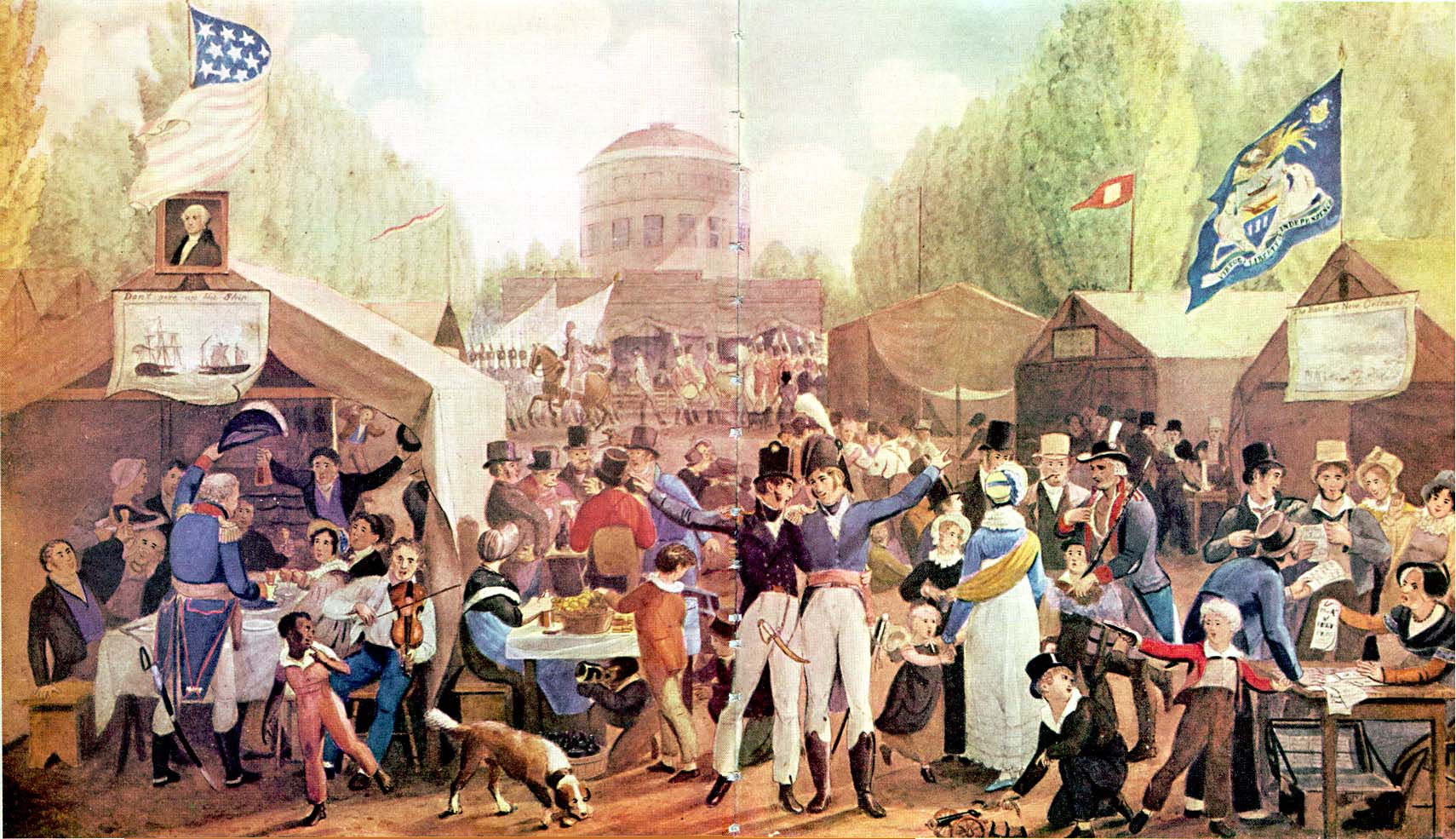
July 4, 1826

Randall Stephens

It was fifty years to the day after the 13 colonies declared independence from Great Britain.

President John Quincy Adams wrote in his diary about the festivities in Washington. "The volunteer companies assembled on the square," he observed, "fronting the house and paid the passing salute by marching through the yard."

Arriving at the door of the Capitol, I was there met by Mr. Anderson, the Comptroller, with whom we entered the hall of the House of Representatives. The Reverend Mr. Ryland made an introductory prayer.

Joseph Anderson, the Comptroller, read the Declaration of Independence; Walter Jones delivered an oration commemorative of the fiftieth anniversary; the Reverend Mr. Post, Chaplain of H. R. U. S., made a concluding prayer.


After which, Governor Barbour delivered an address to the citizens assembled, soliciting subscriptions for the relief of Mr. Jefferson. . .

News traveled slowly over bad roads. Members of congress knew of Jefferson's troubles, but the severity of his situation was unclear. Few could have guessed that Jefferson's one-time rival and on-again/off-again friend John Adams was also in his last throes. Thomas Jefferson and John Adams died on that hot July day.

Four days later John Quincy received a batch of letters. One brought bad news. A missive "from my brother, written on the morning of the 4th, announcing that, in the opinion of those who surrounded my father's couch, he was rapidly sinking; that they were sending an express for my son in Boston, who might perhaps arrive in time to receive his last breath. The third was from my brother's wife to her daughter Elizabeth to the same purport, and written in much distress." On his way north to Boston, while in Waterloo, MD, he heard that his father had died. It was July 9th. He was stricken with grief. "My father had nearly closed the ninety-first year of his life," he confided to his diary, "a life illustrious in the annals of his country and of the world."

He had served to great and useful purpose his nation, his age, and his God. He is gone, and may the blessing of Almighty Grace have attended him to his account! I say not, May my last end be like his!—it were presumptuous. The time, the manner, the coincidence with the decease of Jefferson, are visible and palpable marks of Divine favor, for which I would humble myself in grateful and silent adoration before the Ruler of the Universe. For myself, all that I dare to ask is, that I may live the remnant of my days in a manner worthy of him from whom I came, and, at the appointed hour of my Maker, die as my father has died, in peace with God and man, sped to the regions of futurity with the blessings of my fellow-men.

Plenty of Americans in 1826 had something to say about the death of two lions of the Revolution. Prone to view the world through the eyes of faith, and to read signs in the sky and on the ground, newspaper editors, clergy, and laypeople were astounded. On July 11 the Massachusetts Salem Gazette lamented "We know not in what language to express ourselves in announcing . . . another event which has transpired to render the late glorious anniversary, the national jubilee, in some respects the most memorable day in the history of our country." That was no hollow encomium. It rang true across the young nation. The New York Commercial Advertiser rhapsodized: "it seems as though Divine Providence had determined that the spirits of these great men, which were kindled at the same altar, and glowed with the same patriotic fervor . . . should be united in death, and travel into the unknown regions of eternity together!"

Some years back Margaret P. Battin wrote in Historically Speaking about the strange coincidence of Jefferson's and Adam's deaths on the same day. "Although the fact that Adams and Jefferson died the same day is taught to practically every schoolchild, asking why is not," Battin noted. "What could explain this? There are at least six principal avenues to explore, but all of them raise further issues." She then offered some of the explanations given over the ages for their demise on that same anniversary.

It makes me wonder about the comparison and contrast between our age and the beginning of the Jacksonian era. Do Americans now have similar ideas linking nation, patriotism, and providence? Do Americans esteem their leaders and the political giants of our day in any way like they did 184 years ago? How have citizens understood God and country from one era to the next?