Showing posts with label Recent History. Show all posts

The Cold War Mentality of "A Nation at Risk"

Steven Cromack

“Our nation is at risk,” declared a 1983 report released by the National Commission on Excellence in Education.   The fallout from this simple, short report was astounding.  Its lucid words indicted the American education system and sparked national panic.  Schools across the country scrambled to assess their own standards, revised them, and implemented standardized tests.  Twenty-nine years later, as far as the state of American education is concerned, not all hope is lost.  This document was a product of Cold War mentality.  The Commission examined America’s schools under a microscope of fear. Was the United States losing the Cold War?  Only through education—advancement in math, science, and literacy—could the Land of the Free defeat the Communist threat.  “A Nation at Risk,” its language, and its implications reflect Cold War dogma—in examining this document in the era of globalization, it is evident that the Commission’s Cold War mindset failed to recognize that in the midst of the conflict, America’s schools were not failing; instead, they were shaping the future competition in which the United States finds itself in 2012.

Many Americans believed, as did the Commission, that the United States was not the great giant of innovation it once was.  The Commission asserted, “Our once unchallenged preeminence in commerce, industry, science, and technological innovation is being overtaken by competitors throughout the world.”  Like most Americans, the members of the Commission believed that America was falling far behind the lurking Communists.  America’s greatness, in their eyes, was drowning in its own falling standards.  The Commission echoed national fears: “The educational foundations of our society are presently being eroded by a rising tide of mediocrity that threatens our very future as a Nation and a people.”  Furthermore, they captured the cynicism of the American public with the declaration, “What was unimaginable a generation ago has begun to occur—others are matching and surpassing our educational attainments.”  It seemed to the Commission, and many others, that America was losing the Cold War. 

The language used in the subsequent paragraphs continued to examine the American educational system through the Cold War lens.  “We have squandered the gains in achievement made in the wake of the Sputnik challenge,” the Commission avowed, reaffirming the idea that America had fallen behind the Soviets.  The United States failed to maintain a competitive edge in science and industry.  Ultimately, the Commission argued that the underlying cause of this loss was the faltering education system.  Its members claimed, “We have dismantled essential support systems which helped make those gains possible.  We have, in effect, committed an act of unthinking, unilateral educational disarmament.”  Here, the Commission dropped the phrase that no politician during President Reagan’s first term dared use: “disarmament.”  Many fretted that disarmament would lead to defeat.  Dismantling armaments meant weakening the state.  In using disarmament as a metaphor for not stimulating education, the Commission highlighted its Cold War ideology.  It was a metaphor that reflected the period.
   
With ending of the Cold War came a new way to view the increasingly globalizing world.  The economic boom of the 1990s, albeit an illusion of boom, led to a rise in per capita income.  How was it possible that this boom came on the heels as a “functionally illiterate” generation entered the workforce?  In his book Catching Up or Leading the Way, Yong Zhao asked the question: If America is indeed a nation at risk, and if education is always on the decline, how does the United States maintain its competitiveness?   The Global Competitive Index rates nations on the level of prosperity brought to their citizens.  In 2007, the United States ranked number one of 131 countries (41).  Furthermore, the years between 1993 and 2003 saw a 40 percent increase in college graduation.  That decade also saw a 1 percent increase in the number of graduates who hold science and engineering jobs (42).

In 2011, David von Drehle published an article in Time Magazine titled, “Don’t Bet against the United States.”  Like Zhao, Drehle examined the concept of a “Nation at Risk” in the era of globalization and saw what the Commission could not see with their Cold War mentality.  He argued that throughout the Cold War self doubt drove the United States: from Nixon declaring that America was worse off since Eisenhower left office, to the “crisis of confidence” exuded by Carter.  It was easy to blame schools.   But, Drehle asserts, “fallen trees don’t prove the forest is dying” (35).  Yes, reform is necessary, but America is not on the decline, it just needs to refocus itself in the world it has created.  Drehle concluded, “When more people in more countries are free to rise, to invent, to communicate, to dissent, it’s not the doom of U.S. leadership.  It is the triumph of the American way.”

This Cold War mindset meant that the Commission could not view America’s education and uncertainty as one of its greatest strengths.  The American education system is nowhere near perfect.  The United States must now refocus upon its education system in order to maintain a competitive edge, and drive the competition that the future holds. 

Economics in the Age of Fracture

Dan Allosso

I’ve started re-reading Daniel T. Rodgers’ Age of Fracture.  I glanced at it in the final run-up to my PhD comps, but it didn’t make much of an impression.  Then Jane Kamensky mentioned it during her closing talk at the Historical Society’s recent conference, and I thought I ought to pick it up again.

This closer reading led me to a couple of thoughts.  First, that there’s probably a whole lot more in many of those books we powered through in grad school; it’s probably worth revisiting some of them and digesting them slowly.  Second, what doesn’t seem relevant when you’re under the gun and trying to absorb the historiography of a field may be really useful when you’re thinking about teaching or writing – especially for the public.

I’ve only scratched the surface of Age of Fracture so far, but it strikes me as a very interesting attempt to argue a complicated point for a more-or-less general audience.  This fascinates me, since I think historians really need to help us all understand how we got to where we are today.  I hope to pick up some ideas about how to do this, especially about where the boundary is between assertion and explication: how much of an argument you can carry with an authoritative voice and how much you need to demonstrate with evidence and analysis.  At one point, for example, Rodgers says, “What precipitates breaks and interruptions in social argument are not raw changes in social experience, which never translate automatically into mind. What matters are the processes by which the flux and tensions of experience are shaped into mental frames and pictures that, in the end, come to seem themselves natural and inevitable: ingrained in the very logic of things” (Kindle Locations 125-127).  This is an interesting claim; very close to the idea I just found in Giambattista Vico’s New Science (another book I picked up as a result of the conference), “Every epoch,” Vico wrote, “is dominated by a ‘spirit’, a genius, of its own. Novelty, like beauty, recommends certain faults which, after fashion changes, become glaringly apparent. Writers, wishing to reap a profit from their studies, follow the trend of their time” (quoted in Anthony Grafton’s Introduction).  It’s a provocative idea, and it obviously has a lineage – but is it true?  And can it be used to explain social change over time?
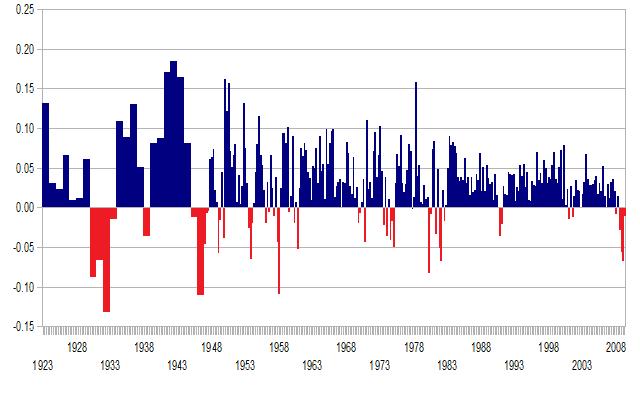
GDP Growth, 1923-2008, (Source: wikimedia).
Another thing Rodgers does, in the early pages of Age of Fracture, is to provide a schematic for a “historiography” of the field of Economics.  Beginning with Alfred Marshall (Principles of Economics, 1890), Rodgers traces the development of economic thinking (and college economic teaching) through Paul Samuelson (Economics, 1948), and then into the variety of competing interpretations resulting from the failure of macro-economic prediction in the 1970s and 80s.  Along the way, Rodgers mentions many of the relevant texts in this development: popular texts such as Milton Friedman’s Capitalism and Freedom and F. A. Hayek’s Road to Serfdom as well as academic titles like Ronald Coase’s “The Problem of Social Cost” and Richard Posner’s Economic Analysis of Law.  It would be interesting to organize a syllabus around these titles, and read them one after another.  In addition to tracing the development of economic theory, the themes of such a class might be to examine whether theory or contingency really moved society, and more importantly to test the point made above by Rodgers and Vico: to see if the explanations offered by economists in their historical moments contain “faults which, after fashion changes, become glaringly apparent.”

Running on Empty: Back to the Seventies

Randall Stephens

At least since Bruce Schulman published his The Seventies: The Great Shift In American Culture, Society, and Politics in 2002, historians have been reflecting on that pivotal decade and how it altered the course of recent American history. Maybe it's a sign of the historiographical times that Jefferson R. Cowie's Stayin' Alive: The 1970s and the Last Days of the Working Class won the prestigious Parkman Prize in 2011.

Historians like Daniel T. Rodgers (Age of Fracture) and Judith Stein (Pivotal Decade: How the United States Traded Factories for Finance in the Seventies) also weighed in on the era in 2011. And new explorations of religion and politics in the postwar years are changing what we think about the "recent" rise of the Religious Right (see Dan Williams' God's Own Party: The Making of the Christian Right and Darren Dochuk's From Bible Belt to Sunbelt: Plain-Folk Religion, Grassroots Politics, and the Rise of Evangelical Conservatism).

Is this the scholarly analogue of what The Onion hilariously described back in 1997?: "U.S. Dept. Of Retro Warns: 'We May Be Running Out Of Past'". Unlikely. But, still, the past keeps catching up with us. The seventies--with all it's tragic pathos, decline, hirsute decadence, and acres of polyester--just pulls us in. The decade is certainly a draw for those observes who like to emphasize the heartbreaking, grim side of life. Maybe in these desperate economic times we also see ourselves reflected back in that bleak era.

Josh Rothman makes that point in the Boston Globe this Sunday. He also cites out very own Journal of the Historical Society.

When we talk about today's economic crisis, we tend to think about the 1930s and the Great Depression. Increasingly, though, economic historians are focusing on another decade -- the 1970s. It was during the seventies, conventionally dismissed as an aesthetically challenged interegnum between the revolutionary sixties and the Reaganite eighties, that the seeds of our current crisis were planted. The argument was advanced last year, primarily in Pivotal Decade: How the United States Traded Factories for Finance in the Seventies, by Judith Stein, a historian at CUNY. Now it's gaining momentum, with a roundtable of historians and economists responding to the book in this month's issue of The Journal of the Historical Society. As the historian Daniel Rodgers puts it, "In the economic history of the first half of the twentieth century, the crucial decade was the 1930s. For the second half of the twentieth century," there is a "growing consensus" that "the pivotal decade was the 1970s."

I couldn't agree more. In a modern US course several years ago my students and I explored the cultural and political dimensions of the seventies hangover by reading
Andreas Killen's captivating, yet underappreciated 1973 Nervous Breakdown: Watergate, Warhol, and the Birth of Post-Sixties America. (I take special pride in being born in such an awful year.)

John Lennon, not long before his death at the hands of a deranged man, told an interviewer: "Wasn't the 70s a drag, you know? Here we are. Well, let's try and make the 80s good, you know?" Yet the Me Decade would linger on and on. So writes Killen in his intro paragraph:

Will the seventies never end? The question asked recently by a pundit in the New York Times is a valid one. The sevenries are, indeed, the decade that refuses to end--despite the fact that, for a long time, they barely counred as a decade, so completely were they obscured by the long shadows cast by both the sixties and the eighties and by the noisy clamor of their respective partisans. While the former were claimed by the Left and the latter by the Right, the seventies remained the foundling of recent American history, claimed by no one. Despite the current wave of seventies nostalgia and revisionism, these years still need to be liberated from the two decades that bracket them. More than simply the aftermath to the one and the prelude to the other, this decade should be considered on its own terms, as a distinct cultural moment, a moment of rupture and discontinuity in American history but also of tremendous creativity.

James Cobb on "The Necessary South" in Historically Speaking

_
In the Latest issue of Historically Speaking, James Cobb writes about the role the South has played on the national political stage. Read his essay on the what pundits, historians, and others have made of the South. Here's an excerpt:

James Cobb, "The Necessary South," Historically Speaking (September 2010)

Since the earliest days of the republic the South has served primarily as what Jack P. Greene called “a negative example of what America had to overcome before it could finally realize its true self.” The struggle to transcend this burdensome regional anomaly would play out over the better part of two centuries, but by the time it appeared finally to have run its course, some were beginning to complain that, in the end, it was the South that had actually overcome, and, in the process, prevented the nation from becoming all that it could be. Even before 30 million Americans outside the South chose a bona fide representative of a racially transformed and economically vibrant Dixie to lead the country out of its post-Watergate funk in 1976, liberals were bemoaning the ominous “rise of the Southern Rim” and the insidiously conservatizing effects of the “Southernization of America.” That such rhetoric is still in vogue more than a generation later suggests that not all of the resistance to integrating the South into national life has originated in the South itself. For all the evidence that a once-recalcitrant Dixie is, for better or worse, now one with the rest of the country, many outside the region and even a few within it still cling to a static vision of a defiantly unchanged, indisputably inferior South, which, in turn, provides the negative counterpoint necessary to sustain their equally rigid and decidedly idealized vision of America’s “true self.”

Pointing to critical changes in the South, a veritable slew of pundits had suggested that the perceived differences between region and nation were disappearing long before John Egerton referred in 1973 to the “Americanization of Dixie.” On the other hand, Egerton was one of the first to argue that the South’s loss of distinctiveness had actually been accelerated by the concomitant “Southernization of America,” observing that “the North, for its part, seems more overtly racist than it had been; shorn of its pretensions of moral innocence, it is exhibiting many of the attitudes that once were thought to be the exclusive possession of white Southerners.”

Egerton used “Southernization” merely as a figurative description of what he saw happening in the 1970s, but a host of liberal commentators quickly seized on the term as a literal explanation, in which a sudden, aggressive, nationwide contagion of southern white values became primarily responsible for America’s pronounced tilt to the right during the last quarter of the 20th century. “Southernization,” wrote George Packer, “was an attitude that spread north—suspicion of government, antielitism, racial resentment, a highly personal religiosity.”

Catering to white Southerners’ resentment of Democratic support for civil rights advances, Barry Goldwater had carried five southern states in 1964, and by 1966 Richard Nixon was already assuring Pat Buchanan that the GOP’s future lay “right here in the South.” Yet in the “Southernization” version of events it was not until George Wallace, the presumed embodiment of the southern white mentality, had expertly manipulated the race issue in 1968 that the Republican Party was seduced into its infamous, racially coded “southern strategy.” This strategy, in turn, succeeded in forging southern white racial antagonism (not unlike the violent sentiments on shocking public display at the time in Chicago or Detroit or Boston) into such a sizable and solid core of Republican support in the South that the GOP was able to win the presidency four out of five times between 1972 and 1988. To be sure, the virtual certainty of strong support from southern whites allowed Republican candidates to concentrate their resources elsewhere. Still, Richard Nixon and Ronald Reagan claimed at least 90% of the remaining electoral votes nationally in 1972, 1980, and 1984, and George H.W. Bush drew nearly 75% in 1988, meaning that all of them ran nearly as well outside the South as within it, and thus not a single southern vote had been essential to any of their victories. >>>

The Moon Landing at 40

Randall Stephens

With the 40th anniversary of the Apollo 11 moon mission just around the corner--the landing was on July 20--it's a good time to reflect on what that meant and still means. In 1969/70, some rhapsodized about the power of human innovation and the horizon of exploration. With tongue firmly planted in cheek, playwright Arthur Miller wrote in the July 21 edition of the New York Times:

There are two schools of thought about the moon landing. One heralds it as the start of a new Age of Discovery like the period that began in 1492. The other regards it as a distraction from social problems. Few, though, feel anything but pride in the men who step over the astral frontier; even the crabbers are secretly envious of them.

I think it's a great thing for all of us. After the moon we undoubtedly will put men on other planets further and further away from Earth. The climax, which I doubt anyone alive will witness, will come when a scientific expedition finally lands on 125th Street or the North Side of Waterbury, Connecticut.

On the run in Algiers, Eldridge Cleaver, Information Minister of the Black Panther party, unleashed a torrent of criticism. On July 20 he told New York Times reporters that the moon landing program was a "misuse of public funds." Cleaver didn't see "what benefit mankind will have from two astronauts landing on the moon while people are being murdered in Vietnam," and starving in the U.S. Politicians like Nixon, "number one pig," were to blame

Others, like Norman Mailer--razor-tongue gonzo journalist, premature curmudgeon, and egomaniac--used the moon landing to rant against America's banal technophilia. He wrote in Of a Fire on the Moon: "Armstrong and Aldrin were to do an EVA that night. EVA stood for Extra Vehicle Activity, and that was presumably a way to describe the most curious steps ever taken. It is one thing to murder the language of Shakespeare - another to be unaware how rich was the
victim. Future murders stood in the shadow of the acronyms. It was as if on the largest stage ever created, before an audience of half the earth, a man of modest appearance would walk to the centre, smile tentatively at the footlights, and read a page from a data card. The audience would groan and Beckett and Warhol give their sweet smiles."*

Now to the present... In the Guardian Christopher Riley has written "The Moon Walkers: Twelve Men Who Have Visited Another World." Maybe his piece indicates that the landing is no longer a sounding board for politics?

The 12 members of the most exclusive club in human history had many things in common.

All came from a highly technical background and all but one studied aeronautical or astronautical engineering. Growing up, many had been Boy Scouts and even more were active members of their University fraternities. They all went on to study for further degrees – many at military test pilot schools – and almost all of them saw active service in cold war skies, often flying nuclear weapons behind enemy lines.

Popular Mechanics features a collection of essays on all things 40th-anniversary-moon-landing related. Highlights include: "Is America's Space Administration Over the Hill? Next-Gen NASA"; "Giant Leaps: Apollo 11 Alums Reflect 40 Years Later at MIT Conference"; and "Exploring the Moon: Apollo 11, The Untold Story."

For an excellent documentary on the moon landing and space race, see Race to the Moon (PBS, 2005).