Showing posts with label Nixon. Show all posts

Richard Nixon: Victim of Religious Prejudice and Religious Pluralism

Chris Beneke

The morning after his loss to John F. Kennedy in the 1960 presidential balloting, Vice-President Richard M. Nixon was awakened by vigorous tugging on his arm. No doubt groggy after two hours of election-shortened sleep, Nixon found his twelve-year-old daughter Julie next to him. She had been concerned by the previous evening’s returns and wanted to know the final outcome. Hearing the bad news, Julie then posed what her father described as a “strange and disturbing question.” “Daddy,” she asked, “why did people vote against you because of religion?” As Nixon recalled in his 1962 political biography Six Crises, he assured his daughter that people didn’t choose candidates because they “happen to be Jews or Catholics.” Instead, they chose them based on their estimation of the individual candidate’s merits.

This was an inspiring vision of political decision-making that didn’t comport with much else that Nixon wrote about religion and the 1960 election, nor much else in Nixon’s general approach to politics. Never one to underestimate the forces aligned against him nor his own suffering, Nixon went on to explain to readers that a smaller proportion of Catholic voters turned out for him than “any Republican presidential candidate in history (22 per cent).” Worse for his prospects that year, “there was not a corresponding and balancing shift of Protestants away from Kennedy.”

It may have taken the famously huge and fragile ego of Richard M. Nixon to imagine himself as a casualty of both religious tolerance and religious bigotry in the 1960 election, but that seems to have been what he was driving at. Nixon later made the point in a less veiled form. Kennedy’s Catholicism only appeared to be a political liability, Nixon wrote in his 1978 memoir. It actually improved the Massachusetts Senator’s chances:


"The Religious Issue: An Un-American Heritage,"
Life Magazine, July 4, 1960.
The pockets of fundamentalist anti-Catholic prejudice that still existed were concentrated in states that I stood to win anyway. But many Catholics would vote for Kennedy because he was Catholic, and some non-Catholics would vote for him just to prove they were not bigoted.

A master at harvesting resentments for electoral advantage, Nixon had somehow failed to turn anti-Catholicism into a critical mass of votes in the 1960 election. Aside from some covert overtures to anti-Catholics, his strategy seems to have involved subtle references to Kennedy’s Roman Catholic faith coupled with ecumenical appeals to Catholic Republicans and liberal Protestants. Shaun Casey, author of The Making of a Catholic President, notes that a supposedly confidential Nixon campaign memorandum, indicating that Kennedy’s faith would not be exploited for electoral gain, was “actually released publicly.” The same style of disingenuity may have been at work in television speech delivered on the eve of the election, in which the Vice-President urged voters to vote for the best candidate no matter what their religious affiliation.

One reasonable conclusion to be drawn from Nixon’s frustration regarding the “religious issue” in the 1960 election was that anti-Catholicism was such a doddering, parochial prejudice by this point in American history that even Nixon (the man whose own White House Counsel would later outline a plan to “use the available federal machinery to screw our political enemies.”) dared not put it to explicit use. The fear that it would provoke a fierce reaction among Catholics, as well as sympathetic Protestants and Jews, was well-founded. Moreover, Kennedy and his team adeptly refuted charges that the Pope would take up residence in a JFK-White House, simultaneously co-signing bills and issuing encyclicals to Protestants. The result was that the Nixon camp was not able to successfully evoke the gaunt, withered specter of Vatican political power.
Then again, we don’t have to buy Nixon’s full self-pitying narrative to appreciate that he hit on something approaching truth when he portrayed himself as a victim of both Catholic preference for a fellow Catholic and the public’s aversion to the appearance of bigotry. Indeed, Nixon may have stumbled upon a fundamental paradox in the history of modern American thought, which accommodates certain expressions of group identity, while labeling the rest as mere chauvinism. There was no shortage of prejudice in 1960 (religious and otherwise), but what Nixon may have been describing was the tipping of electoral scales toward the flawed liberal dogma of pluralism, which has so far proven superior to all of the alternatives. 

Elvis and the American Dream

Heather Cox Richardson

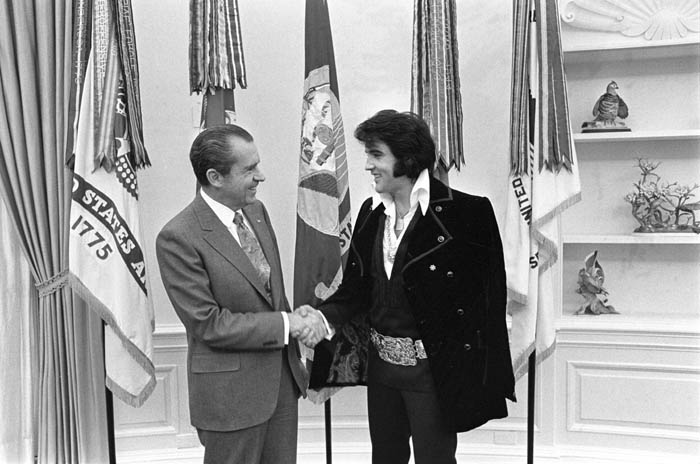
Forty years ago today, Elvis Presley showed up at the gates of the White House with two bodyguards and handed the guards a letter addressed to President Nixon. He said he knew the president was busy, but was hoping he could say a quick hello and present the president with a gift.

One can only imagine the flurry of astonished commentary in the White House when news arrived that Elvis wanted to drop in for a chat. An aide skimmed Elvis’s letter and sent a quick memo to Chief of Staff H. R. Haldeman. “The thrust of Presley’s letter is that he wants to become a ‘Federal agent at large’ to work against the drug problem. . . . Drug culture types, the hippie elements, the SDS, and the Black Panthers are people with whom he can communicate since he is not part of the establishment.” The aide warned that it would be a bad idea to push Elvis off on the Vice President, since “it will take very little of the President’s time and it can be extremely beneficial for the President to build some rapport with Presley.”

While the aide was right that Presley wanted a federal badge, the thrust of his letter was not that he could talk to members of the counterculture. The gist of his note was that, more than anything, he wanted legitimacy. Elvis wanted to achieve the American Dream—not to be rich and famous (although he certainly was), but to be respectable.

Elvis had been an enormously talented young man with pretty moderate ambitions, in part because his horizons were so limited that he couldn’t see beyond stability and respectability. He wanted to take care of his parents; he wanted a job and a nice house. When his career took off, he bought Graceland, and decorated it in the fanciest way he could imagine—not with fine antiques and expensive art, but with a wall of mirrors and a carpeted ceiling.

Elvis seemed to be the epitome of the American dream. And perhaps he was, but not in the way that concept is usually used. As Elvis’s career went upward, his control over his success sloped inversely downward. Elvis’s life made it clear that even a man with such superlative talent could never rise to security without an education and connections. He took his financial advice from his father, a man who went to jail for altering a $4 check. He took career advice from a manager who was taking 50% of his earnings by the time the singer died (the going rate was 10%) and who pushed him constantly to make more and more money. By 1970, Elvis’s talent had become a commodity over which he had little control. Rather than enabling him to achieve the American dream, his ability was destroying him. His grueling schedule had him increasingly dependent on prescription drugs, and his marriage was falling apart.

What Elvis wrote to Nixon was that he craved solid middle-class respectability. “I . . . admire you and have great respect for your office,” he wrote. Countercultural figures might call the president and his advisors “the establishment,” but “I call it American and I love it.” “I can and I will be of any service that I can to help the country out,” Elvis wrote. He and President Nixon had something in common, and the singer made sure to point it out: “I was nominated this coming year one of America’s Ten Most Outstanding Young Men,” “I believe that you, Sir, were one of the Top Ten Outstanding Men of America also.”

Well over a hundred of Elvis’s records had gone gold, platinum, or multi-platinum, but when Elvis met with President Nixon at 12:30, he felt obliged to explain to the president who he was. And he didn’t focus on his music; he focused on the law, respectability, family, government. The first thing the singer did was to show the president his collection of police badges. He gave President Nixon some Presley family photos and a commemorative WWII Colt 45, and warned him that the Beatles had been fomenting anti-Americanism.

Then, as the White House notes from the meeting relate:

“Presley indicated to the President in a very emotional manner that he was ‘on your side.’ Presley kept repeating that he wanted to be helpful, that he wanted to restore some respect for the flag which was being lost. He mentioned that he was just a poor boy from Tennessee who had gotten a lot from his country, which in some way he wanted repay. . . . At the conclusion of the meeting, Presley again told the President how much he supported him, and then, in a surprising, spontaneous gesture, put his left arm around the President and hugged him.”

Nixon’s people managed to get Presley a special badge from the Bureau of Narcotics and Dangerous Drugs. The badge was a symbol of what Elvis wanted, but it couldn’t give him the middle-class respectability that was at the center of his American dream. It couldn’t buy him the economic understanding that would enable him to rearrange his business affairs, or admission to a professional culture of lawyers and agents whose knowledge would protect him from his parasitic manager.

Ironically, it also couldn’t stop Elvis from dying of drugs only seven years later, sad proof that all the talent in the world could not produce success if it were not protected by education and connections.