Showing posts with label Crime. Show all posts

Jesse James and Anwar al-Awlaki

Heather Cox Richardson

There has been a great deal of debate over whether or not it was legal for the Obama administration to order the September 30 killing of Anwar al-Awlaki. It seems unlikely to go far in the realm of political discussion, since al-Awlaki was not on American soil, and since few Americans seem to have digested the fact that, although he had a foreign name and was clearly implicated in major terrorist attacks on the United States, al-Awlaki was born in America and was thus an American citizen.

A similar question did, though, roil American politics in the 1880s: should the government be able to order the assassination of an American citizen? Then, unlike now, it was discussed on both sides of the political divide as a principled question of executive power and the rights of citizens.

The targeted citizen, in that case, was Jesse James.

James had fought for the Confederacy as one of Quantrill’s Raiders in Missouri. These men were so hated by the pro-Union Missourians that, when the end of the war permitted most Confederate soldiers to go home in peace, Unionists refused to acknowledge the Raiders as Confederate soldiers. Someone put a bullet in Jesse as he made his way home from the fighting.

For their part, James and his buddies were not cheerfully reconstructed ex-Confederates. They survived by robbing trains, banks, and express companies, all of which were associated after the Civil War with the Republican federal government. But James insisted that he was not a criminal; he had been forced outside the law by the government itself. After the war, ex-Confederate Democrats in Missouri could not vote, sit on juries, work as lawyers, or hold government offices. James maintained that the true perpetrators of the crimes for which he was blamed were Republicans. In his view, state laws barring Democrats from access to legal protection, juries, and offices guaranteed that he could never get a fair hearing. According to a sympathetic biographer (he referred to Jesse as “an angel of light”), their manhood forced men like James to “turn upon that law that hounded them and that society that hunted them, and outrage and defy it.”

Missouri officials had no luck bringing James to justice. Neither did Pinkerton detectives, hired by angry express company owners. (The James Gang robbed stagecoaches, banks, and trains and committing a host of murders along the way.) Finally, in desperation, the Missouri governor, T. T. Crittenden, persuaded a member of James’s own gang to murder him. Bob Ford shot James as he straightened a picture on the wall. When Ford and his brother pled guilty to the murder and were sentenced to death, the governor promptly pardoned them and paid them the bounty he had placed on James’s head.

Predictably, Democrats were outraged by the prospect of an elected Republican official arranging for the murder of a Democrat. But many Republicans were also unsettled. Crittenden had “hired an assassin” as if he were a potentate, one Republican newspaper editor wrote. Popular opinion swung quickly to an acknowledgement that James was a criminal, and even rejoiced that he was out of commission, but rejected entirely the idea that government officials should have the power to ignore legal processes and simply murder their domestic enemies. James’s portrayal as a man persecuted by the government made him a popular hero.

While any parallels should not be pushed too far, James’s situation was not unlike that of al-Awlaki. Both appear to have been criminals who protested a government that would not acknowledge their grievances. At the same time, al-Awlaki’s case raises questions the James case did not, questions, for example, about the nature of war powers during times of undeclared war, and how international terrorism should affect Constitutional rights. These are not unimportant issues. It’s too bad that they will most likely not get the bipartisan public airing they need in the wake of al-Awlaki’s death, the same public debate that followed Jesse James’s assassination.

The Delusions of “Strongmen”

Philip White

Though Osama Bin Laden was protected by armed guards and 18-foot high, barbed wire-topped walls, in his Pakistan hideout, many other ne’er-do-wells live far more conspicuous lives.

When Ratko Mladic, the former Bosnian Serb general accused of eleven counts of genocide and war (including the killing of more than 8,000 Bosnian Muslims in Srebrenica), was arrested last week, one assumed that he had been living in a high-security secret compound in a non-extradition country for the past few years. In fact, he had done nothing of the sort—preferring to live in the open in Belgrade. He had appeared at public functions, nightclubs and football matches, yet somehow evading capture.

Mladic is not the first diabolical “strongman” to have flaunted his freedom in the face of national and international arrest warrants and indictments. His boss, Slobodan Milosevic also resided at a villa in Belgrade, Serbia’s capital and largest city, though he put up more of a fight when cornered, threatening to kill his wife and daughter as he and his henchmen defended his weapons-filled residence. Such was his disregard for human life. Milosevic was found dead in his cell at the U.N. war crimes detention center in the Hague in March 2006.

Many Nazi war criminals fled to South America, where they enjoyed luxurious lifestyles and the diplomatic protection of sympathetic despots. Others remained closer to home, such as Milivoj Asner, the Austria-based former Nazi police chief of Croatia, who, at age 95, caused worldwide outcry with his appearance at a Croatia-Austria football match in 2008. Apparently the lure of the “beautiful game” was too much to resist, even for notorious men of violence. He was repeatedly declared mentally and physically unfit to stand trial, despite his claims to the contrary, and was called a “good neighbor” by far right Austrian President Jörg Haider.

A continent away, former Ugandan tyrant Idi Amin, who killed at least 300,000 of his own people, fed out-of-favor ministers to crocodiles and butchered political opponents, lived a life of luxury in Saudi Arabia. When author Riccardo Orizio met Amin as part of his research for the book Talk of the Devil: Encounters with Seven Dictators, the so-called “Big Daddy,” “had spent the previous years taking a morning swim in the pool of the local Hilton, having his back massaged by an Egyptian masseur at the Intercontinental, and finally having lunch at a third hotel.” Some “justice”!*

So what can we conclude from such brazen attitudes? Some of these individuals have become so used to wielding terrifying power, with friends and enemies cowering before them, that they think they are immune from justice. In the case of others, their delusions are so all-consuming that they have talked themselves into believing the fallacy that no crimes were committed. According to Orizio this was the case with Amin, who, when asked if he had any regrets, shamelessly replied, “No, only nostalgia.” Sadly, those Ugandans who survived his brutality have quite different memories.
____________

*Accessed via the New York Times archive.

Forward to the Past: Debt and Debtor's Prisons

Randall Stephens

How will historians understand the rise in unemployment and the increase in bankruptcy when they look back on our era? (See the graph here from www.uscourts.gov.) What are the historical and cultural ramifications of the economic downturn? Cycles of recession and depression mark major turning points in American history. The panics of 1837 and 1857 upset family life, toppled businesses, and can be charted through the rise in suicide rates and bankruptcies. The depressions of the 1890s and the 1930s shook the world.

In ages past one way to deal with all those folks who could not pay up was to throw them into the clink. If you gambled away your money and lived a profligate life in the 18th century, there was no safety net to catch you.

An entry in Mitchel P. Roth's, ed., Prisons and Prison Systems: A Global Encyclopedia (Greenwood Press, 2006) sheds light on London's famous debtor's prison:

FLEET PRISON. Built in the twelfth century, Fleet Prison became London's most famous debtors' prison and was the first building in London constructed for the specific purpose of being a gaol (jail). 11 was rebuilt numerous times and by the fourteenth century was holding; debtors, individuals convicted in the Court of Star Chamber, and those charged with contempt of the Royal Courts. Among its most distinguished prisoners was the poet John Donne, who spent a stint in Fleet Street in 1601, and later William Penn. It was demolished by the Great Fire of 1666 and then rebuilt. Partly because of its prominence as a jail for debtors and bankrupts, it was burned down once more during the 1780 Gordon Riots.

The Fleet Prison had a well-earned reputation for cruelty and corruption. The office of warden, or keeper, was considered a hereditary position. The position of keeper was a highly lucrative position with opportunities to earn fees for providing prisoners with food, lodging, and even short-term release. In the eighteenth century an individual purchased the office of the Keeper of the Fleet for 5,000 pounds. When he stepped down, he then sold the position to the deputy warden for the same price. During its heyday prisoners of both sexes mingled freely, leading one observer to describe it as the "largest brothel in England." Here women could improve their conditions by selling their bodies. The prison was usually overcrowded. In 1774 it held 243 debtors along with 475 members of their families who had nowhere else to go. The prison was finally closed in 1842. (105-106)

How did all fare in the colonies? Peter J. Coleman writes of the state of things in Pennsylvania in his book Debtors and creditors in America: Insolvency, Imprisonment for Debt, and Bankruptcy, 1607-1900 (Beard Books, 1999)

The early treatment of poor and insolvent debtors was not significantly more liberal or humane than in New York, New Jersey, or in some of the New England colonies. To be sure, the Frame of Government of 1682 embodied enlightened principles-that prisons should be workhouse-reformatories rather than mere places of punishment, and that prisoners should not have to support themselves or pay fees-but the legislature modified these concepts almost immediately (1683 and 1684) by requiring debtors to support themselves and by introducing the system of servitude for debt. Nevertheless, it proved exceedingly difficult to formulate acceptable rules governing debtor-creditor relations. The colonists quarreled among themselves and with the proprietor and his governors, and the Crown disallowed many of the early laws, including the act establishing the support and servitude systems and another of 1700 establishing (141)

Reformers began to challenge the system in force in the 19th century. (Click to enlarge the reformist paper to the right.) The following comes from the fabulously useful Gilder Lehrman Institute of American History. This portion is from "Guided Readings: Pre-Civil War Reform":

Imprisonment for debt also came under attack. As late as 1816, an average of 600 residents of New York City were in prison at any one time for failure to pay debts. More than half owed less than $50. New York's debtor prisons provided no food, furniture, or fuel for their inmates, who would have starved without the assistance of relatives or the charity of humane societies. In a Vermont case, state courts imprisoned a man for a debt of just 54 cents, and in Boston a woman was taken from her three children as a result of a $3 debt.

Increasingly, reformers regarded imprisonment for debt as irrational, since imprisoned debtors were unable to work and pay off their debts. Piecemeal reform led to the abolition of debtor prisons, as states eliminated the practice of jailing people for trifling debts, and then forbade the jailing of women and veterans.

Here's a question to ask history students in the classroom. Could something like a debtors' prison come back in the western world? If so, what social or economic forces could lead to that. Is that an impossibility? If so, why?

History and America's Most Wanted

Randall Stephens

"The United States adheres to its own theory of history," writes Paul Berman in the New Republic. He weighs in on the country's peculiar view of the past and American ideas of progress and looks at the raid on Osama bin Laden's compound and the larger meaning of his death. History, in the view of many citizens, has a clear direction, an identifieable purpose. "In our own liberal and democratic theory of history," says Berman, "doctrines like Al Qaeda’s are doomed to defeat. This is because, in our estimation, the mad and fantastical doctrine about resurrecting an ancient caliphate is comparable to other such doctrines that we have encountered during the last century—e.g., the doctrine about resurrecting the Roman Reich in an Aryan version, or the doctrine about resurrecting the ancient Russian peasant communes in the form of a proletarian Soviet civilization." Here's the sort of inevitability that historians find so out of whack.

"But let us also recognize that, beyond the details of an efficient operation," Berman remarks, "the symbolism is hard to mistake."

And, since the present war is ultimately a war of ideas, let us not fail to recognize that symbolism is ultimately crucial. The symbolism of this present raid says: Relentlessness expresses history. History is not on bin Laden’s side. History is on the side of democracy and freedom. History will not be deterred. Yes, we should ask ourselves: Does it make sense to speak about abstractions like “history”? Does the relentlessness of a manhunt contain any deeper meanings at all? There is an answer to these questions. The abstractions express a meaning if we choose to endow them with meaning. Ten years of man-hunting suggest that we have chosen to do so.>>>

What is the larger meaning of bin Laden's demise? How will it shape America's relation with the world? After shouts of "USA, USA, USA" have died down and revelers have put away their gigantic flags, will we see what the larger significance or symbolism of his death is? Perhaps it will take many years for the implications to play out.

In the meantime it might be interesting to consider other "most wanted" figures who have plagued the government and struck fear in the hearts of citizens. (Caveat: I don't intend any sort of moral equivalency with bin Laden.) The list below could include many more, but here's a partial who's who:

* Geronimo, mid to late 19th century

* Billy the Kid, 1860s-1880

* Frank and Jesse James, late 19th century

* Pancho Villa, nineteen-teens


* John Dillinger, 1930s

* Al Capone, 1920s-1930s


* Ted Kaczynski, 1970s-1990s

* Timothy McVeigh, 1990s


* Mohammed Farah Aidid, 1990s

* Eric Robert Rudolph, 1990s-2000s

Take Pancho Villa. The Mexican revolutionary and guerilla fighter brought Americans to new heights of anxiety. This feared bandit killed 34 Americans in 1916 and became, for Americans at least, one of the most reviled figures of the day. Villa--a liberator in the eyes of many of his countrymen--was thought to be a murderous blackguard, a villainous butcher, a subhuman thug. President Woodrow Wilson sent General John J. Pershing to hunt down Villa in Mexico. But, because of the outlaw's widespread support and the unfamiliar, hostile terrain, Pershing failed.

In 1916 the Atlanta Constitution excitedly reported what proved to be a false account of Villa's death: "Villa's body has been dug up out of a two weeks' old grave by Carlos Carranza, nephew of General Carranza" (April 17). He "Died in Agony" so went the report. The writer, at the end of the piece, did mention that some doubted the claims.

Villa did finally meet his end in 1923. He had received a pardon and was retired to a ranch. Villa, said Will Rogers in what passed for humor back then, died of Mexican natural causes. He was shot in the back. Americans let their rage melt into laughter.

Historians now can read from the Villa trouble something about American culture and diplomacy in the Wilson years. What did he symbolize? What did his menacing presence on the U.S. southern border mean for Americans? For that matter, what have so many other criminals, arch-villains, terrorists, and "blackguards" at home and abroad meant to Americans over the decades, centuries?

Religion and American Prisons in the Antebellum Era: An Interview with Jennifer Graber

Randall Stephens

"Americans incarcerate," writes Jennifer Graber in her new engaging book The Furnace of Affliction: Prisons and Religion in Antebellum America (University of North Carolina Press, 2011). "Though the United States has less than 5 percent of the world's population," she writes, "it has almost a quarter of its prisoners." Such facts make the long history of American prisons and their maintenance all the more interesting. Graber, an assistant professor in the department of religious studies at the College of Wooster, analyzes the "intersection of Christianity and politics in the American penitentiary system."* Her interesting account also looks at the religious dimensions of discipline and the ideas that undergirded punishment from the 1790s to the 1950s.

Randall Stephens: You write that antebellum Americans disagreed on much when it came to prisons, but most “affirmed religion's central importance” to prisons and reform. How was criminal justice “religious” in this era?

Jennifer Graber: If you were concerned about criminal punishment in the early republic, there were lots of things to fight about. Once the states began to build prisons, the big debate was between a discipline out of Pennsylvania that featured total solitary confinement and one out of New York that combined labor in workshops during the day with solitary confinement at night. Partisans for these two systems called the other side un-American and un-Christian. Beyond the rival disciplines, people debated the best way to reform inmates. They argued about what was more important: a good Sunday School teacher in Sing Sing or clean water and decent food in Sing Sing? Without fail, everyone interested in the debate claimed that “religion”—and they used the word “religion” even though they meant variations of evangelical Protestantism—was central to inmate reformation and the overall health of American prisons as strong institutions. What they didn't realize is that their common evocation of “religion” masked significant differences. For instance, they all thought that prison chaplains were necessary, but disagreed—sometimes violently—over the role these ministers should play inside institutions. Or, they all assumed that God ordained the civil authorities to punish lawbreakers, but varied on the question of that punishment’s severity.

Stephens: What kinds of problems did evangelicals target in the prison system? What can we learn about them by the sort of reforms they pursued?

Graber: Their first target was colonial-era punishments, whether it was steep fines, corporal punishments such as whipping or branding, or the gallows. They joined a trans-Atlantic movement to reform punishment and were active in the construction and administration of the first prisons. Protestant evangelicals—and I include many Quakers in this group, which might ruffle some historians’ feathers—envisioned the prison as an ideal site for prompting criminals’ conversion and reformation. Because these reformers had the new nation’s urban slums in mind, they emphasized the need for a decent physical environment, steady labor, education, and worship. Once the prisons were off the ground and running, reformers also had to take a stand on the reemergence of corporal punishment.

What can we learn about these evangelicals? Unfortunately, I think we see their utter inability to countenance cultural patterns and systems of meaning outside their own. Many of them were certain that criminals from poor neighborhoods would welcome the opportunity to go to prison. Despite the rising number of Irish inmates in the 1830s and 40s, it never occurred to them that it might be a good idea to have a Roman Catholic priest visit inmates on their deathbeds. Ultimately, for evangelicals the prison was one site for making the America they wanted. They had a vision in which all newcomers—as well as slaves and American Indians—would become like them. Of course, this perspective was shared by the broader upper and middle classes. It would have been strange for these reformers to see things otherwise. I mention it because this worldview helps explain how they approached criminal justice and why they failed to see that their prison experiments weren’t working.

Stephens: When it came to prisons, how did Alexis de Tocqueville, Gustave de Beamont, and other observers understand the American difference?
Graber: Tocqueville and Beaumont were coming from France, where there had been no substantial criminal justice reform. Other interested onlookers came from England, where most of the reform ideas came from, but had never been realized. For these folk interested in prisons, then, America was a blank slate, a place where something new and revolutionary could be attempted. Touring these facilities, however, brought many visitors out of abstract considerations and back to the difficulties of organizing an ethnically and religiously diverse population. Just because Americans could try something new did not mean that they could achieve the perfect institution. Slavery also cast a shadow over these tours of facilities where people labored against their will and could be whipped for disobeying. Foreign tourists struggled with the resemblance between prisons and slavery. In this way, America’s prisons both fascinated and repelled them.

Stonewall, the Mafia, History, and Teaching

Heather Cox Richardson

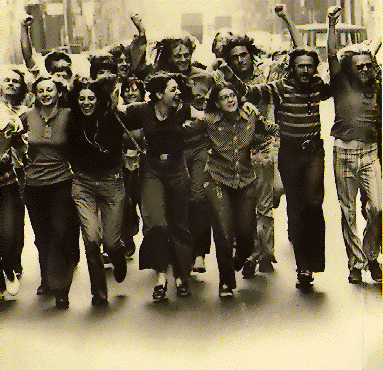
A week or so ago, a group of high school sophomores asked me what the Stonewall Riots were. I could give the basic survey answer: 1969, New York, the spark for the gay liberation movement. The basics. But my young friends wanted to know more. What, exactly, happened, and why?

We went to the internet to poke around. And there, on some basic website, we found a throwaway line that went something like: “although the Stonewall Inn was owned by the Mafia . . .”

This was certainly news to me, so I wrote to ask Jennifer Fronc, author of New York Undercover, about it. She studies moral policing in communities and law, so I figured she might know why the Mafia owned a gay bar. She did. She answered:

The Stonewall Inn, and most gay bars in NYC at the time, were, in fact, owned by the Mafia (or at least petty criminals of Italian-American descent). The reason that they owned them was purely as a business venture--not out of some sense of civil rights or justice. The New York State Liquor Authority had very strict codes about dress and conduct in public houses, and you could easily lose your liquor license if your patrons did not abide by those codes. So, in the case of gay bars, the codes that affected the patrons were no same-sex kissing, touching, or dancing, and your patrons were required to wear 5 articles of clothing that corresponded with their biological sex (this was targeting drag queens but ended up nailing dykes much harder). So, what started happening is the cops would raid gay bars and frisk/strip search the patrons to make sure they were wearing the right clothes. Bar owners couldn't afford to pay off the police or get back their licenses after raids like this, so the mafia stepped in and started running the gay bars and paying off the local cops….

The Stonewall Inn was a frequent target of those raids, and there are 2 theories as to why they rioted that night, which was like any other: 1. they were just fed up and 2. the memorial service for Judy Garland had been earlier that night, and the men were drunker than usual. Although it was allegedly a tough dyke who threw the first punch at the cops.

For contemporary newspaper clippings, she sent me to an online exhibit at Columbia University:

This is, itself, one of those great connections in history (like Elvis and Nixon) that make it possible to survive January in New England. But it also raises for me two other issues.

First, it indicates the importance of a renewed historiographical interest in societal systems. In this case, the New York code dictating dress in public had huge implications for gay culture, suggesting that we must understand the legal codes in order to understand what happened at Stonewall. That code also clearly had big economic repercussions for business owners, suggesting that we cannot understand discrimination without looking closely at the economic systems with which it is intertwined.

There is a strong tendency among historians of America to see legal history, economic history, political history, and the study of similar systems as old-fashioned and reactionary, but it seems to me the very opposite is true. We can’t understand most aspects of social history completely without these systems factored in.

Second, the fact these high school students came to a neighbor who teaches history for information on Stonewall speaks to this blog’s on-going discussion of teaching. They asked me about Stonewall because they have a teacher who always has the answer to everything. They figured out in the first two days that she was often wrong, and their education has taken a fascinating turn. Rather than being turned off to history, the students have made it a game to learn everything better than she knows it. (The Stonewall question apparently came up when she tried to tell them that the “Stonewall Riots” had something to do with Stonewall Jackson.) Had she assigned them an essay on Stonewall, they likely would have grumbled and done as little as possible. But since they were doing it for themselves, they took their own time to find answers, and they didn’t stop with the job half done.

While making things up to drive students to try to embarrass us is hardly a model for how to teach, it does suggest that our job is less to have all the answers than to have enough answers just to whet curiosity, and then to make sure our students know how to keep learning. This, curiously enough, is the conclusion of a new study on learning conducted at the University of California.

[Thanks to Jennifer Fronc for her information, and for letting me post from her email.]