Showing posts with label Assignments. Show all posts

Brief Hiatus this Week

Randall Stephens

In the interests of getting some research and writing done, the blog will take a short break this week.

In the meantime, have a look at some of these posts on grading . . . the favorite pastime of all history profs and GTAs!

"'Will this be on the test?' Rough Seas Ahead,"
April 30, 2011
Randall Stephens

"Historians Teaching Grammar," February 7, 2011
Heather Cox Richardson

"Where Should the Thesis Go in a College Essay?" March 29, 2011
Jonathan Rees

"The Plagiarism Gamble and Theory of Mind," August 31, 2011
Randall Stephens

"History’s Tests," June 28, 2011
Chris Beneke

Some Teaching Ideas

Heather Cox Richardson

Next year, I’m going to have the opportunity to teach the American Civil War and Reconstruction to a small group of students at a new university. It seems like a perfect time to try out some new approaches. I’ve been trolling through syllabi and teaching discussions on the internet, and have unearthed a couple of new ideas I think are worth entertaining:

First of all, I always organize classes backward, using my own version of the Understanding by Design method explored by Grant Wiggins and Jay McTighe. This method requires tight organization of material to illuminate a larger point: the “take away” students should learn from a course. Every reading, every lecture, supports this larger theme (sometimes by challenging it).

A number of people use diagnostic essays early in the semester to gauge the level of student writing, but professor Lendol Calder of Augustana College in Illinois has put an interesting quirk in an early assignment that could be used to make the diagnostic essay do double duty. Calder asks students in the survey to write a two-page essay explaining what they know about American history. His goal is less to gauge their writing than it is to see what “story” they use to organize their knowledge. Have they learned “the glory story, the people versus the elites,” or that the story of America is that of “high ideals/mixed results”? This twist on the diagnostic essay would fit particularly well with a course on the Civil War, since so many students come to such a course with fervent views of the conflict, but it seems like it would work well with a number of courses.

And then there’s this gem. I’m afraid I might have to break down and switch to a Mac to be able to use this timeline. Constructed carefully—and yes, it will take ages, I’m sure—this would free up a great deal of time I used to use lecturing, enabling us to spend more time analyzing primary documents.

What about assessments? I’m still not sure about them, or rather, I’m even less sure about them than I am about the other aspects of the course. For an upper division course on American history, a long paper based in primary research is a no-brainer. Americanists have the great luxury of being able to send students to almost limitless primary sources that are in a language they speak. There’s no reason not to let them experience the excitement of their own research and having the fun of writing it up. (There will soon be similar reason to celebrate for people studying British history, too.)

But what about exams? I’ve written before about team research projects, and I do like the idea of assigning teams of people to research a topic. In this era, knowing how to find information, weigh it, and assimilate it into an argument seems crucial. But for a topic as widely covered as the Civil War, is it possible to come up with interesting assignments that will really require significant teamwork?

The same friend who has tried cooperative work has also tried exams that place the student directly in the era being studied, as in: “You are a 25-year-old man from southern Ohio, visiting New York City on July 12, 1863. How will you spend the day?” In this example, a student would have to understand the history that made southern Ohioans tend to be Democratic and sympathize with the South, and would have to realize that the young man would arrive in New York City in the middle of the Draft Riots that pitted Democrats against Republicans, local government against the national government, and workers against African Americans. I have not yet heard how the experiment went when my friend tried it. It seems to me to have great potential, but also the chance of getting some utter fantasies that would be incredibly irritating.

It’s a wonderful thing to have so many new tools for teaching. Perhaps most of all, it’s wonderful to have the intellectual space to try new approaches. If anyone else has been kicking around new ideas, do let the rest of us know.

Contingency: In the Event of a Moon Disaster . . .

Morgan Hubbard

When I lead discussion sections as a Teaching Assistant at UMass, I try as often as I can to bring up the notion of historical contingency. I think it’s important that we keep in mind, all of us, that the world looks and works as it does in large part because of the collected decisions of many people over many years. But history has a weight to it, and when we learn it as children and young adults it can acquire an inertia that feels like determinism: things are the way they are because they couldn’t have been any other way, right?

Every once in a while, a historical document is

especially good at shaking up this determinism.

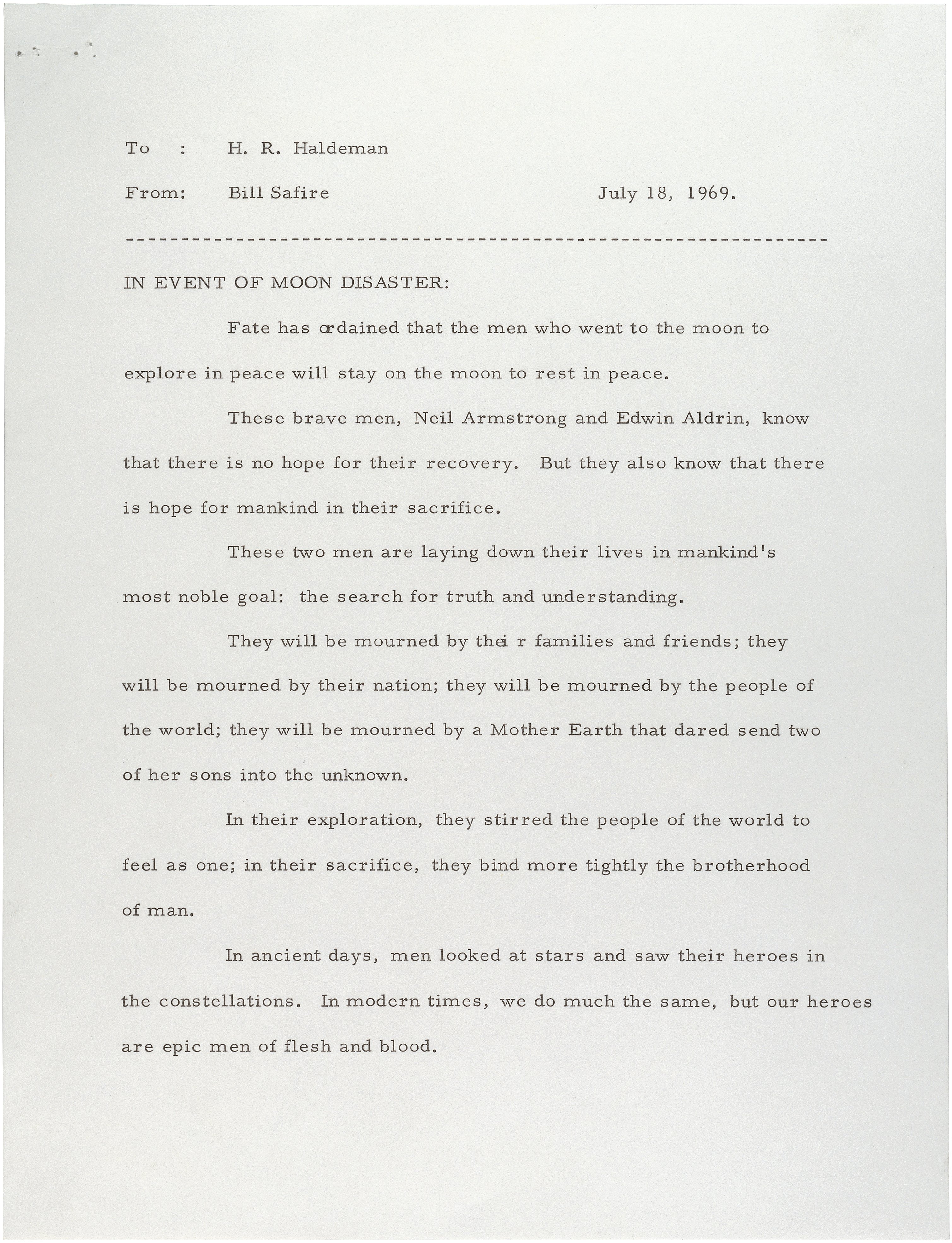
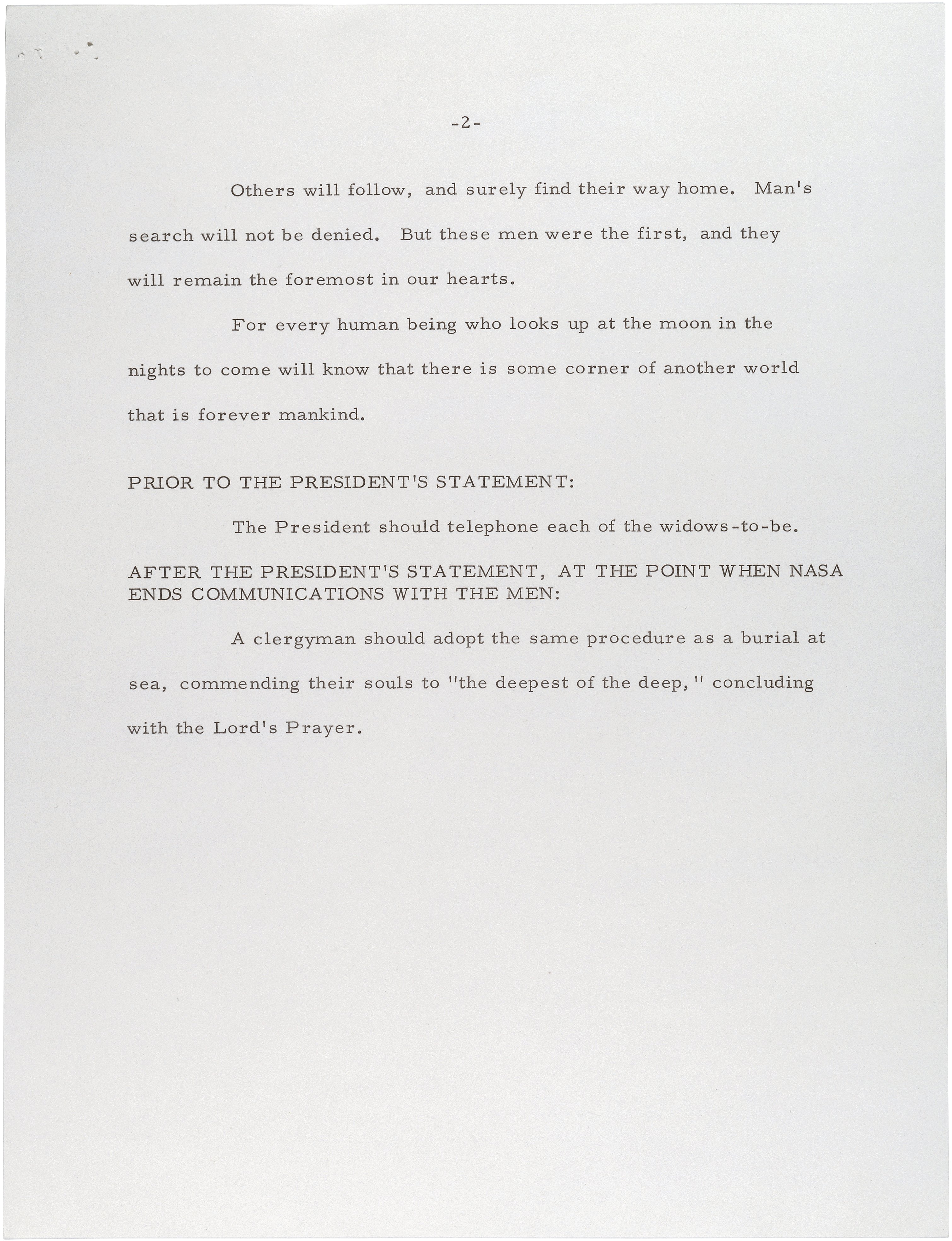
Below is a July, 1969, memo titled 'IN EVENT OF MOON DISASTER' written by then-speechwriter William Safire to Richard Nixon's Chief of Staff, H. R. Haldeman. The memo was penned two days before the first manned moon landing. It was meant to be read by Nixon as a public statement in the event that astronauts Neil Armstrong and Buzz Aldrin were somehow stranded on the moon during the Apollo 11 mission and consigned to perish, as the statement reads, in “the deepest of the deep.”

http://www.archives.gov/press/press-kits/american-originals-photos/moon-disaster-1.jpg

http://www.archives.gov/press/press-kits/american-originals-photos/moon-disaster-2.jpg

Images courtesy of the National Archives and hat tip to the fantastic blog Letters of Note. Click images to enlarge.

December 2, 1859 (for example) in the Classroom

Heather Cox Richardson

Randall’s post on the most boring day in recent history reminded me of a very popular research assignment for high school or early college students. The assignment is to take one day’s newspaper from nineteenth-century America and draw a portrait of the time based on that document. Students can use other primary and secondary sources to learn about the subjects discussed in the newspaper, but their focus is on that one day.

This accomplishes a number of things. First of all, it requires the students to learn to use microfilm and to figure out the difference between primary and secondary sources. It also teaches them how to interrogate different types of primary sources, since a little prodding will help them to realize they can use advertisements, as well as news stories, to make inferences about society.

It’s also a good way to help them understand that people living in a time do not necessarily recognize the importance of the same things that historians do. A nineteenth-century newspaper is a jumble of political stories, opinions, the doings of local notables (whom nobody has ever heard of today), stories about the potential for human settlement on the sun, and so on. Often the newspaper will also disrupt what kids think they know: American newspapers in the early 1870s are chock full of calls for war with Spain over Cuba, for example, although textbooks generally miraculously produce the Spanish-American War in 1898.

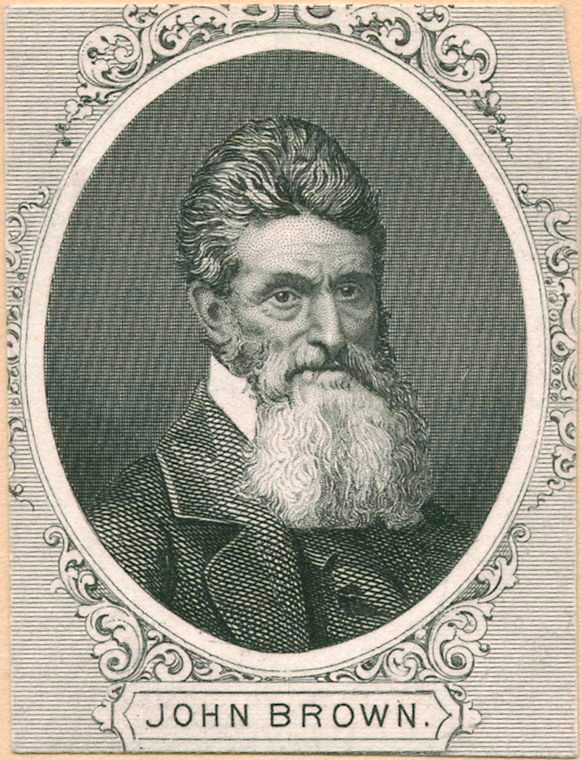
The assignment also demonstrates that events, literature, science, fashion, and so on, existed together, rather than being separated out as they usually are in textbooks. In the New York Times for December 2, 1859, for example, students would learn about that day’s execution of John Brown, but not in the measured tones of a textbook. The newspaper reported the ejection of several Northern reporters from the railroad cars on their way to the site of the execution, thanks to an arrangement between the governor of Virginia and the president of the railroad. It noted that wild stories of invaders into Virginia were keeping people riled up, and that any local citizens who left his home after dark faced a ten dollar fine—which a student would note was a high fee, considering that the same newspaper offered steamboat travel from New York City to Bridgeport for fifty cents.

But the paper did not focus only on the upcoming execution: it also noted the recent discovery of a mastodon jaw in Alton, Illinois, and that, after killing his wife in an alcoholic rage, Frank S. Wright claimed that the murder was her own fault, since—according to Wright—she had been sleeping with his brother.

This assignment gives students a window into history that they already have some tools to use. Most of them have some familiarity with a newspaper, and recognize the difference between an advertisement and legal news. They seem to approach this project with less uncertainty than they do documents or even photographs from the same era.

They also seem to enjoy the assignment.

I should state that this project works very well for nineteenth-century America because newspapers were quite short then—usually no more than eight pages. I’ve done this with earlier American newspapers, too, although they’re a bit harder since they often have a narrower range of stories. Twentieth-century papers would be harder, of course, since they’re much longer. I’ve had no experience with newspapers from other countries, so can’t say how this would translate to other countries.